L'industrie de l'IA est passée de l'« empilement de données » à une exigence de données de haute qualité, traçables et adaptées à des scénarios verticaux précis. Les modèles d'annotation centralisés traditionnels peinent désormais face à des coûts élevés, une difficulté à répondre aux besoins de longue traîne et des contributeurs exclus de la valeur générée. Les plateformes de crowdsourcing à incitation par token visent à résoudre des problèmes tels que des incitations opaques, le parasitisme et une qualité difficile à quantifier, grâce à des règles on-chain. AGT est la version industrialisée de cette approche par Alaya AI ; sa conception influence directement la durabilité de l'offre de données, la rétention de la communauté et la disposition des projets Alaya AI à payer des frais à long terme.
Dans une perspective d'intégration Web3 et IA, AGT agit également comme la « couche de règlement et d'autorisation » pour la coordination de la tokenisation des modèles, l'accès multi-chaînes des utilisateurs et le fonctionnement de la plateforme de données ouvertes. Ci-dessous, nous détaillons les usages principaux d'AGT, son allocation et sa structure d'incitation, son rôle dans le système de contribution de données, les mécanismes de croissance communautaire, les raisons pour lesquelles le crowdsourcing repose sur des tokens, les moteurs de valeur, les risques d'investissement et le potentiel à long terme, offrant ainsi aux lecteurs un cadre structuré pour évaluer la logique de croissance de l'écosystème de données Alaya AI.
Fonctions principales et cas d'usage du token AGT
Selon la documentation officielle d'Alaya AI, AGT remplit trois rôles majeurs : accès et coordination, contribution et gouvernance, et circulation au sein de l'écosystème.
Pour l'accès et la coordination, les utilisateurs doivent staker des AGT afin de participer à la vérification des données, au développement de modèles d'auto-étiquetage, soumettre des demandes de données personnalisées, référencer des offres de jeux de données et effectuer des tâches d'étalonnage de données de niveau supérieur. Les documents officiels précisent : le staking d'AGT n'offre aucun rendement passif ni intérêt de dépôt – il fonctionne comme un coût irrécupérable dans la Preuve d'enjeu, limitant l'étiquetage malveillant et le farming de volume de faible qualité, tout en débloquant des tâches à fort effet de levier pour récompenser les contributeurs à fort impact.
Pour la contribution et la gouvernance, l'accomplissement de tâches de formation, l'atteinte de jalons et la participation aux activités de la plateforme permettent de gagner directement des AGT. La détention et le staking d'AGT confèrent également des droits de vote DAO – par exemple, sur les priorités des fonctionnalités d'auto-étiquetage et les propositions de la plateforme. Le système NFT consomme des AGT à des niveaux spécifiques et lors de mises à niveau périodiques ; avec les Medallions, il détermine l'éligibilité aux tâches professionnelles de formation en IA.
Pour la circulation dans l'écosystème, les développeurs de modèles d'IA peuvent créer des pools de récompenses en AGT pour des besoins de données personnalisés ; la communauté peut financer le réglage fin de modèles spécifiques via des pools de staking AGT. La plateforme s'engage à utiliser les revenus des services de données pour racheter des AGT et les réinjecter dans les pools de récompenses des utilisateurs, soutenant ainsi la boucle métier « contribuer – gagner – réinciter ».
De plus, le mécanisme de Rachat d'AGT, actif depuis 2025, permet aux utilisateurs de convertir les crédits AIA gagnés via les tâches en AGT dans le cadre de quotas mensuels, créant une cadence régulière entre l'activité de tâche et la distribution de tokens.
Allocation du token AGT et mécanisme d'incitation
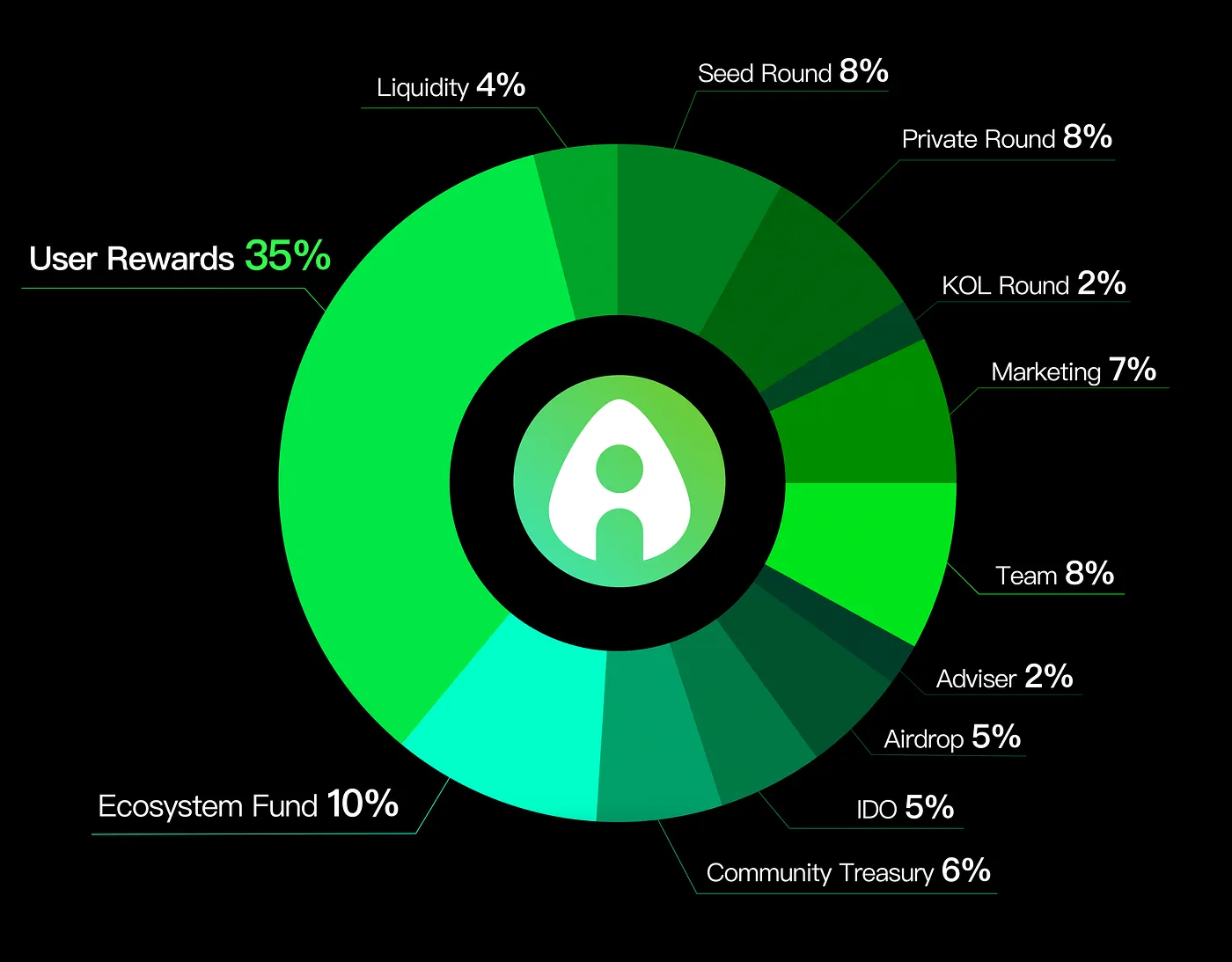
AGT possède une offre totale fixe de 5 milliards de tokens. Les données publiques de tokenomics indiquent une répartition approximative comme suit :
- Communauté : ~57 %, dont 35 % de récompenses utilisateurs, 10 % de fonds écosystème et 7 % de marketing – soulignant l'accent mis sur les contributeurs à long terme et la croissance communautaire.
- Investisseurs : ~18 %, couvrant les tours seed, private sale et KOL.
- Équipe et conseillers : ~10 %.
- Fondation : ~10 %, pour la trésorerie communautaire et la liquidité.
- Vente publique (IDO) : ~5 %.
Lors du TGE, ~28 % sont débloqués ; le reste suit un calendrier de vesting linéaire ou par étapes. Pour le marché secondaire, le calendrier de déblocage des tokens des investisseurs et de l'équipe constitue une variable majeure du côté de l'offre.
Le mécanisme d'incitation comporte cinq niveaux :
- Incitations au travail : annotation gamifiée, défis de connaissances, tâches quotidiennes pour gagner AGT ou AIA. L'AIA est converti mensuellement en AGT via des pools de rachat (nécessite un portefeuille BSC ; minimum ~3 000 AIA par échange).
- Seuils de staking : la vérification avancée et la collaboration d'auto-étiquetage exigent un staking d'AGT pour débloquer des multiplicateurs de récompense plus élevés – il ne s'agit pas d'un revenu passif sans risque.
- Pools spécifiques aux projets : les équipes IA créent des pools de récompenses en AGT ou en tokens personnalisés pour recruter des annotateurs aux compétences spécialisées (dialectes, médical, visuel, etc.).
- Rachat et redistribution : les revenus de la plateforme rachètent des AGT et les réinjectent dans les pools de récompenses. Si cette opération est menée avec suffisamment d'intensité et de transparence, elle peut soutenir la circulation du côté de la demande.
- Viralité sociale : commissions de parrainage, boosters quotidiens et progression NFT réduisent les coûts d'acquisition et améliorent la rétention.
L'hypothèse sous-jacente de ce modèle est que les revenus des services de données de la plateforme doivent continuer à croître et que l'ampleur des rachats doit compenser la pression vendeuse liée aux déblocages et aux rachats. Dans le cas contraire, les pools d'incitation dépendent de plus en plus des nouveaux entrants plutôt que des flux de trésorerie endogènes.
Rôle d'AGT dans le système de contribution de données IA
Alaya AI considère les données comme le seul canal par lequel l'IA interagit avec la réalité, le feedback humain étant essentiel pour améliorer l'alignement des modèles. AGT relie « qui fait quoi, selon quelle norme, et ce qu'il reçoit en retour ».
Dans la collecte et l'annotation, les contributeurs réalisent des tâches multimodales via la dApp, le système combinant pré-annotation automatisée et vérification humaine. Le staking d'AGT associe les tâches de vérification de grande valeur à la réputation : les scores de qualité historiques influencent l'attribution future des tâches, récompensant économiquement les annotateurs fiables et limitant la fréquence des tâches pour les utilisateurs à faible score.
Dans le développement de modèles d'auto-étiquetage, la communauté stake des AGT pour participer à la vérification et à l'étalonnage, garantissant que les améliorations du modèle bénéficient directement des contributeurs de données de première ligne – et non seulement des itérations internes de l'équipe. La tokenisation des modèles permet à la communauté Web3 d'utiliser des pools de staking AGT pour financer le réglage fin de modèles verticaux spécifiques, raccourcissant ainsi le chemin pour les projets de petite et moyenne taille vers des données personnalisées.
Du côté de la demande, les entreprises et les équipes IA acquièrent des ensembles de données via des demandes personnalisées et le marché de données ouvert. AGT agit comme une unité de coordination unifiée, rendant les règles de récompense, le règlement et les autorisations audibles on-chain, répondant ainsi aux lacunes de transparence du Web2 concernant la traçabilité des données et les droits des contributeurs.
Avec la vague des agents IA et des petits modèles verticaux, la demande de données de niche (langues régionales, imagerie spécialisée, feedback RLHF) augmente. Les pools d'incitation AGT peuvent rapidement organiser un travail distribué aligné sur les objectifs du modèle – c'est là son avantage principal par rapport à l'externalisation standard d'annotation.
Alaya AI déclare une base d'utilisateurs de plusieurs millions avec des interactions on-chain quotidiennes substantielles ; la croissance de la communauté est étroitement liée à la conception du token.
Une interface gamifiée – points d'expérience, énergie, tâches quotidiennes, quiz – transforme l'annotation fastidieuse en habitudes durables, abaissant la barrière psychologique. Les NFT sont plus que de simples objets de collection ; ils déterminent l'éligibilité aux tâches et les accréditations de niveau. Les NFT de niveau supérieur débloquent des tâches plus complexes et mieux récompensées. La mise à niveau des nœuds consomme des AGT, créant un système de progression de type « investissement en temps + dépense de token → amélioration de capacité ».
Le rachat mensuel d'AGT offre une « fenêtre d'encaissement » prévisible : les contributeurs soumettent leurs AIA du 1er au 21 (UTC) de chaque mois, puis reçoivent proportionnellement des AGT du pool du 21 à la fin du mois. Ce rythme de jour de paie maintient les cycles d'activité et réduit le désengagement dû aux crédits persistants.
La liquidité sur les plateformes d'échange constitue un autre levier de croissance. AGT a été listé sur KuCoin en mai 2025 avec un support spot et bot, améliorant l'accessibilité mondiale aux échanges. Les classements de marché et le volume de transactions influencent l'appétit du capital externe pour le risque de l'écosystème.
Les références sociales et les incitations affiliées amplifient la croissance organique : les utilisateurs existants en attirent de nouveaux pour effectuer des tâches de données, gagnant des commissions ou des bonus – un avantage de coût dans l'environnement Web3 sensible aux coûts.
Objectivement, le nombre d'utilisateurs n'équivaut pas à une production d'annotation de haute qualité. Les métriques de qualité pour la croissance communautaire devraient se concentrer sur le taux de participation au rachat, le nombre de pools personnalisés d'entreprise, le volume d'ensembles de données ODP et le ratio de contributeurs actifs de manière répétée – et non seulement le nombre total d'utilisateurs.
Pourquoi le crowdsourcing de données IA a besoin d'incitations par token
L'annotation de données traditionnelle repose sur des salaires en Fiat et des plateformes centralisées, ce qui fonctionne bien dans la plupart des cas. Cependant, lorsque trois lacunes structurelles apparaissent sur le marché des données IA, les incitations par token deviennent une solution viable.
-
Lacune d'offre : la demande de données d'entraînement générales et verticales dépasse la capacité d'annotation professionnelle, en particulier dans les domaines de longue traîne comme les langues minoritaires, les dialectes et les spécialités médicales. Les fournisseurs centralisés facturent des frais élevés et ont des délais longs. Les tokens permettent aux projets de lancer instantanément des pools de récompenses à l'échelle mondiale, en payant par tâche, ce qui améliore théoriquement l'élasticité de l'offre de longue traîne.
-
Lacune de participation : une grande partie du temps fragmenté des professionnels qualifiés reste inutilisée. La gamification associée aux récompenses crypto monétise le « temps libre », attirant les contributeurs des marchés émergents. Les tokens permettent également les règlements transfrontaliers, contournant certaines frictions liées aux paiements internationaux de main-d'œuvre (sous réserve de conformité).
-
Lacune de confiance et de droits : les entreprises se soucient de plus en plus de la traçabilité des données, des droits des annotateurs et de l'utilisation secondaire. Les enregistrements on-chain et la représentation des droits via NFT revendiquent de manière proactive les droits de contribution. La gouvernance AGT donne à la communauté une voix sur les règles d'auto-étiquetage et les priorités des fonctionnalités.
Les tokens ne sont pas une solution miracle : sans garde-fous de qualité, les incitations encouragent le farming de volume. Alaya répond à cela par le staking AGT, le consensus multi-annotateurs et un pipeline hybride combinant auto-étiquetage et révision par des experts. Les tokens résolvent les problèmes d'incitation et de coordination ; la qualité dépend de la conception du mécanisme.
Facteurs clés influençant la valeur du token AGT
Le prix d'AGT sur le marché secondaire est façonné par le sentiment général du marché crypto et par les fondamentaux du projet. Les observables clés incluent :
- Du côté de la demande : les revenus des services de données d'Alaya AI, la fréquence et l'ampleur des rachats, le nombre de pools personnalisés de projets IA, le volume de trading ODP et le volume de tâches des contributeurs actifs. Une activité plus élevée de tâches et de rachats renforce la demande utilitaire pour AGT.
- Du côté de l'offre : l'offre circulante (~2,3 milliards), les déblocages des investisseurs et de l'équipe, les libérations mensuelles du pool de rachat (par exemple, 15 millions d'AGT par période) et les récompenses de tâches de type minage. Des pics d'offre périodiques sans rachats compensateurs peuvent peser sur le prix.
- Liquidité : la gamme de cotation sur les échanges, le volume sur 24 heures, la profondeur du carnet d'ordres. Les tokens à petite capitalisation sont sensibles aux ordres importants. Les cotations sur KuCoin améliorent l'accessibilité, mais la profondeur peut encore être limitée.
- Récit et secteur : l'infrastructure Web3 et IA reste un thème porteur en 2025-2026. La résonance d'AGT avec des récits tels que les agents IA, les données haute fidélité et les stacks d'entraînement décentralisés affecte l'allocation de capital.
- Gouvernance et livraison produit : le déploiement des fonctions DAO, les mises à niveau des outils d'auto-étiquetage, le déploiement multi-chaînes et les partenariats avec des protocoles de taux de hachage ou de marché de modèles déterminent si les récits se traduisent en progrès vérifiables.
Risques à considérer lors de l'investissement dans AGT
AGT est un actif crypto à haut risque. Les détenteurs potentiels devraient surveiller :
- Risque de marché : les prix sont très volatils – des fluctuations significatives ont suivi les principales cotations sur les échanges et les baisses de marché plus larges. Une faible liquidité peut provoquer un slippage élevé sur les ordres importants.
- Pression de déblocage et de vente : les tokens de la communauté, des investisseurs et de l'équipe se débloquent par étapes. Les rachats mensuels distribuent également de nouveaux AGT. Si la croissance de la demande est en retard sur l'offre, les prix subissent une pression.
- Risque fondamental : une large base d'utilisateurs existe, mais les revenus d'entreprise et les détails des rachats nécessitent une divulgation et une validation continues. Si les participants se concentrent sur le farming de volume de faible qualité, cela compromet les renouvellements des clients IA et le récit du token.
- Mauvaise compréhension du mécanisme : la documentation officielle indique clairement que le staking AGT ne génère pas d'intérêts. Si le marché s'attend par erreur à un « revenu passif de staking », des attentes non satisfaites pourraient déclencher des ventes.
- Risque réglementaire : le travail à incitation par token, les flux de données transfrontaliers et la classification des titres font face à une incertitude réglementaire dans différentes juridictions.
- Risque concurrentiel : les géants centralisés comme Scale AI possèdent de solides avantages en matière de SLA d'entreprise et de relations avec les clients gouvernementaux. La voie Web3 d'Alaya doit prouver sa qualité et sa capacité de livraison.
- Risque technique et opérationnel : les vulnérabilités de smart contract, les erreurs de liaison de portefeuille empêchant les rachats et les attaques d'annotation malveillante peuvent toutes nuire à la crédibilité de l'écosystème.
Ceci n'est pas un conseil en investissement. Faites vos propres recherches et n'investissez que ce que vous pouvez vous permettre de perdre.
Potentiel à long terme de l'écosystème AGT
Du point de vue des tendances sectorielles, le marché mondial de l'annotation de données IA est prêt pour une forte croissance au cours de la prochaine décennie, la demande de données verticales haute fidélité et de feedback RLHF augmentant avec la prolifération des agents et des petits modèles. Alaya AI se positionne comme « données haute fidélité + infrastructure Web3 ouverte ». Si son pipeline hybride d'auto-étiquetage et de révision par experts gagne l'adoption par les entreprises, AGT pourrait passer d'un « outil de récompense communautaire » à une « couche de règlement et de coordination pour les services de données B2B ».
La feuille de route de l'écosystème inclut l'expansion des ODP et des marchés de données personnalisées, l'amélioration de la gouvernance DAO, la réduction des coûts de participation via le multi-chaînes et la collaboration avec les protocoles DePIN et de calcul décentralisé pour construire une pile ouverte de données-entraînement-déploiement. Si les rachats mensuels se poursuivent à long terme, cela peut devenir un outil stable de gestion des attentes des contributeurs.
Trois variables clés pour la valeur à long terme d'AGT :
- La plateforme peut-elle convertir des millions d'utilisateurs en une capacité de données stable et de haute qualité ?
- Les revenus des services de données peuvent-ils soutenir des rachats et des incitations viables ?
- La plateforme peut-elle attirer suffisamment d'équipes de projets IA pour utiliser les pools de récompenses AGT pour les besoins de longue traîne, créant ainsi un véritable volant d'inertie rémunérateur ?
Si ces trois points se matérialisent progressivement, AGT pourrait passer d'un actif spéculatif à un actif utilitaire lié au PIB de la plateforme. Si le projet reste confiné au rachat de crédits et au battage médiatique à court terme, il risque l'épuisement du récit. Les saisons de rachat consécutives et l'intégration de liquidité sur KuCoin montrent que l'équipe renforce la boucle « participer – racheter – détenir ». À l'avenir, concentrez-vous sur les cas clients d'entreprise et les divulgations de revenus.
Résumé
Le modèle de tokenomics d'AGT condense le crowdsourcing de données, l'auto-étiquetage, le marché de données ouvert et la gouvernance communautaire d'Alaya AI en un ensemble de règles on-chain exécutables : le staking pour la sécurité et les autorisations de haut niveau, les tâches et le rachat AIA-AGT pour les récompenses de travail, les pools de récompenses et le staking de modèles pour la demande des projets IA, et les rachats pour tenter de boucler la boucle métier.
La logique de croissance du modèle est claire : abaisser les barrières pour les contributeurs mondiaux, améliorer l'élasticité de l'offre de données de longue traîne et maintenir l'adhérence via le rachat mensuel et la progression NFT. Parallèlement, le prix d'AGT et sa valeur à long terme dépendent de la demande réelle de données, des revenus de la plateforme et des calendriers de déblocage. Les investisseurs doivent peser dynamiquement la croissance utilitaire par rapport à la pression de l'offre.
Pour les lecteurs qui suivent la piste des données IA Web3, comprendre AGT ne devrait pas se résumer à « va-t-il monter ou descendre ? ». Posez-vous plutôt ces questions : combien de tâches d'annotation sont payées par de vrais clients IA ? Les rachats sont-ils vérifiables on-chain ? La proportion de contributeurs de haute qualité augmente-t-elle ? Les réponses à ces questions vous en apprendront plus sur la capacité du tokenomics d'AGT à réellement stimuler la croissance de l'écosystème de données Alaya AI que n'importe quel graphique de prix à court terme.