BLESS Tokenomics: How the Token Drives Growth in the Bless Network Computing Ecosystem

Last Updated 2026-06-05 09:30:57
Reading Time: 3m
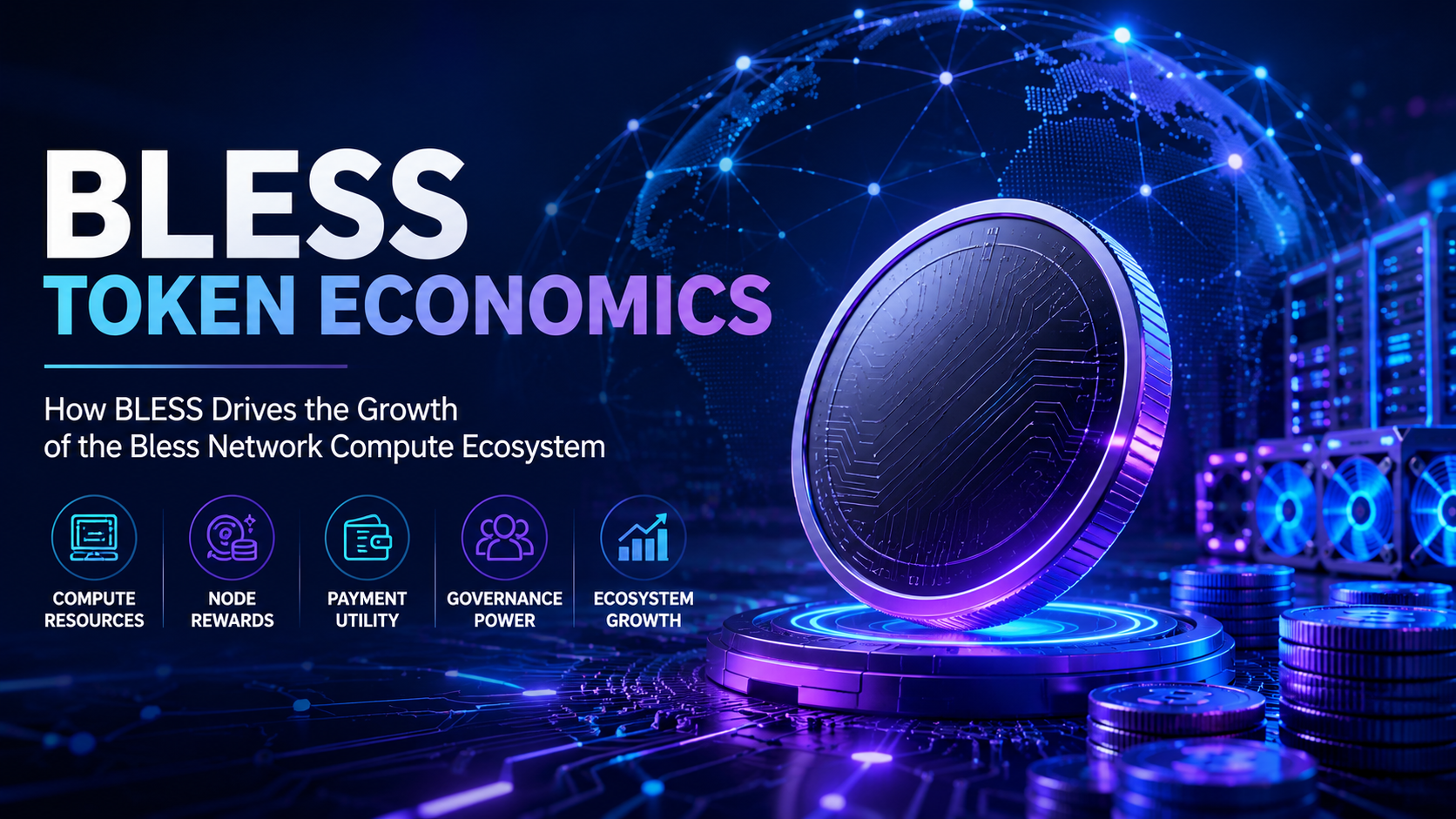
BLESS serves as the native token of the Bless Network ecosystem, playing a pivotal role in connecting hashrate suppliers and demanders within a decentralized edge computing network. It facilitates resource scheduling, value settlement, network governance, and ecosystem incentives. Built as an economic layer for AI, DePIN, and Web3 infrastructure, BLESS goes beyond payment and reward functions—it is also the key driver of the network's sustainable growth.

BLESS Tokenomics Model

The rapid rise of generative AI, AI agents, large model inference, and decentralized physical infrastructure networks (DePIN) is driving a sustained increase in global demand for computing power. While traditional cloud platforms offer mature data center ecosystems, issues like high costs, resource centralization, and scalability bottlenecks are becoming increasingly apparent. In this context, Bless Network aims to build a shared computing network from idle global device resources, with BLESS serving as the critical value medium powering this network.

Looking at trends in digital asset and blockchain economic models, DePIN projects are transitioning from "infrastructure building" to a "value capture" phase. Network growth alone does not automatically translate into token value—what matters is whether the token can participate in revenue distribution, resource settlement, and governance. BLESS's design centers on this logic. Its long-term performance hinges not just on node count but also on sustained growth in real computing demand and ecosystem application scale.

Core Functions and Use Cases of the BLESS Token

Within the Bless Network architecture, BLESS is far more than a reward token; it is a foundational component of the entire computing economy.

BLESS currently serves the following key functions:

Node Rewards

Node operators earn BLESS rewards by contributing CPU, GPU, storage, and bandwidth resources.

This model turns idle devices into quantifiable productive assets.

Computing Power Payments

Future developers and enterprise users will pay for Bless Network's compute resources in BLESS.

This establishes BLESS as the primary settlement medium within the network.

Network Governance

Token holders can vote on protocol upgrades, parameter adjustments, and ecosystem development directions.

Ecosystem Incentives

BLESS fuels ecosystem expansion through developer rewards, partner incentives, and community growth programs.

From a functional standpoint, BLESS covers four dimensions: payment, governance, incentives, and value transfer—a mainstream approach adopted by many next-generation DePIN projects.

BLESS Token Distribution and Incentive Mechanisms

The core goal of its tokenomics model is to balance network growth with long-term sustainability.

Based on publicly available information from Bless Network, the token system targets the following participant groups:

  • Node contributors
  • Community users
  • Development team
  • Ecosystem fund
  • Investment institutions
  • Long-term strategic partners

For any DePIN project, node contributors are the most critical incentive targets. Without sufficient resource providers, the network cannot achieve scale. Therefore, Bless Network allocates a significant portion of tokens early on to reward testnet users and node operators. The previously introduced TIME points system records user contributions during the testing phase and establishes a basis for future BLESS distribution. This design effectively discourages short-term speculation while encouraging long-term network participation.

Industry experience shows that successful DePIN projects typically go through three phases:

  1. Incentivize resource supply
  2. Introduce real demand
  3. Form a revenue loop

BLESS's incentive model follows this proven trajectory.

How BLESS Incentivizes Node Computing Contributions

Bless Network's core strength comes from its globally distributed nodes. BLESS is the primary driver keeping these nodes online. The logic is simple: contribute resources → complete tasks → earn rewards.

The network evaluates node contributions across several metrics:

  • Uptime
  • CPU performance
  • GPU performance
  • Network stability
  • Tasks completed
  • Historical reputation score

Different node tiers earn different reward rates.

For instance, high-performance GPU nodes handling AI inference tasks have higher earning potential, while standard CPU nodes handle basic computing and data processing. This differentiated incentive structure improves resource utilization.

Additionally, a dynamic scheduling system assigns tasks to the most suitable devices, optimizing overall efficiency. For Bless, incentives are not just about rewarding users—they are about continuously expanding the network's available computing power.

BLESS's Role in Governance

As the network scales, relying solely on the development team for management becomes insufficient. Bless Network addresses this by introducing a token-based governance mechanism.

BLESS holders will be able to participate in:

Protocol Upgrade Voting

Determine the network's future technical roadmap and feature updates.

Parameter Adjustments

Set reward ratios, staking requirements, and resource scheduling rules.

Ecosystem Fund Allocation

Decide which projects receive ecosystem funding.

Community Proposals

Advance new product directions and partnership initiatives.

Governance allows the network to gradually shift from project-driven to community-driven. For infrastructure projects, this model boosts ecosystem engagement and long-term stability. However, governance effectiveness ultimately depends on token distribution being sufficiently decentralized and community activity remaining high.

BLESS and Network Value Capture

Token value does not automatically correlate with network size.

What matters is whether the token can capture the value created by network growth.

For Bless Network, value derives from three main sources.

Growing Demand for Computing Power

More developers using network resources creates genuine payment demand.

This translates into demand for BLESS.

Expansion of the AI Inference Market

The generative AI boom is driving global compute demand.

If Bless captures a share of the AI inference market, network revenue will grow accordingly.

Ecosystem Application Growth

AI agents, DePIN apps, on-chain data processing, and Web3 services are all potential clients.

As the ecosystem expands, so do BLESS circulation scenarios.

For investors evaluating BLESS's long-term value, the focus should be less on short-term price movements and more on whether the network is generating real revenue.

Only sustained real demand can put the tokenomics model into a positive feedback loop.

Key Factors Influencing BLESS Token Value

Several factors shape BLESS's long-term value.

Network Node Scale

More nodes mean more available resources.

But node growth alone does not equal value growth.

AI Industry Growth Rate

Bless positions itself as AI infrastructure.

So, the AI market size directly impacts its potential demand.

Developer Adoption Rate

The number of projects using Bless's compute resources is a key indicator of commercialization success.

Network Revenue Level

Revenue determines whether the token has sustainable value support.

Competitive Landscape

Several compute projects already exist in the DePIN space, including Render, Aethir, io.net, and Akash.

Competition will directly affect Bless's market share.

In short, BLESS's value is the combined result of technology, ecosystem, and market demand.

Risks to Consider When Investing in BLESS

Despite Bless Network's strong growth narrative, investors should weigh the following risks.

Technology Implementation Risk

Decentralized compute networks are still in early commercialization stages.

Performance and stability require ongoing validation.

Demand Risk

If developer adoption falls short, network revenue may not reach scale.

Incentive Imbalance Risk

Excessive token emission could increase sell pressure.

Too-low rewards could dampen node participation.

Competition Risk

Existing players like Render, Aethir, io.net, and Akash are all building distributed compute markets.

Competitive pressure is real.

Macro Market Risk

Crypto market cycles will also affect BLESS price performance.

Therefore, BLESS is best viewed as a high-growth, high-volatility infrastructure asset for observation and research.

Long-Term Development Potential of the BLESS Ecosystem

From an industry perspective, Bless operates in a high-growth niche.

Multiple research institutions predict strong expansion in the global AI infrastructure market over the coming years.

Meanwhile, DePIN is emerging as one of Web3's most promising infrastructure verticals.

Bless's long-term opportunities fall into three categories:

Sustained AI Inference Demand

Commercialization of large models will keep driving compute needs.

Unlocking Global Idle Resources

Vast amounts of underutilized device capacity have market potential.

DePIN Ecosystem Maturity

As on-chain infrastructure evolves, distributed compute networks gain more use cases.

If Bless can grow its node base, boost developer adoption, and build a stable revenue system, it has the potential to become a key infrastructure network in both AI and DePIN.

Summary

BLESS serves as the core value vehicle for Bless Network, powering node incentives, resource payments, governance, and ecosystem expansion. As an economic layer connecting global distributed compute resources, its long-term value depends not on token issuance alone but on whether Bless Network can attract ongoing node participation, developer usage, and genuine computing demand. Against the rapid growth of AI and DePIN, BLESS's decentralized compute model is drawing market attention—but its future success requires navigating technology deployment, commercial validation, and ecosystem scaling.

Author:  Max
Disclaimer
* The information is not intended to be and does not constitute financial advice or any other recommendation of any sort offered or endorsed by Gate.
* This article may not be reproduced, transmitted or copied without referencing Gate. Contravention is an infringement of Copyright Act and may be subject to legal action.

Related Articles

The Future of Cross-Chain Bridges: Full-Chain Interoperability Becomes Inevitable, Liquidity Bridges Will Decline
Beginner

The Future of Cross-Chain Bridges: Full-Chain Interoperability Becomes Inevitable, Liquidity Bridges Will Decline

This article explores the development trends, applications, and prospects of cross-chain bridges.
2026-04-08 17:11:27
Solana Need L2s And Appchains?
Advanced

Solana Need L2s And Appchains?

Solana faces both opportunities and challenges in its development. Recently, severe network congestion has led to a high transaction failure rate and increased fees. Consequently, some have suggested using Layer 2 and appchain technologies to address this issue. This article explores the feasibility of this strategy.
2026-04-06 23:31:03
Sui: How are users leveraging its speed, security, & scalability?
Intermediate

Sui: How are users leveraging its speed, security, & scalability?

Sui is a PoS L1 blockchain with a novel architecture whose object-centric model enables parallelization of transactions through verifier level scaling. In this research paper the unique features of the Sui blockchain will be introduced, the economic prospects of SUI tokens will be presented, and it will be explained how investors can learn about which dApps are driving the use of the chain through the Sui application campaign.
2026-04-07 01:11:45
Navigating the Zero Knowledge Landscape
Advanced

Navigating the Zero Knowledge Landscape

This article introduces the technical principles, framework, and applications of Zero-Knowledge (ZK) technology, covering aspects from privacy, identity (ID), decentralized exchanges (DEX), to oracles.
2026-04-08 15:08:18
What is Tronscan and How Can You Use it in 2025?
Beginner

What is Tronscan and How Can You Use it in 2025?

Tronscan is a blockchain explorer that goes beyond the basics, offering wallet management, token tracking, smart contract insights, and governance participation. By 2025, it has evolved with enhanced security features, expanded analytics, cross-chain integration, and improved mobile experience. The platform now includes advanced biometric authentication, real-time transaction monitoring, and a comprehensive DeFi dashboard. Developers benefit from AI-powered smart contract analysis and improved testing environments, while users enjoy a unified multi-chain portfolio view and gesture-based navigation on mobile devices.
2026-03-24 11:52:42
What Are Altcoins?
Beginner

What Are Altcoins?

An altcoin is also known as a Bitcoin Alternative or Alternative Cryptocoin, which refers to all cryptocurrencies other than Bitcoin. Most of the cryptocurrencies in the early stage were created through forking (copying Bitcoin codes).
2026-04-09 10:51:50