À mesure que la DeFi, les NFT et les applications on-chain ont évolué, la manière dont les utilisateurs du Web3 interagissent avec les réseaux blockchain est passée progressivement des systèmes de comptes centralisés aux portefeuilles non custodials. Dans cette transition, les portefeuilles ne sont plus de simples outils de stockage d'actifs : ils sont devenus des passerelles essentielles reliant les utilisateurs, les Smart Contracts et les réseaux blockchain.
MetaMask, l'un des portefeuilles les plus utilisés de l'écosystème Ethereum, est largement utilisé pour les transferts de tokens, les transactions on-chain, les interactions NFT et les connexions aux applications décentralisées (DApps). Pour la majorité des utilisateurs, une opération on-chain débute par la connexion de leur compte et la signature d'une transaction via MetaMask.
En tant que portefeuille non custodial, les fonctions principales de MetaMask comprennent la gestion des comptes, la signature par clé privée, les transactions on-chain et la connectivité aux DApps. Contrairement aux plateformes d'échange centralisées, MetaMask ne détient pas les actifs des utilisateurs ; il recourt plutôt aux clés privées pour leur permettre de contrôler leurs comptes blockchain.
Lorsqu'un utilisateur crée un portefeuille MetaMask, le système génère une phrase de récupération. Celle-ci permet de dériver la clé privée, la clé publique et l'adresse du portefeuille. La clé privée sert à signer les transactions, tandis que l'adresse du portefeuille reçoit et envoie des actifs numériques. MetaMask lui-même ne stocke aucun actif : les tokens et NFT de l'utilisateur sont enregistrés sur la blockchain, et le portefeuille fait simplement office d'interface pour y accéder.
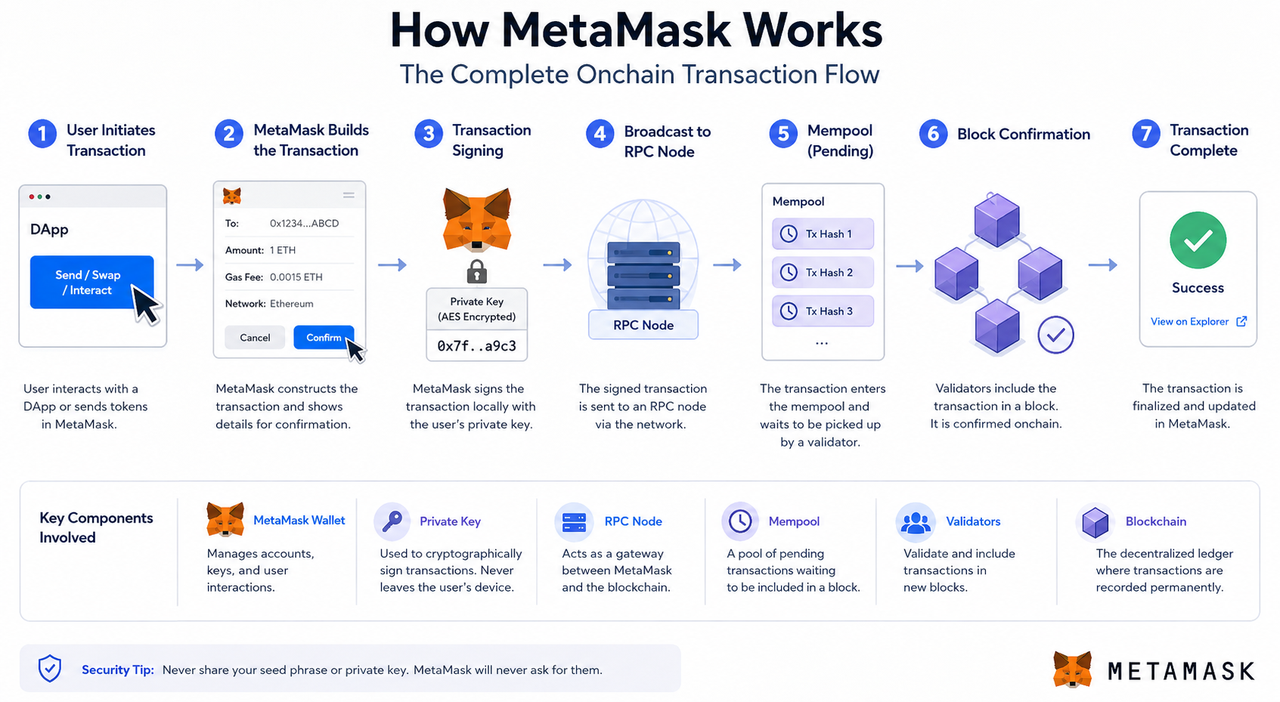
Que se passe-t-il après qu'un utilisateur a initié une transaction ?
Quand un utilisateur clique sur « Envoyer » dans MetaMask ou confirme une transaction dans une DApp, le portefeuille commence à construire une transaction on-chain. Celle-ci inclut généralement l'adresse de l'expéditeur, l'adresse du destinataire, le montant, les frais de Gas, le Nonce et les données d'appel du Smart Contract.
Avant la confirmation, MetaMask affiche une fenêtre de transaction présentant les frais estimés, le statut du réseau et les détails de l'approbation. Si la transaction implique un Smart Contract, le portefeuille montre aussi les permissions d'appel correspondantes. Ce n'est qu'après confirmation par l'utilisateur que la transaction entre dans la phase de signature.
La signature de transaction est l'une des fonctions essentielles de MetaMask.
Lorsqu'un utilisateur confirme une transaction, MetaMask fait appel à la clé privée stockée localement pour signer numériquement les données de la transaction. Durant ce processus, la clé privée n'est jamais exposée ; une signature cryptographique est générée à la place, que les nœuds de la blockchain peuvent vérifier.
Le réseau blockchain vérifie la signature pour confirmer que la transaction a bien été autorisée par le compte correspondant. Cela signifie que la blockchain ne repose pas sur les systèmes traditionnels de nom d'utilisateur et de mot de passe, mais utilise la cryptographie pour la vérification d'identité. C'est pourquoi la sécurité de la phrase de récupération et de la clé privée est cruciale. Si elles sont compromises, un attaquant pourrait directement contrôler les actifs du portefeuille.
Quel rôle jouent les frais de Gas dans une transaction ?
Les frais de Gas sont les frais payés par les utilisateurs au réseau blockchain pour inciter les nœuds à vérifier et exécuter les transactions.
Sur Ethereum et la plupart des réseaux EVM, toute opération on-chain consomme des ressources informatiques, donc les transactions doivent payer du Gas. MetaMask estime automatiquement les frais en fonction des conditions du réseau et permet aux utilisateurs d'ajuster la vitesse de transaction et les paramètres de Gas.
En période de congestion du réseau, les coûts de Gas augmentent généralement. L'un des principaux objectifs des réseaux Layer 2 comme Linea, Arbitrum et Optimism est de réduire les coûts de Gas on-chain des utilisateurs, améliorant ainsi l'efficacité des transactions et l'expérience utilisateur.
Après la signature, MetaMask envoie la transaction au réseau blockchain via un nœud RPC. Le nœud RPC sert d'interface de communication entre le portefeuille et la blockchain, utilisé pour synchroniser les données on-chain et diffuser les transactions.
Une fois diffusée, la transaction entre dans le pool de mémoire (Mempool) de la blockchain, où elle attend qu'un validateur l'inclue dans un bloc. Une fois la transaction incluse dans un nouveau bloc, son statut passe de « En attente » à « Confirmée ».
Si l'utilisateur définit un Gas trop bas, la transaction peut rester en statut « En attente » pendant longtemps, voire échouer. Ainsi, les paramètres de Gas affectent directement la vitesse de confirmation.
L'interaction de MetaMask avec les DApps ne se limite pas aux simples transferts : elle inclut aussi les autorisations de Smart Contracts.
Par exemple, lorsqu'un utilisateur interagit pour la première fois avec un token dans un protocole DeFi, il doit généralement effectuer une approbation (Approval). Cela permet au Smart Contract d'appeler l'actif spécifié jusqu'à une certaine limite.
Après l'approbation, le protocole peut exécuter des opérations telles que des échanges, des prêts ou du staking. Cependant, des approbations illimitées de longue durée présentent des risques. Si un contrat malveillant obtient des permissions excessives, les actifs de l'utilisateur pourraient être transférés. Par conséquent, vérifier et révoquer régulièrement les approbations est devenu une pratique de sécurité essentielle pour les utilisateurs de Web3.
MetaMask est un portefeuille non custodial, tandis que les plateformes d'échange centralisées utilisent un modèle de garde de la plateforme.
Sur une plateforme d'échange, celle-ci stocke les actifs et les informations de compte des utilisateurs. Dans MetaMask, les utilisateurs gèrent eux-mêmes leurs clés privées et phrases de récupération. Cela leur confère un contrôle total sur leurs actifs, mais leur impose aussi l'entière responsabilité de la sécurité.
MetaMask est idéal pour se connecter aux DApps, participer aux protocoles on-chain et gérer les identités on-chain. Les comptes de plateformes d'échange, quant à eux, sont mieux adaptés au trading centralisé et à la garde d'actifs. Les deux jouent des rôles distincts dans l'écosystème Web3.
La popularité de MetaMask est étroitement liée à la croissance de l'écosystème Ethereum.
En proposant très tôt une interface de plugin de navigateur standardisée, il a obtenu le support par défaut d'un large éventail de DApps. À mesure que les marchés DeFi et NFT se sont développés, MetaMask a construit un fort effet de réseau.
De plus, MetaMask a continuellement étendu son écosystème de plugins multi-chaînes, Layer 2, Swap, Bridge et Snaps, passant d'un simple outil de portefeuille à une infrastructure Web3 complète. Pour de nombreux utilisateurs, le premier pas dans le Web3 consiste à installer MetaMask et à se connecter aux applications on-chain.
Résumé
Le rôle principal de MetaMask est d'aider les utilisateurs à gérer les comptes on-chain, signer des transactions et se connecter aux applications Web3. Une transaction on-chain, de l'initiation à la confirmation, implique généralement la construction de la transaction, la signature par clé privée, le calcul du Gas, la diffusion RPC et la confirmation de bloc.
FAQ
MetaMask stocke-t-il les clés privées des utilisateurs ?
MetaMask chiffre et stocke les clés privées des utilisateurs localement, mais ne les télécharge jamais sur des serveurs centralisés. Les phrases de récupération et les clés privées sont toujours gérées par l'utilisateur.
Pourquoi les transactions on-chain nécessitent-elles des frais de Gas ?
Les frais de Gas compensent le réseau blockchain pour les coûts de calcul et de vérification, incitant les nœuds à traiter les transactions et à maintenir les opérations du réseau.
Que signifie le statut « En attente » ?
Le statut « En attente » signifie que la transaction a été diffusée mais pas encore formellement confirmée par la blockchain. Cela est généralement dû à une congestion du réseau ou à des paramètres de Gas trop bas.
MetaMask peut-il annuler une transaction ?
Si une transaction n'a pas été confirmée, les utilisateurs peuvent essayer de la remplacer en augmentant le Gas ou en envoyant une transaction de remplacement, mais l'annulation n'est pas toujours garantie.