How to Buy U.S. Stocks with USDT? The Complete Guide to Trading U.S. Stocks, ETFs, and Nasdaq Assets Using Stablecoins

Last Updated 2026-05-26 08:08:05
Reading Time: 2m
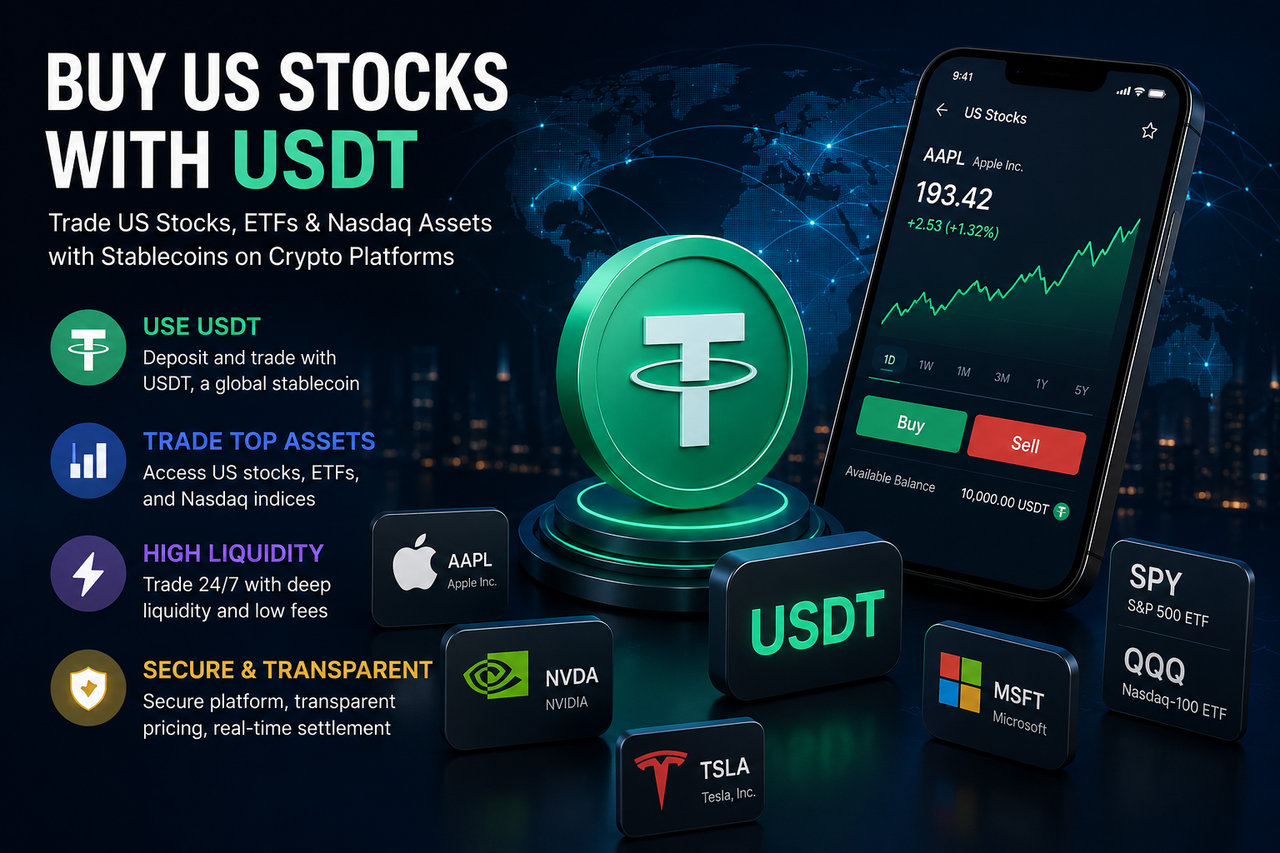
An increasing number of investors are using stablecoins such as USDT to buy US stocks, ETFs, and Nasdaq-related assets. Compared to traditional overseas brokerages, crypto platforms often allow users to settle directly with stablecoins and offer price exposure to Apple, Nvidia, Tesla, the S&P 500, and Nasdaq ETFs through structures like CFDs (Contracts for Difference), Tokenized Stocks, and RWAs (Real World Assets).

In the past, most users looking to buy U.S. stocks had to open an overseas brokerage account and link an international bank card to fund it. But with tighter cross-border financial regulations, some online brokerages scaling back their international operations, and global demand for dollar-denominated assets rising steadily, more people are seeking flexible alternatives for U.S. stock investing.

At the same time, the crypto industry has positioned stablecoins as the "digital dollar." USDT, USDC, and other stablecoins aren't just for crypto trading anymore—they're increasingly used for TradFi (Traditional Finance) asset settlement. This means users can now access U.S. stocks, ETFs, and commodities via crypto platforms without needing a traditional bank account.

How to Buy U.S. Stocks with USDT?

Most crypto platforms don't offer direct stock trading. Instead, they provide price exposure to U.S. stocks through CFDs (Contracts for Difference), tokenized stocks, or RWA products.

How to buy US stocks with USDT?

The typical process is:

  1. Sign up on a crypto platform that supports TradFi products and complete KYC verification.
  2. Deposit USDT as margin.
  3. Go to the TradFi or Stocks product page and select the stock or ETF you want to trade.

Currently, supported assets include:

Users can trade the price movements of these assets directly with stablecoins—no traditional brokerage account needed.

How Does Buying U.S. Stocks with USDT Actually Work?

There are two main structures behind "buying U.S. stocks with USDT."

Stock CFDs: Users don't own the actual stock; they trade on price movements. The platform settles the difference, letting users capture gains or losses from price changes. These typically support leverage and allow both long and short positions.

Tokenized stocks: A custodian holds the actual shares and issues corresponding tokens on-chain. For example, one on-chain token may represent one real share. This is closer to asset mapping, but compliance and redemption processes vary widely across platforms.

So when you search "buy U.S. stocks with USDT," it's important to know whether you're looking at CFDs, on-chain securities, or other RWA products.

Stock CFDs vs. Real Stocks: What's the Difference?

This is a common point of confusion.

Owning real stock means you hold equity in the company—with voting rights, shareholder benefits, and the ability to hold long-term. Stock CFDs are derivatives: you're trading the price, not the actual security.

Stock CFDs are better suited for:

  • Short-term trading
  • Leveraged trading
  • Short selling strategies
  • High liquidity trading

Real stocks are better for long-term allocation and value investing.

Since CFDs integrate more easily with existing derivative systems on most crypto platforms, the vast majority of "buy U.S. stocks with USDT" offerings today are CFD-based.

Why Are More Users Allocating Global Assets Through Crypto Platforms?

This trend reflects the convergence of global capital markets and crypto.

In the past, crypto and traditional finance were separate. But with stablecoins, RWA, and tokenization, users can now trade all of the following on one platform:

  • BTC and ETH
  • U.S. stocks
  • ETFs
  • Gold
  • Crude oil
  • U.S. Treasuries

Crypto platforms are evolving from digital asset exchanges into global asset trading gateways.

For many, using USDT to allocate global assets lowers cross-border barriers and improves capital efficiency. Stablecoins are becoming the critical bridge between Crypto and TradFi.

What Are the Risks of Buying U.S. Stocks with USDT?

While the barrier is low, there are risks to consider.

Stock CFDs often involve leverage, which can amplify both gains and losses. Different platforms have different compliance structures for tokenized stocks and RWA products, so users need to understand custody, liquidity, and regulatory risks.

Plus, most products don't represent actual stock holdings, so you may not have traditional shareholder rights. Stablecoins themselves carry liquidity and regulatory change risks.

Before jumping in, make sure you fully understand the product structure—not just the price action.

Conclusion

USDT is evolving from a crypto trading medium into a key financial infrastructure linking global capital markets. Through CFDs, tokenized stocks, and RWA products, more users are using stablecoins to access U.S. stocks, ETFs, and Nasdaq-related assets.

For those who can't easily use overseas brokerages or want to improve global asset allocation efficiency, crypto platforms offer a new gateway. But it's essential to understand the differences between CFDs, tokenized stocks, and real stocks—and to be aware of product structures and risks.

FAQs

Can I directly buy Apple and NVIDIA stocks with USDT?

Some crypto platforms support trading stocks like Apple, NVIDIA, and Tesla with USDT, but in most cases these are CFDs or tokenized stocks, not direct stock ownership.

Does buying U.S. stocks with USDT guarantee real stocks?

Not necessarily. Many platforms offer CFDs or on-chain mapped assets. Always check the product structure.

What is a stock CFD?

A stock CFD is a contract for difference that lets you trade price movements without owning the underlying stock.

Do I need an overseas bank card to buy U.S. stocks with USDT?

Some platforms let you transact directly with stablecoins, so no overseas bank card is required.

Are tokenized stocks legal?

Regulations vary by jurisdiction. Legality depends on the platform's location and compliance framework.

Author: Jayne
Disclaimer
* The information is not intended to be and does not constitute financial advice or any other recommendation of any sort offered or endorsed by Gate.
* This article may not be reproduced, transmitted or copied without referencing Gate. Contravention is an infringement of Copyright Act and may be subject to legal action.

Related Articles

Exploring 8 Major DEX Aggregators: Engines Driving Efficiency and Liquidity in the Crypto Market
Beginner

Exploring 8 Major DEX Aggregators: Engines Driving Efficiency and Liquidity in the Crypto Market

DEX aggregators integrate order data, price information, and liquidity pools from multiple decentralized exchanges, helping users find the optimal trading path in the shortest time. This article delves into 8 commonly used DEX aggregators, highlighting their unique features and routing algorithms.
2026-04-05 18:15:50
What Is Copy Trading And How To Use It?
Beginner

What Is Copy Trading And How To Use It?

Copy Trading, as the most profitable trading model, not only saves time but also effectively reduces losses and avoids man-made oversights.
2026-04-09 06:04:24
What Is Technical Analysis?
Beginner

What Is Technical Analysis?

Learn from the past - To explore the law of price movements and the wealth code in the ever-changing market.
2026-04-09 10:30:57
How to Do Your Own Research (DYOR)?
Beginner

How to Do Your Own Research (DYOR)?

"Research means that you don’t know, but are willing to find out." - Charles F. Kettering.
2026-04-09 10:20:26
What Is Fundamental Analysis?
Intermediate

What Is Fundamental Analysis?

Suitable indicators and tools combined with crypto news make up the best possible fundamental analysis for decision-making
2026-03-24 11:52:13
What Are Altcoins?
Beginner

What Are Altcoins?

An altcoin is also known as a Bitcoin Alternative or Alternative Cryptocoin, which refers to all cryptocurrencies other than Bitcoin. Most of the cryptocurrencies in the early stage were created through forking (copying Bitcoin codes).
2026-04-09 10:51:50