PreStocks dan investasi Pre-IPO tradisional sama-sama membidik perusahaan pra-IPO, memberi pelaku pasar akses ke peluang pertumbuhan nilai di perusahaan seperti OpenAI, SpaceX, dan Anthropic — perusahaan yang belum go public. Namun, struktur mendasar dan logika operasional keduanya berbeda secara signifikan.
Seiring kemajuan tokenisasi Real World Asset (RWA), ekuitas swasta on-chain telah muncul sebagai arah utama dalam digitalisasi pasar modal. PreStocks memanfaatkan blockchain untuk membentuk kembali cara pasar swasta mengedarkan aset, sementara investasi Pre-IPO tradisional mengikuti kerangka kerja modal ventura dan ekuitas swasta yang sudah mapan.
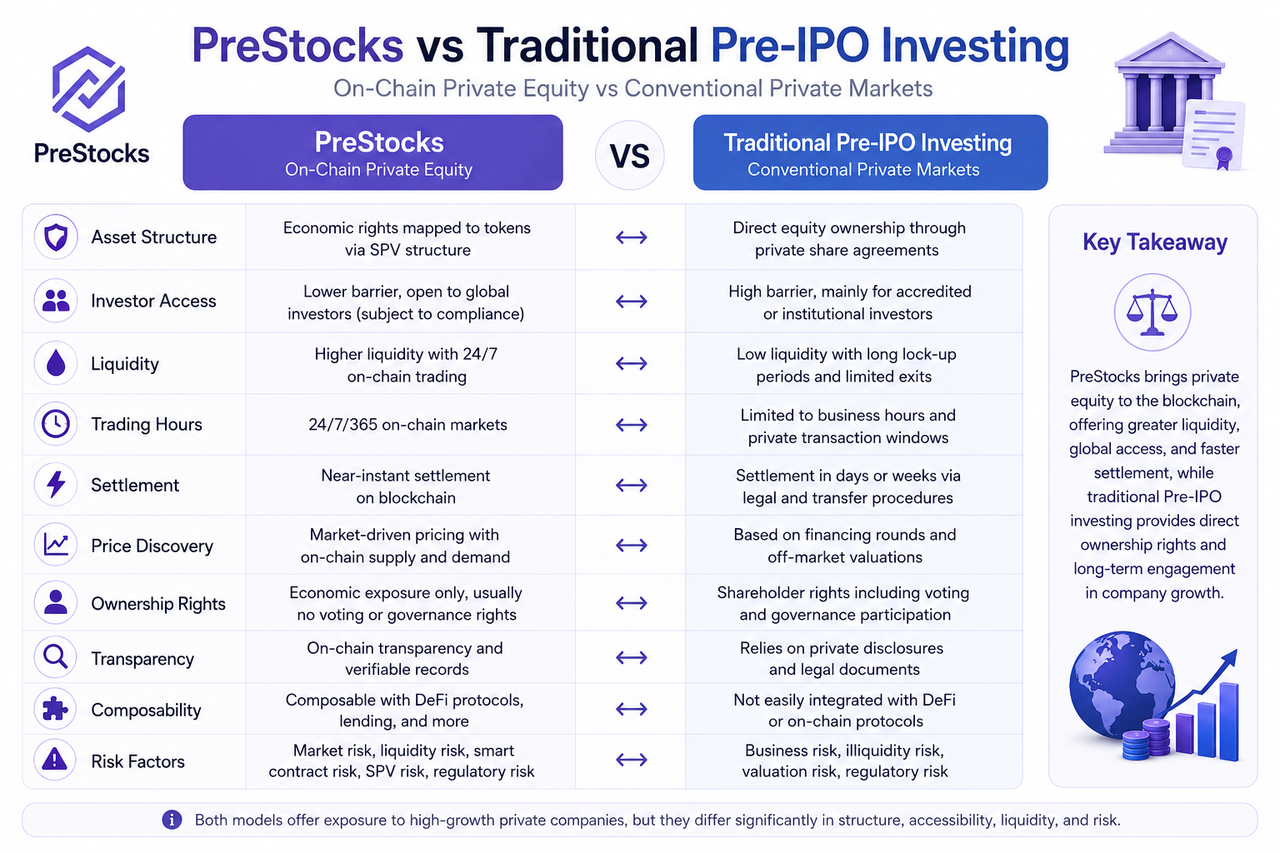
PreStocks vs. Pre-IPO Tradisional: Ikhtisar Cepat
PreStocks menggunakan SPV untuk memegang kepemilikan ekuitas di perusahaan target, memetakan nilai ekonomi terkait ke dalam token blockchain. Yang dimiliki pengguna bukanlah saham resmi perusahaan, melainkan aset on-chain yang terkait dengan fluktuasi nilai perusahaan.
Investasi Pre-IPO tradisional mengacu pada penempatan ekuitas swasta yang dilakukan sebelum perusahaan listing, yang secara langsung melibatkan kepemilikan ekuitas perusahaan. Dengan demikian, investasi ini memiliki struktur hak hukum yang jelas — termasuk hak pemegang saham, kewajiban pengungkapan, dan perlindungan hukum.
Saat ini, perusahaan modal ventura, dana ekuitas swasta, investor bernilai tinggi, dan karyawan perusahaan biasanya memperoleh saham melalui putaran pendanaan, pasar ekuitas sekunder, atau perjanjian pengalihan saham.
Bagaimana Struktur Kepemilikan Aset Berbeda?
Struktur kepemilikan aset merupakan salah satu perbedaan paling mendasar antara keduanya.
Investasi Pre-IPO tradisional mewakili ekuitas aktual di perusahaan. Investor memperoleh kepemilikan sebagian melalui perjanjian ekuitas dan menikmati hak yang sesuai dalam kerangka hukum yang berlaku.
PreStocks, sebaliknya, memetakan kepentingan ekonomi melalui struktur SPV. Token on-chain umumnya mencerminkan perubahan nilai perusahaan target, tetapi tidak serta merta memberikan status pemegang saham.
Ini menciptakan perbedaan mendasar dalam kedudukan hukum dan atribusi hak.
Bagaimana Perbandingan Ambang Batas Investasi?
Pasar swasta tradisional memberlakukan hambatan masuk yang tinggi.
Banyak penempatan swasta hanya terbuka untuk investor institusi atau terakreditasi dan memiliki jumlah investasi minimum. Beberapa memerlukan verifikasi identitas dan dokumentasi hukum yang rumit.
PreStocks dirancang sebagian untuk meningkatkan aksesibilitas pasar.
Dengan memungkinkan partisipasi melalui aset digital, PreStocks menawarkan fleksibilitas lebih besar dan keterbagian aset yang lebih baik, sehingga menurunkan hambatan akses yang khas dari pasar swasta tradisional.
Mengapa Likuiditas Begitu Berbeda?
Likuiditas adalah salah satu keunggulan yang paling banyak dibicarakan dari ekuitas swasta on-chain.
Saham Pre-IPO tradisional biasanya memiliki periode lock-up yang panjang. Keluar dari investasi sering berarti mencari pembeli dan melalui proses pengalihan ekuitas yang rumit.
PreStocks mengonversi aset menjadi token on-chain yang dapat diperdagangkan secara terus-menerus di pasar yang didukung.
Meskipun likuiditas on-chain masih bergantung pada kedalaman pasar, efisiensi perdagangannya umumnya melebihi transfer ekuitas swasta tradisional.
Bagaimana Perbedaan Perdagangan dan Penyelesaian?
Transaksi ekuitas swasta tradisional bergantung pada pengacara, kustodian, dan sistem pencatatan ekuitas.
Prosesnya mungkin melibatkan beberapa putaran peninjauan dokumen, pemeriksaan identitas, dan penyelesaian dana, sering memakan waktu berhari-hari hingga berminggu-minggu.
PreStocks beroperasi di jaringan blockchain.
Setelah perdagangan disepakati, aset dan dana diselesaikan on-chain sesuai aturan smart contract, secara dramatis mengurangi keterlibatan perantara.
Perbedaan ini menyoroti nilai infrastruktur blockchain dalam memodernisasi pasar modal.
Bagaimana Perbedaan Mekanisme Penemuan Harga?
Penemuan harga menentukan bagaimana nilai aset terbentuk di pasar.
Pasar Pre-IPO tradisional terutama mengandalkan putaran pendanaan dan transaksi OTC untuk penilaian. Setiap putaran baru memberikan titik referensi yang diperbarui.
PreStocks menambahkan pasar perdagangan on-chain sebagai saluran pembentukan harga.
Harga token dipengaruhi tidak hanya oleh perubahan valuasi perusahaan, tetapi juga oleh penawaran dan permintaan on-chain, sentimen pasar, dan aktivitas perdagangan.
Akibatnya, kedua pasar menunjukkan karakteristik volatilitas harga yang berbeda.
Bagaimana Perbedaan Struktur Risiko?
Kedua model menghadapi faktor risiko yang berbeda.
Investasi Pre-IPO tradisional berfokus pada operasi perusahaan, kemampuan penggalangan dana, lanskap persaingan, dan jadwal IPO.
PreStocks membawa risiko bisnis yang sama ditambah risiko on-chain tambahan: risiko likuiditas, risiko smart contract, risiko manajemen SPV, dan volatilitas pasar aset digital.
Profil risiko yang lebih luas membuat ekuitas swasta on-chain menjadi proposisi yang lebih kompleks.
PreStocks vs. Pre-IPO Tradisional: Tabel Perbandingan
| Dimensi |
PreStocks |
Pre-IPO Tradisional |
| Aset Dasar |
Pemetaan kepentingan ekonomi |
Kepemilikan ekuitas aktual |
| Status Hukum |
Biasanya bukan pemegang saham langsung |
Kedudukan pemegang saham yang jelas |
| Jenis Pasar |
Pasar on-chain |
Pasar swasta |
| Likuiditas |
Relatif tinggi |
Relatif terbatas |
| Jam Perdagangan |
24/7 |
Tidak kontinu |
| Kecepatan Penyelesaian |
Real-time atau cepat |
Berhari-hari hingga berminggu-minggu |
| Akses |
Melalui aset digital |
Terutama investor terakreditasi |
| Sumber Risiko |
Risiko bisnis + on-chain |
Terutama risiko bisnis |
Kapan Ekuitas Swasta On-Chain Masuk Akal?
Ekuitas swasta on-chain cocok untuk skenario yang mengutamakan likuiditas dan komposabilitas aset digital.
Karena aset sudah didigitalkan, mereka dapat berintegrasi dengan protokol pinjaman, alat manajemen aset, dan produk RWA lainnya.
Selain itu, pasar on-chain beroperasi secara global sepanjang waktu, menjangkau peserta yang sering terlewatkan oleh pasar swasta tradisional.
Model ini mendorong pasar modal dari struktur tertutup menuju jaringan digital terbuka.
Kapan Pasar Pre-IPO Tradisional Lebih Masuk Akal?
Investasi Pre-IPO tradisional menekankan hak hukum dan alokasi modal jangka panjang.
Perusahaan modal ventura dan ekuitas swasta peduli pada tata kelola, kursi dewan, dan kemitraan strategis.
Hak-hak ini sulit direplikasi dengan pemetaan token sederhana, sehingga model tradisional tetap penting dalam penggalangan dana perusahaan.
Dalam banyak kasus, pasar on-chain dan tradisional akan saling melengkapi, bukan menggantikan satu sama lain.
Ringkasan
PreStocks dan Pre-IPO tradisional sama-sama berpusat pada perusahaan pra-IPO, tetapi perbedaan inti mereka terletak pada struktur aset dan infrastruktur pasar. Pre-IPO tradisional secara langsung memegang ekuitas, sedangkan PreStocks menggunakan SPV untuk memetakan kepentingan ekonomi menjadi aset on-chain, memungkinkan model perdagangan yang lebih terbuka dan efisien.
Mulai dari ambang batas investasi, likuiditas, dan kecepatan penyelesaian hingga profil risiko, kedua model mewakili jalur evolusi yang berbeda untuk pasar modal. Pasar swasta tradisional menawarkan kerangka hukum yang lebih jelas, sementara ekuitas swasta on-chain menunjuk pada masa depan RWA dan pasar modal digital.
FAQ
Apakah PreStocks sama dengan membeli saham perusahaan pra-IPO?
Tidak. Token PreStocks umumnya tidak secara langsung mewakili saham resmi perusahaan. Token tersebut adalah instrumen on-chain yang memetakan kepentingan ekonomi melalui struktur SPV, berbeda dengan ekuitas yang dipegang oleh pemegang saham tradisional.
Mengapa PreStocks biasanya menawarkan likuiditas yang lebih tinggi?
PreStocks mendigitalkan aset dan menempatkannya di pasar on-chain, sehingga memungkinkan perdagangan dan transfer secara terus-menerus. Ini meningkatkan efisiensi peredaran dibandingkan dengan proses transfer ekuitas tradisional.
Apakah holder PreStocks memiliki hak suara?
Dalam kebanyakan kasus, pemegang PreStocks tidak secara langsung memegang hak suara pemegang saham. Hak spesifik bergantung pada struktur SPV dan pengaturan hukum produk.
Apakah ekuitas swasta on-chain dianggap sebagai RWA?
Ya. Ekuitas swasta on-chain adalah bagian penting dari tokenisasi Real World Asset (RWA). Aset dasarnya berasal dari ekuitas perusahaan di dunia nyata atau kepentingan ekonomi terkait.
Akankah PreStocks menggantikan pasar Pre-IPO tradisional?
PreStocks dan Pre-IPO tradisional menjawab kebutuhan yang berbeda. Pasar tradisional berfokus pada kepemilikan ekuitas dan tata kelola perusahaan; pasar on-chain memprioritaskan likuiditas dan perdagangan digital. Keduanya lebih mungkin untuk hidup berdampingan dan saling melengkapi dalam jangka panjang.