À mesure que l'écosystème blockchain et les applications décentralisées continuent d'évoluer, les preuves à connaissance nulle (ZK Proof) sont devenues une technologie essentielle pour vérifier les calculs off-chain et les résultats d'exécution des Smart Contracts.
Différents types de zkVM jouent des rôles distincts dans les applications concrètes, SP1 zkVM et zkEVM étant les deux implémentations les plus observées. SP1 zkVM offre un calcul vérifiable généraliste et inter-écosystèmes, tandis que zkEVM se concentre sur la vérification des Smart Contracts compatibles avec l'EVM d'Ethereum. En pratique, certains développeurs peuvent confondre les deux, mais ils diffèrent considérablement dans leurs mécanismes sous-jacents, leurs cas d'usage et leurs incitations économiques.
Qu'est-ce que SP1 zkVM ?
Machine virtuelle à connaissance nulle généraliste développée par Succinct, SP1 zkVM permet de générer des Preuves pour n'importe quel programme écrit en Rust. Ses fonctionnalités principales incluent :
- Prise en charge de l'écriture de programmes vérifiables dans des langages généralistes
- Génération automatique de Preuves STARK/SNARK
- Capacités de preuve récursive et d'extension modulaire
- Adaptation à la vérification cross-chain, au passage à l'échelle des rollups et au calcul vérifiable par l'IA
Grâce à un Réseau de provers décentralisé, SP1 zkVM sépare la génération de Preuves de la vérification on-chain, créant ainsi un marché ouvert du taux de hachage avec des incitations économiques en boucle fermée. (succinct.xyz)
Qu'est-ce que zkEVM ?
Conçu pour l'écosystème Ethereum, zkEVM est une machine virtuelle à connaissance nulle compatible avec le jeu d'instructions EVM. Il permet aux Smart Contracts et aux transactions de générer des Preuves off-chain pour une vérification rapide sur la chaîne principale d'Ethereum. Ses caractéristiques incluent :
- Compatibilité totale avec les Smart Contracts Ethereum
- Génération de Preuves principalement destinée au passage à l'échelle des rollups ou des Layer2
- Accent mis sur l'efficacité de la vérification on-chain et l'équivalence EVM
- Un écosystème communautaire étroitement lié à Ethereum
zkEVM est surtout adapté à la vérification des transactions et des contrats au sein de l'écosystème Ethereum et ne dispose pas de la programmabilité inter-écosystèmes d'un zkVM généraliste.
Différences clés entre SP1 zkVM et zkEVM
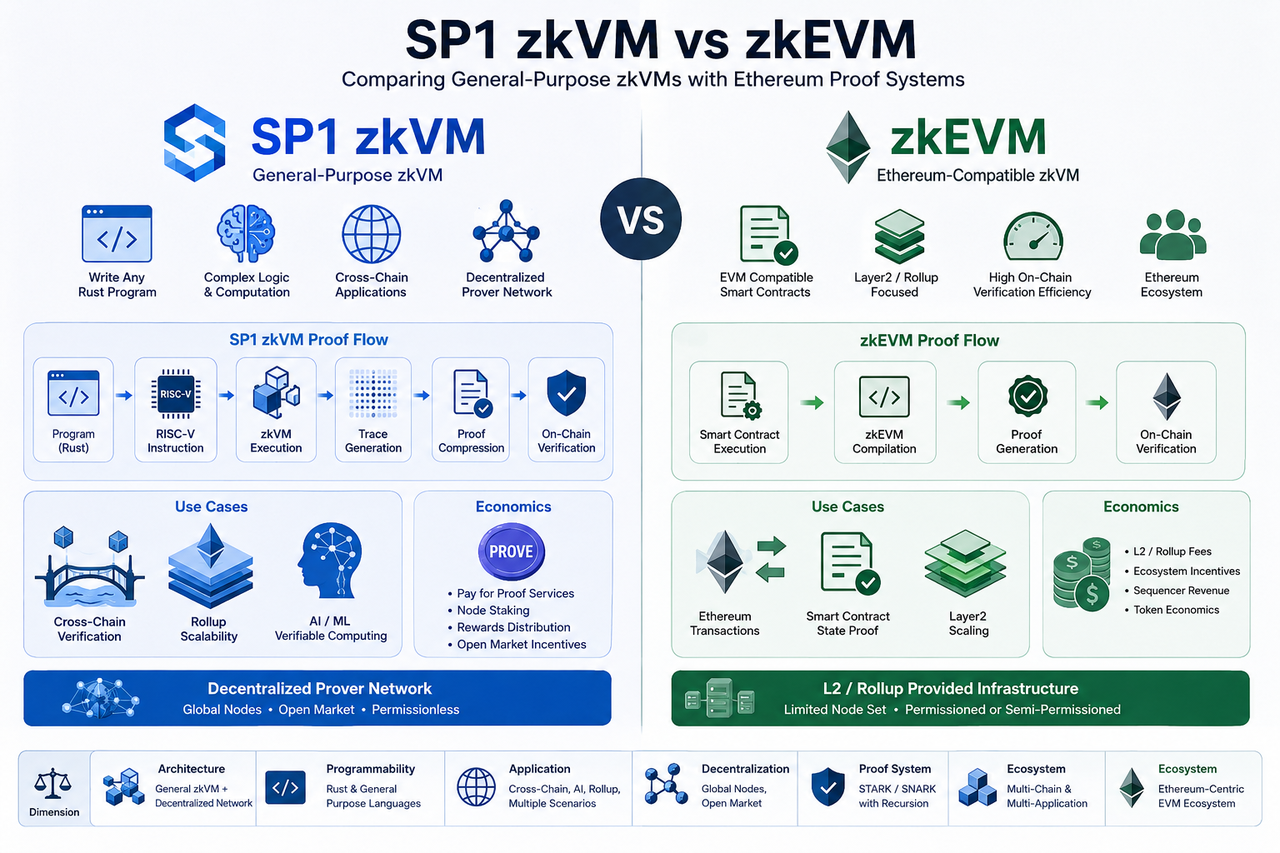
SP1 zkVM vs zkEVM : Architecture
SP1 zkVM et zkEVM sont tous deux des infrastructures de preuve à connaissance nulle, mais ils poursuivent des objectifs différents.
SP1 zkVM privilégie le calcul vérifiable généraliste. Son cœur est constitué du SP1 zkVM et d'un Réseau de provers décentralisé, permettant aux développeurs d'écrire des programmes en Rust ou dans d'autres langages généralistes et d'effectuer la génération et la vérification de Preuves via un réseau global. Cette conception libère SP1 zkVM de tout écosystème de chaîne unique, permettant des scénarios complexes comme la vérification cross-chain, le calcul off-chain et la vérification d'inférence IA.
En revanche, zkEVM se concentre sur la compatibilité avec l'écosystème Ethereum. Sa logique sous-jacente repose sur les instructions EVM et les Smart Contracts Solidity, visant à améliorer l'efficacité de la vérification des transactions et le passage à l'échelle des Layer2 via les Preuves ZK, tout en préservant l'expérience de développement Ethereum.
SP1 zkVM vs zkEVM : Génération de Preuves
Les deux solutions diffèrent sensiblement dans la manière dont les Preuves sont générées.
Le processus de SP1 zkVM commence généralement par l'écriture d'un programme par le développeur. Ce programme est converti en instructions RISC-V et exécuté dans le zkVM pour produire une Trace. Le système effectue ensuite une compression des Preuves et une vérification récursive avant de soumettre le résultat à la vérification on-chain. Comme le système sous-jacent prend en charge le calcul généraliste, l'ensemble du flux est mieux adapté aux logiques complexes et au calcul vérifiable à grande échelle.
Le processus de zkEVM reflète plus étroitement l'environnement d'exécution d'Ethereum. Lorsqu'un utilisateur initie une transaction, le Smart Contract s'exécute dans le zkEVM, générant à la fois une Trace d'exécution et la Preuve correspondante. Étant donné que zkEVM est nativement compatible EVM, la Preuve générée peut être directement utilisée pour la vérification de l'état Layer2 et le règlement on-chain. Ce modèle est idéal pour la vérification de transactions à haute fréquence et le passage à l'échelle des rollups.
SP1 zkVM vs zkEVM : Programmabilité
En termes de flexibilité de développement, SP1 zkVM offre une plus grande généralité. Les développeurs peuvent écrire des logiques complexes dans des langages généralistes comme Rust — y compris l'inférence IA, la vérification d'état cross-chain et le traitement de données off-chain — sans être contraints par les frameworks de Smart Contracts.
zkEVM, quant à lui, s'articule autour de Solidity et du jeu d'instructions EVM. Bien que cette compatibilité réduise les coûts de migration pour les développeurs Ethereum, elle limite également l'environnement d'exécution aux logiques de Smart Contracts, le rendant inadapté aux calculs généralistes complexes.
SP1 zkVM vs zkEVM : Cas d'usage
SP1 zkVM est mieux adapté aux scénarios nécessitant des calculs complexes et une vérification inter-écosystèmes. Parmi les exemples, on trouve les ponts cross-chain qui doivent vérifier en continu les états d'autres chaînes, les systèmes d'IA qui doivent valider les sorties des modèles, et les réseaux de rollups traitant de grands volumes de Preuves récursives. Tous ces cas exigent de solides capacités de vérification généralistes.
zkEVM sert principalement au passage à l'échelle de l'écosystème Ethereum. Les cas d'usage typiques incluent les rollups Layer2, la vérification d'état des Smart Contracts et la compression des transactions Ethereum. Comme sa conception est explicitement orientée EVM, il dispose d'un avantage clair en termes de compatibilité Ethereum et d'efficacité d'intégration on-chain.
SP1 zkVM vs zkEVM : Modèles économiques et réseaux de taux de hachage
Le réseau Succinct derrière SP1 zkVM introduit un Réseau de provers décentralisé avec le mécanisme d'incitation PROVE. Lorsqu'un développeur soumet une demande de Preuve, les nœuds du monde entier peuvent participer à la génération de Preuve et recevoir un règlement et des récompenses via le mécanisme de Token. Ce modèle favorise progressivement un marché ouvert du taux de hachage pour la génération de Preuves.
zkEVM, en revanche, repose généralement sur l'infrastructure de nœuds des projets Layer2 ou rollup. Ses ressources de taux de hachage sont principalement fournies par les équipes de projet ou les nœuds de vérification, ce qui entraîne une décentralisation relativement limitée.
Tableau comparatif multidimensionnel : SP1 zkVM vs zkEVM
| Dimension de comparaison |
SP1 zkVM |
zkEVM |
| Positionnement central |
zkVM généraliste et couche de calcul vérifiable |
Solution de passage à l'échelle ZK compatible Ethereum |
| Langage de programmation |
Langages généralistes (Rust, etc.) |
Solidity / EVM |
| Architecture sous-jacente |
RISC-V + Réseau de provers |
Environnement d'exécution compatible EVM |
| Génération de Preuve |
Programme généraliste génère la Preuve |
Exécution de Smart Contract génère la Preuve |
| Domaine d'application |
IA, cross-chain, calcul complexe |
rollup, vérification de transactions |
| Capacité d'extension |
Prend en charge logique complexe et Preuves récursives |
Met l'accent sur la compatibilité Ethereum |
| Structure du taux de hachage |
Réseau de provers décentralisé |
Réseau de nœuds Layer2 |
| Mécanisme d'incitation |
Incitations token PROVE |
Modèle de Frais de trading rollup |
Résumé
SP1 zkVM et zkEVM représentent deux directions différentes dans l'infrastructure ZK. SP1 zkVM met l'accent sur le calcul vérifiable généraliste, utilisant un Réseau de provers décentralisé pour prendre en charge les logiques complexes, la vérification cross-chain et l'inférence IA. zkEVM se concentre sur la compatibilité Ethereum, abordant principalement la vérification des transactions et le passage à l'échelle des Layer2.
Pour les projets nécessitant un calcul off-chain complexe et une collaboration inter-écosystèmes, SP1 zkVM offre un plus grand potentiel d'extension. Pour les rollups et les applications Smart Contracts construits au sein de l'écosystème Ethereum, zkEVM est souvent plus facile à intégrer et à déployer. Les deux ne sont pas de simples substituts ; ils répondent à différents besoins d'application ZK.
FAQ
Quelle solution est la meilleure pour la vérification cross-chain ?
SP1 zkVM est meilleur pour la vérification cross-chain car il prend en charge l'exécution de logique complexe et bénéficie d'un Réseau de provers décentralisé.
Quelle solution est la meilleure pour les rollups Ethereum ?
zkEVM est meilleur pour le passage à l'échelle des Layer2 et rollups Ethereum en raison de sa compatibilité native avec EVM et Solidity.
SP1 zkVM prend-il en charge les preuves récursives ?
Oui. SP1 zkVM peut compresser les résultats de calcul à grande échelle à l'aide de Preuves récursives, ce qui le rend idéal pour les scénarios de vérification complexes.
zkEVM peut-il exécuter des programmes arbitraires ?
Non. zkEVM prend principalement en charge Solidity et le jeu d'instructions EVM, de sorte que son champ d'application est généralement limité aux logiques de Smart Contracts.