Ethereum est une plateforme blockchain décentralisée et open source, caractérisée par l’introduction pionnière de Smart Contract Turing-complets. Cette innovation offre aux développeurs la possibilité de concevoir une vaste gamme d’applications décentralisées (dApps) sur sa couche de règlement mondiale. Au sein de l’écosystème, l’ETH agit à la fois comme Gas pour les frais de calcul du réseau et comme principal Collatéral assurant la sécurité du mécanisme de consensus Proof of Stake (PoS).
À mesure que la technologie blockchain s'est transformée d'un simple outil de transfert de valeur en une infrastructure programmable, Ethereum s'est imposé comme la plateforme centrale de l'écosystème Web3, générant une vaste gamme d'applications et de protocoles tels que la finance décentralisée (DeFi), les NFT, la gouvernance on-chain et la tokenisation d'actifs.
La valeur d'Ethereum réside dans sa quête continue de la « souveraineté programmable », marquant un changement fondamental dans le système de confiance humain — passant d'une validation centralisée à un consensus fondé sur le code. Grâce à ses efforts vers la « statelessness » et à la mise à niveau Verkle tree, Ethereum réduit les obstacles opérationnels pour les nœuds, tout en maintenant une forte résistance à la censure, même à grande échelle. Cette approche équilibrée — associant sécurité, décentralisation et compatibilité écosystémique — offre une base standardisée pour la migration on-chain de milliers de milliards d'actifs et établit un socle technique solide pour un réseau mondial de collaboration numérique ouvert et sans frontières.
Les origines d'Ethereum
Ethereum est une plateforme blockchain décentralisée et open source prenant en charge les Smart Contract et les applications décentralisées (DApp), souvent appelée « ordinateur mondial ». Elle permet à la fois des transferts et paiements peer-to-peer comme bitcoin, et fournit une infrastructure programmable pour que les développeurs créent une large palette de protocoles financiers, jeux et applications on-chain.
Vitalik Buterin a proposé Ethereum dans un livre blanc en 2013, avec l'objectif de créer une « blockchain programmable ». En 2014, l'équipe a lancé une vente de tokens, levant environ 18 millions de dollars en bitcoin pour financer le développement et le lancement du réseau Ethereum.
Le 30 juillet 2015, le mainnet Ethereum a été lancé officiellement, marquant la transition de la phase Frontier à une ère concrète pour les plateformes de Smart Contract. Depuis, Ethereum a connu plusieurs mises à niveau et événements majeurs, dont le hard fork crucial après l'incident DAO (qui a séparé Ethereum et Ethereum Classic). Ces événements ont révélé des risques techniques et de gouvernance, tout en renforçant la résilience de la communauté Ethereum dans la coordination du consensus et l'évolution du protocole.
Qu'est-ce qu'Ethereum
Analyse de l'architecture sous-jacente : fonctionnement d'Ethereum
Le réseau Ethereum fonctionne comme un ordinateur mondial distribué, avec une architecture en couches qui traite les transactions, exécute les Smart Contract et assure le consensus, garantissant que tous les nœuds maintiennent un état synchronisé.
Ethereum distingue l'Execution Layer et la Consensus Layer, qui coopèrent via l'Engine API : l'Execution Layer exécute les Smart Contract et met à jour les états des comptes, tandis que la Consensus Layer assure l'ordre des blocs et la sécurité du réseau.
L'Ethereum Virtual Machine (EVM) est le cœur de l'Execution Layer — un environnement Turing-complet qui interprète et exécute le bytecode des Smart Contract de façon identique sur chaque nœud complet. Lorsqu'un utilisateur initie une transaction, l'EVM consomme du Gas (carburant informatique) pour calculer le coût de chaque opération et éviter les boucles infinies. Une fois terminée, la modification d'état (comme la mise à jour des soldes) est diffusée et vérifiée sur le réseau, garantissant l'immutabilité.
Couche d'architecture
Responsabilités principales
Clients représentatifs
Execution Layer
Exécution des transactions, fonctionnement de l'EVM, mise à jour des états
Geth, Erigon
Consensus Layer
Proposition/attestation des blocs, confirmation de la finalité
Prysm, Lighthouse
Network Layer
Découverte P2P et diffusion gossip
protocole libp2p
Le flux de transaction est simple : les utilisateurs signent les transactions (incluant le Nonce pour la protection contre les replays, la Limite de gas pour le budget, et les champs Data pour les appels de contrat), les validateurs les regroupent en blocs (en moyenne 12 secondes par bloc), puis, après validation par tous les nœuds, elles sont ajoutées à la chaîne. Après « The Merge » en septembre 2022, Ethereum est passé du PoW (Preuve de travail) énergivore au PoS (Preuve d'enjeu), réduisant la consommation d'énergie de 99,95 % et plaçant les validateurs au centre du réseau à la place des mineurs.
Rôles du réseau Ethereum et structure des participants
Le réseau Ethereum s'appuie sur différents participants, formant un écosystème décentralisé avec des fonctions distinctes : les validateurs assurent le consensus, les nœuds stockent les données, et les utilisateurs initient les interactions. Chaque rôle dispose de mécanismes d'incitation et de pénalités spécifiques.
Rôle
Responsabilités principales
Seuil d'entrée / Risques
Validateur
Production de blocs et attestation des transactions, maintien du consensus PoS
32 ETH en staking ; pénalités de slashing
Nœud complet
Vérifie et stocke toutes les données de la chaîne, propage les transactions
Disque dur de plus de 2 To et bande passante élevée ; pas de récompense directe
Nœud léger
Synchronise uniquement les en-têtes de blocs, vérification simplifiée des paiements (SPV)
Matériel mobile suffisant ; dépend des nœuds complets pour les données
Sequencer
Trie les transactions Layer 2 et les télécharge sur L1
Géré généralement par les équipes L2 ; risque de centralisation
Validateurs : la base sécuritaire du réseau
À l'ère du PoS, les validateurs remplacent les mineurs. En stakant 32 ETH, les utilisateurs activent un nœud validateur, alternant entre les rôles suivants :
Proposer : construit et propose de nouveaux blocs.
Attestor : vote pour confirmer les blocs proposés.
Récompenses et pénalités : les propositions de blocs réussies rapportent 3 % à 5 % de rendement annualisé. Les nœuds hors ligne ou impliqués dans des attaques de double signature subissent un slashing de leur ETH staké.
Système de comptes : EOA vs comptes de contrat
Externally Owned Account (EOA) : contrôlé par une clé privée utilisateur (MetaMask Wallet par exemple), peut initier des transferts et interagir avec les Smart Contract.
Compte de contrat : sans clé privée ; piloté par la logique du code stocké on-chain, comme les protocoles de prêt DeFi (Aave) ou les exchanges décentralisés (Uniswap).
Hiérarchie des nœuds et infrastructure
Niveaux de données : les nœuds complets valident toutes les transactions pour l'autonomie ; les nœuds d'archive stockent chaque état historique, idéal pour l'analyse des données ; les nœuds légers offrent un accès basse puissance pour les portefeuilles mobiles.
Services middleware : les fournisseurs RPC (Infura, Alchemy) proposent des points d'accès API pour les développeurs, évitant la gestion de leur propre nœud ; les pools de staking (Lido) permettent aux utilisateurs avec moins de 32 ETH de partager les récompenses des validateurs.
Fonctions et mécanismes économiques d'ETH
L'ETH est le token natif d'Ethereum et le « moteur » de l'écosystème décentralisé, servant de carburant, de collatéral et de réserve de valeur.
Carburant informatique (frais de gas) : utilisé pour payer les frais de transaction du réseau. Chaque transaction et appel de contrat consomme de l'ETH afin d'éviter que du code malveillant ne consomme des ressources illimitées.
Collatéral de sécurité (staking) : sous PoS, l'ETH fait office de « dépôt de sécurité » du réseau. Les validateurs verrouillent de l'ETH pour obtenir le droit de proposer des blocs et gagner des récompenses, constituant la colonne vertébrale de la sécurité du réseau.
Moyen de transfert de valeur : en tant que principale devise de règlement du Web3, l'ETH est utilisé pour les paiements, le collatéral des prêts DeFi, les achats de NFT et comme ancrage de valeur pour la tokenisation des RWA (actifs réels).
La mise à niveau EIP-1559 en 2021 a modifié le modèle économique de l'ETH, introduisant un mécanisme automatique de brûlage des frais. Les frais de base de chaque transaction sont brûlés, tandis que les tips vont aux validateurs. L'offre d'ETH est passée d'une inflation pure à un équilibre dynamique — le brûlage accélère lors des périodes de congestion réseau.
Les incitations au staking encouragent les validateurs à rejoindre le réseau, permettant aux détenteurs d'ETH de percevoir des rendements passifs :
Méthode de participation
Seuil / Caractéristiques
Rendement annualisé attendu
Validateur indépendant
32 ETH et serveur dédié requis
3 % à 5 % plus récompenses de droit de priorité
Liquid Staking (LSD)
ex : Lido (stETH) ; minimum 0,01 ETH
Environ 3 % à 4,5 % (net de frais de gestion)
Restaking
ex : EigenLayer ; utilise l'ETH staké pour sécuriser d'autres services
Rendement supplémentaire
Layer 2 : moteur d'expansion et écosystème d'Ethereum
Si le mainnet Ethereum est la « couche de règlement » pour le consensus principal, Layer 2 est sa « couche d'exécution » haute performance. Aujourd'hui, Ethereum adopte une architecture modulaire, équilibrant performance élevée et décentralisation grâce aux solutions Layer 2.
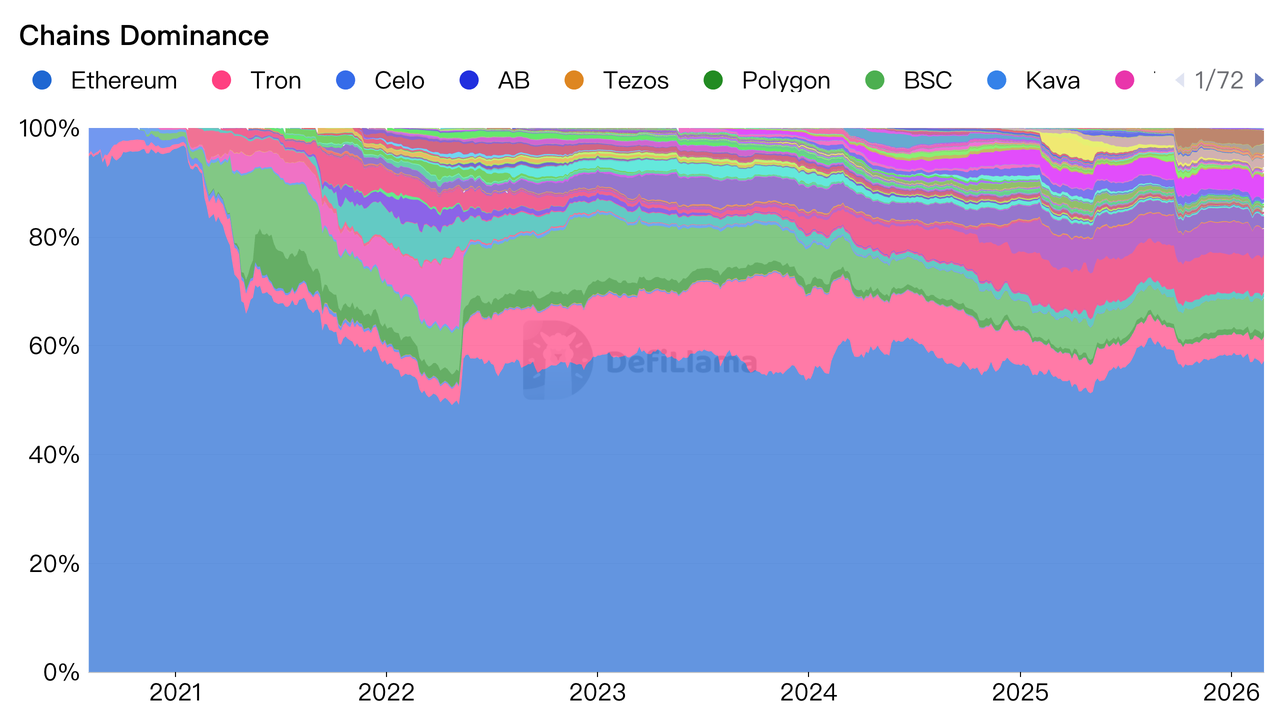
En 2026, Ethereum demeure le cœur incontesté de l'industrie blockchain : la TVL DeFi avoisine 53 milliards de dollars, soit 57 % des actifs totaux du secteur, avec des protocoles comme Uniswap V4, Aave, Lido et Ethena en tête de l'innovation DeFi.
Layer 2 : moteur d'expansion et écosystème d'Ethereum
Pour pallier les coûts élevés et la lenteur du mainnet, les solutions Layer 2 sont au centre des efforts d'expansion d'Ethereum.
Impact de la mise à niveau Dencun en 2024 : avec le stockage de données Blob, les frais de transaction Layer 2 ont chuté de plus de 90 %, le TPS moyen dépasse 5 600, rendant possible l'utilisation commerciale à grande échelle.
Cependant, Layer 2 fait face à de nouveaux défis. En février 2026, Vitalik Buterin a indiqué que « Layer 2 comme ‘sharding de marque’ pour la scalabilité d'Ethereum n'est plus pertinent ».
Avantages et limites d'Ethereum
Ethereum est considéré comme le « système d'exploitation » du Web3. Bien qu'il ait établi la norme en matière de décentralisation et de sécurité, il doit encore relever des défis techniques et de gouvernance pour une adoption massive.
Par rapport à d'autres blockchains publiques, Ethereum bénéficie du plus grand écosystème de développeurs, de la liquidité la plus profonde et de la reconnaissance la plus large auprès des utilisateurs.
Ses limites sont toutefois évidentes : le TPS du mainnet n'est que de 15 à 30 (bien inférieur aux plus de 2 000 de Visa), les frais de gas peuvent atteindre 10–20 dollars, et l'expérience utilisateur en pâtit. Si les solutions Layer 2 ont réduit 90 % de la charge réseau, bridges et sequencers restent des points de défaillance uniques.
En outre, le staking Ethereum fait face à des risques de centralisation — des protocoles comme Lido contrôlent plus de 32 % de l'ETH staké, ce qui peut affecter la décentralisation du réseau. Toutefois, les protocoles de staking décentralisé progressent régulièrement.
Ethereum vs. BTC
Ethereum et bitcoin incarnent les deux pôles « fonctionnalité d'abord » et « valeur d'abord » dans la blockchain — Ethereum privilégie la finance programmable, tandis que bitcoin est positionné comme l'or numérique. Leur positionnement, mécanismes et écosystèmes sont distincts.
Dimension
Ethereum (ETH)
Bitcoin (BTC)
Positionnement
Ordinateur mondial / plateforme de Smart Contract
Or numérique / réserve de valeur
Mécanisme de consensus
PoS (Preuve d'enjeu)
PoW (Preuve de travail)
Limite d'offre
Pas de hard cap (déflation via EIP-1559)
21 millions (hard cap)
Performance
Layer 2 peut dépasser 5 000 TPS
3–7 TPS (mainnet)
Tendance 2026
Tokenisation RWA, sharding modulaire
Adoption ETF, réserves institutionnelles de trésorerie
Idées reçues et clarifications
De nombreux nouveaux utilisateurs ont des idées fausses sur Ethereum, souvent liées à la congestion du réseau à ses débuts ou à une publicité trompeuse. Pourtant, Ethereum réalise progressivement sa vision initiale grâce à des mises à niveau continues.
Idée reçue 1 : ETH = Ethereum
L'ETH est simplement le token natif (carburant et staking) ; Ethereum est le réseau sous-jacent et l'environnement d'exécution EVM. L'essence n'est pas le moteur — il ne faut pas les confondre.
Idée reçue 2 : Ethereum sera remplacé par des « Ethereum killers »
Bien que des blockchains à haute performance comme Solana et Sui progressent rapidement, la base de développeurs et le consensus mondial d'Ethereum rendent ses effets de réseau extrêmement difficiles à perturber.
Idée reçue 3 : les frais de gas sont toujours élevés ; hausse du prix ETH = hausse des frais
Le gas est fixé en ETH (le gwei monte en période de congestion), mais après les mises à niveau Layer 2 et Dencun, la moyenne est de 0,05 dollar ; la hausse du prix ETH n'augmente pas directement les frais de gas — c'est la congestion réseau qui en est le principal facteur.
Idée reçue 4 : les Smart Contract sont immuables et 100 % sûrs
Les Smart Contract peuvent être mis à niveau (via des patterns proxy) et peuvent présenter des failles d'audit, donc des risques existent. Cependant, le déterminisme de l'EVM Ethereum et les pénalités économiques le rendent plus sûr que la plupart des systèmes centralisés.
Conclusion
Depuis son lancement en 2015, Ethereum a évolué d'une vision audacieuse d'« ordinateur mondial » à un système d'exploitation fondamental et incontournable de l'ère Web3.
Grâce à sa compatibilité EVM, à la plus grande communauté de développeurs au monde et à un mécanisme de consensus PoS robuste, Ethereum a atteint un équilibre remarquable entre décentralisation et sécurité.
À l'avenir, Ethereum n'est pas seulement le berceau de la DeFi, des NFT et des DAO, mais favorise aussi l'intégration profonde avec la finance traditionnelle via la tokenisation des RWA. Malgré des défis persistants comme la centralisation du staking et la fragmentation cross-chain, la feuille de route claire d'Ethereum et son innovation continue assurent sa position dominante dans le paysage compétitif des blockchains publiques.
FAQ
Quand Ethereum est-il passé au PoS ?
The Merge a été achevé le 15 septembre 2022, réduisant la consommation d'énergie de 99,95 % et remplaçant les mineurs par des validateurs.
L'ETH est-il déflationniste ?
Oui. L'EIP-1559 brûle les frais de base, et depuis 2024, les brûlages nets dépassent régulièrement les nouvelles émissions.
Layer 2 est-il sécurisé ?
Layer 2 Ethereum hérite de la sécurité du mainnet. Les Optimistic Rollups imposent une période de challenge de 7 jours, tandis que les ZK-Rollups fournissent des preuves instantanées.
Quels sont les frais de gas sur Ethereum ?
Le L1 atteint des pics à 5–15, le L2 est en moyenne à 0,01–0,2 (après Dencun, baisse de 90 %). Utilisez l'outil L2Fees pour vérifier les taux de gas en temps réel.
Comment staker de l'ETH pour obtenir des rendements ?
Actuellement, il existe deux principales façons de staker de l'ETH : exploiter son propre nœud (32 ETH et un serveur requis), ou utiliser des protocoles comme Lido et Rocket Pool, avec un seuil minimum de 0,01 ETH.
Ethereum peut-il remplacer la finance traditionnelle ?
La TVL DeFi Ethereum a atteint le niveau des 100 milliards de dollars, rivalisant avec des banques de taille moyenne, mais des défis réglementaires et de conformité subsistent.
Auteur : Jayne
Traduction effectuée par : Jared
Examinateur(s): Ida
Clause de non-responsabilité
* Les informations ne sont pas destinées à être et ne constituent pas des conseils financiers ou toute autre recommandation de toute sorte offerte ou approuvée par Gate.
* Cet article ne peut être reproduit, transmis ou copié sans faire référence à Gate. Toute contravention constitue une violation de la loi sur le droit d'auteur et peut faire l'objet d'une action en justice.
Cet article examine les distinctions majeures entre Solana (SOL) et Ethereum, notamment en ce qui concerne l’architecture, les mécanismes de consensus, les options de scalabilité et la structure des nœuds, et propose un cadre structuré et réutilisable pour comparer les blockchains publiques.
JTO agit comme le token de gouvernance natif de Jito Network. Au cœur de l’infrastructure MEV dans l’écosystème Solana, JTO accorde des droits de gouvernance tout en alignant les intérêts des validateurs, stakers et searchers via les rendements du protocole et les incitations de l’écosystème. Doté d’une offre totale de 1 milliard de tokens, il est conçu pour équilibrer les récompenses à court terme et favoriser une croissance durable à long terme.
Jito et Marinade figurent parmi les principaux protocoles de liquidité staking sur Solana. Jito améliore les rendements via le MEV (Maximal Extractable Value), ce qui séduit les utilisateurs privilégiant des rendements plus élevés. Marinade propose une solution de staking plus stable et décentralisée, idéale pour les investisseurs ayant une appétence au risque plus modérée. La distinction essentielle entre ces protocoles repose sur leurs sources de rendement et leurs profils de risque.
Pendle et Notional figurent parmi les principaux protocoles du secteur du rendement fixe en DeFi, chacun adoptant des mécanismes spécifiques pour générer du rendement. Pendle propose des fonctionnalités de rendement fixe et de trading de rendement via son modèle de répartition PT et YT, tandis que Notional permet aux utilisateurs de verrouiller leur taux d'emprunt sur un Marché de prêt à taux d'intérêt fixe. Comparativement, Pendle est particulièrement adapté à la gestion d'actifs de rendement et au trading de taux d'intérêt, alors que Notional se spécialise dans les cas d'usage de prêt à taux d'intérêt fixe. Ensemble, ils contribuent à l'évolution du Marché du rendement fixe en DeFi, chacun se démarquant par une approche propre de la structure produit, de la conception de la liquidité et des segments d'utilisateurs visés.
PT et YT constituent les deux tokens de rendement fondamentaux du protocole Pendle. PT (Principal Token) symbolise le capital d’un actif de rendement, s’échange généralement avec une décote et se rembourse à sa valeur nominale à la date d’expiration. YT (Yield Token) confère le droit au rendement futur de l’actif et peut être négocié pour obtenir les rendements anticipés. En scindant les actifs de rendement en PT et YT, Pendle a instauré un marché de trading de rendement au sein de la DeFi, offrant aux utilisateurs la possibilité de garantir des rendements fixes, de spéculer sur les variations de rendement et de piloter le risque associé au rendement.
Cet article présente une analyse structurée de l’écosystème Solana (SOL), couvrant ses volets DeFi, NFT, gaming on-chain et infrastructure, pour permettre aux lecteurs de saisir pleinement ses cas d’usage et l’architecture de son réseau.