Les applications d'Agent IA dans le Web3 étaient initialement centrées sur les bots de trading automatisés et les outils d'analyse de données. Mais à mesure que les grands modèles de langage (LLM) gagnaient en capacités, l'IA a commencé à prendre en charge la décomposition de tâches complexes, le raisonnement stratégique et l'exécution multi-étapes, faisant de la finance on-chain un champ d'application naturel pour les solutions Agentic.
Alors que l'écosystème DeFi s'étend à travers de multiples chaînes, protocoles et types d'actifs, les utilisateurs sont confrontés à une complexité informationnelle et à des coûts opérationnels croissants. INFINIT s'est imposé comme un acteur clé dans l'espace de la finance Agentic. Contrairement aux agrégateurs DeFi traditionnels qui se contentent de fournir des passerelles vers les protocoles, INFINIT propose une boucle complète « découvrir-analyser-exécuter », positionnant les Agents IA comme une couche intermédiaire essentielle pour les interactions financières on-chain.
Qu'est-ce qu'INFINIT ?
Dans la DeFi traditionnelle, les utilisateurs doivent gérer manuellement le bridging d'actifs, le changement de protocole, les swaps, le prêt et la gestion des rendements. Une stratégie sophistiquée peut impliquer une douzaine d'étapes, tout en surveillant les taux d'intérêt, les coûts de gas et le risque de liquidation. Cette complexité a freiné l'adoption de la DeFi par le grand public.
La finance Agentic vise à décharger une partie du flux de travail financier sur des Agents IA. Alors que les agrégateurs conventionnels se concentrent uniquement sur l'agrégation des points d'entrée, la finance Agentic exploite l'IA pour la compréhension, l'analyse et l'exécution. INFINIT a été conçu comme une infrastructure DeFi IA dans ce paradigme.
En tant que plateforme d'automatisation DeFi pilotée par des Agents IA, INFINIT aide les utilisateurs à découvrir, construire et exécuter des stratégies on-chain via le langage naturel : Au lieu de naviguer dans plusieurs protocoles ou de déchiffrer des smart contracts complexes, les utilisateurs n'ont qu'à formuler des requêtes pour guider leurs processus DeFi multi-étapes.
Le Prompt-to-DeFi est l'une des interactions centrales d'INFINIT. Les utilisateurs saisissent des requêtes en langage naturel comme « Trouver une stratégie de rendement stable à faible risque » ou « Créer une position de boucle à effet de levier ETH », et le système analyse automatiquement la requête pour générer le chemin d'exécution on-chain correspondant.
Cela va bien au-delà d'un simple analyse syntaxique. Le système identifie d'abord l'intention de l'utilisateur, puis recoupe les données on-chain en temps réel, les statuts des protocoles et les conditions de rendement pour raisonner et filtrer les stratégies. Ensuite, l'Agent IA décompose les étapes nécessaires — conversion d'actifs, bridging, prêt et allocation de liquidité.
L'architecture Agent Swarm d'INFINIT
INFINIT repose sur une architecture Agent Swarm, où plusieurs Agents IA spécialisés collaborent sur des tâches complexes. Différents agents gèrent l'analyse des protocoles, la récupération de données, la vérification des risques, l'exécution des trades et l'optimisation des résultats.
Les Agents spécifiques aux protocoles jouent un rôle clé. Chacun apprend les règles et les interactions d'un type particulier de protocole DeFi — certains se spécialisent dans le prêt, d'autres dans le bridging cross-chain, et d'autres encore dans l'optimisation des rendements.
Cette conception diffère nettement d'un modèle d'IA unique. Un modèle seul a généralement du mal à jongler entre le raisonnement financier complexe, les mises à jour de données en temps réel et l'exécution multi-étapes. L'Agent Swarm, en revanche, améliore l'efficacité et la précision en répartissant les tâches.
INFINIT intègre également le ReAct Framework et l'Agentic RAG. ReAct met l'accent sur une boucle « raisonnement + action », tandis que l'Agentic RAG fournit aux agents un contexte dynamique en combinant des données on-chain en direct avec des informations sur les protocoles.
Les stratégies DeFi complexes couvrent souvent plusieurs protocoles et étapes on-chain. Une boucle à effet de levier, par exemple, peut impliquer le bridging d'actifs, le swap, le prêt de collatéral, le restaking et le yield farming.
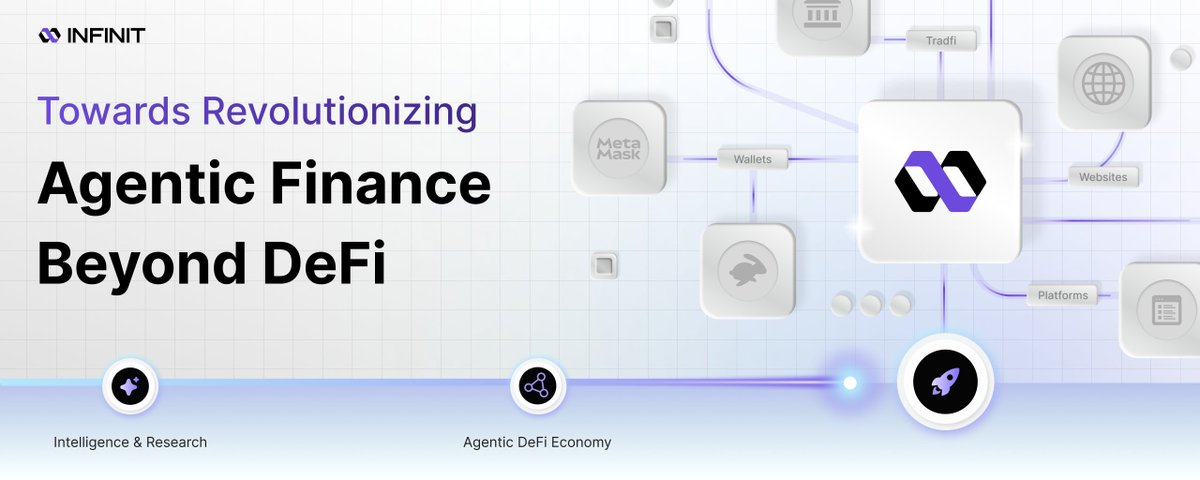
Dans l'approche traditionnelle, les utilisateurs doivent effectuer chaque étape manuellement, en supportant les risques d'erreurs, de slippage et de coûts de gas. INFINIT regroupe ces étapes en un flux de travail unifié que l'Agent IA coordonne automatiquement.
Avant l'exécution, le système lance une simulation de stratégie pour valider le chemin et signaler les risques potentiels — slippage, dangers de liquidation ou états de protocole anormaux. Ce n'est qu'après vérification que l'Agent soumet la transaction on-chain réelle.
INFINIT utilise une architecture non custodiale : la plateforme ne contrôle jamais directement les actifs des utilisateurs. L'Agent IA ne peut exécuter des trades que dans le cadre autorisé par l'utilisateur, réduisant ainsi les risques de garde centralisée.
Le rôle et la gouvernance du token IN
IN est le token central de l'écosystème INFINIT, servant à la gouvernance, aux incitations de l'écosystème et à la coordination des Agents.
Pour la gouvernance, les détenteurs d'IN peuvent voter sur les modifications des paramètres du protocole, les règles de déploiement des Agents et les propositions de l'écosystème. À mesure que la finance Agentic se développe, la gouvernance gagnera encore en importance.
IN pourrait également alimenter les incitations de l'écosystème. Certains services d'Agent, places de marché de stratégies ou fonctionnalités premium pourraient nécessiter IN pour y accéder ou pour payer. De plus, les revenus du protocole pourraient être liés aux détenteurs d'IN.
INFINIT vs. les agrégateurs DeFi traditionnels
Les agrégateurs DeFi traditionnels regroupent les points d'entrée des protocoles afin que les utilisateurs puissent effectuer diverses opérations depuis une seule interface. Néanmoins, les utilisateurs doivent généralement comprendre eux-mêmes la logique de la stratégie et la séquence d'exécution.
INFINIT va plus loin. Il agrège non seulement les protocoles, mais utilise également des Agents IA pour générer et exécuter automatiquement les stratégies. L'interaction utilisateur passe du « clic manuel » aux « invites en langage naturel ».
La différence clé entre INFINIT et les agrégateurs comme Instadapp réside dans la présence d'une « couche de stratégie intelligente ». Les agrégateurs traditionnels sont essentiellement des plateformes d'outils, tandis qu'INFINIT fonctionne davantage comme un système d'exploitation financier on-chain propulsé par l'IA.
| Dimension |
INFINIT |
Agrégateur DeFi traditionnel |
| Interaction utilisateur |
Invite en langage naturel |
Opération manuelle |
| Génération de stratégie |
Générée automatiquement par l'IA |
Conçue par l'utilisateur |
| Exécution multi-étapes |
Coordination automatisée |
L'utilisateur complète étape par étape |
| Capacité IA |
Collaboration multi-agents |
Généralement indisponible |
| Traitement des données |
Analyse dynamique en temps réel |
Agrégation statique de protocoles |
| Niveau d'automatisation |
Élevé |
Modéré |
Cas d'utilisation potentiels pour INFINIT
Alors que l'IA et la finance on-chain convergent, les applications d'INFINIT continuent de se développer.
Pour les utilisateurs particuliers, la plateforme prend en charge l'agrégation de rendement, le bouclage à effet de levier, la gestion d'actifs cross-chain et l'exécution de stratégies automatisées. Son principal avantage par rapport à la DeFi traditionnelle est une complexité réduite et une courbe d'apprentissage plus douce.
Pour les utilisateurs professionnels et les institutions, la finance Agentic peut s'étendre à l'allocation automatisée d'actifs, à la gestion des risques et à l'exécution de stratégies quantitatives. À l'avenir, les Agents IA pourraient devenir une infrastructure financière on-chain essentielle.
De plus, avec l'essor des écosystèmes cross-chain et des blockchains modulaires, les capacités de coordination des Agents IA à travers plusieurs chaînes pourraient devenir un avantage concurrentiel clé.
Résumé
En tant que projet phare dans la fusion des Agents IA et de la DeFi, INFINIT vise à réduire la complexité financière on-chain grâce à l'interaction en langage naturel et à un système de collaboration multi-agents.
Comparé aux agrégateurs DeFi traditionnels, INFINIT amplifie le rôle de l'IA dans la compréhension, la génération et l'exécution des stratégies. Il ne se contente pas d'agréger les points d'entrée des protocoles — il construit une couche d'opérations financières on-chain pilotée par l'IA.
FAQ
Que signifie le Prompt-to-DeFi d'INFINIT ?
Le Prompt-to-DeFi permet aux utilisateurs d'exprimer leurs besoins en langage naturel, et l'IA génère et exécute automatiquement la stratégie DeFi correspondante.
Est-ce qu'INFINIT conserve les actifs des utilisateurs ?
Non. INFINIT est non custodial — les actifs des utilisateurs restent toujours dans leurs propres portefeuilles, et la plateforme ne contrôle jamais les fonds directement.
En quoi INFINIT diffère-t-il des agrégateurs DeFi traditionnels ?
Les agrégateurs traditionnels regroupent principalement les points d'entrée des protocoles ; INFINIT va plus loin en utilisant des Agents IA pour générer, analyser et exécuter automatiquement des stratégies DeFi complexes.
À quoi sert le token IN ?
IN est principalement utilisé pour la gouvernance, les incitations de l'écosystème, la coordination des Agents et l'accès à certaines fonctionnalités du protocole.
Qu'est-ce que la finance Agentic ?
La finance Agentic est un nouveau modèle financier où les Agents IA participent aux activités on-chain, en utilisant le raisonnement automatisé et l'exécution pour aider les utilisateurs à réaliser des opérations DeFi complexes.