Modern computing systems rely not only on CPUs and GPUs for computation, but also on large amounts of memory chips for data reading, caching, and transmission. As large AI models, cloud computing, and high performance servers develop rapidly, the importance of high speed memory and enterprise storage continues to grow. As a result, the memory chip industry has gradually become an important part of AI infrastructure.
From an industry structure perspective, Micron, Samsung, and SK Hynix have long dominated the global DRAM and NAND markets. In the AI era in particular, high bandwidth memory, or HBM, has become an important component of GPUs and AI servers. As AI infrastructure expands, market attention on MU has continued to rise.

Source: micron.com
Micron mainly serves as a memory chip supplier within the global semiconductor value chain. Compared with NVIDIA, which focuses more on AI GPU computing chips, MU places greater emphasis on data storage and high speed memory systems. The two therefore play complementary roles in AI infrastructure.
From an industry positioning perspective, memory chips are essentially the data foundation layer of modern digital systems. CPUs and GPUs handle computation, while DRAM and NAND are responsible for data caching, temporary reading, and long term storage. Without high speed memory support, large scale AI models and data centers would struggle to operate reliably.
The global memory chip market is currently concentrated among a small number of large companies. Because DRAM and NAND production requires extremely high capital investment, advanced manufacturing processes, and long term technical accumulation, the industry has high barriers to entry. This structure also gives the memory chip industry clear long term cyclical characteristics.
DRAM and NAND are the two most important types of memory chips today, and they play clearly different roles in computing systems. DRAM focuses more on high speed data exchange, while NAND focuses more on long term data retention. As a result, both are usually present in servers, smartphones, and AI systems.
DRAM can be understood as the “working memory” of a computing system. When a CPU or GPU runs a program, it continuously calls on DRAM to complete high speed data reading. For example, during AI model training, large amounts of parameters and intermediate data are cached in DRAM.
NAND Flash is closer to a long term data warehouse. SSDs, smartphone storage, and enterprise hard drives rely heavily on NAND to store data. Compared with DRAM, NAND reads data more slowly, but it can retain data even after power is turned off, making it suitable for long term storage scenarios.
The table below shows the main differences among several major types of memory chips:
| Type | Core Function | Main Applications |
|---|---|---|
| DRAM | High speed system memory | GPUs, servers |
| NAND Flash | Long term data storage | SSDs, smartphones |
| HBM | High bandwidth, high speed memory | AI GPUs |
| Enterprise SSD | Data center storage | Cloud computing |
Structurally, Micron covers the DRAM, NAND, and HBM markets at the same time, so its business is affected by consumer electronics, servers, and AI markets simultaneously.
As a U.S. listed semiconductor company, MU (Micron Technology) can usually be traded through brokerage platforms that support U.S. stock trading. Under the traditional model, users generally access the U.S. stock market through overseas securities accounts and follow companies related to the semiconductor and AI value chains.
Recently, the China Securities Regulatory Commission further emphasized that overseas institutions must not illegally provide account opening and trading services within mainland China, while also setting a rectification period for existing business. As a result, some internet brokerage platforms have adjusted their U.S. stock related services, prompting more users to reassess U.S. stock trading channels and alternative trading methods.

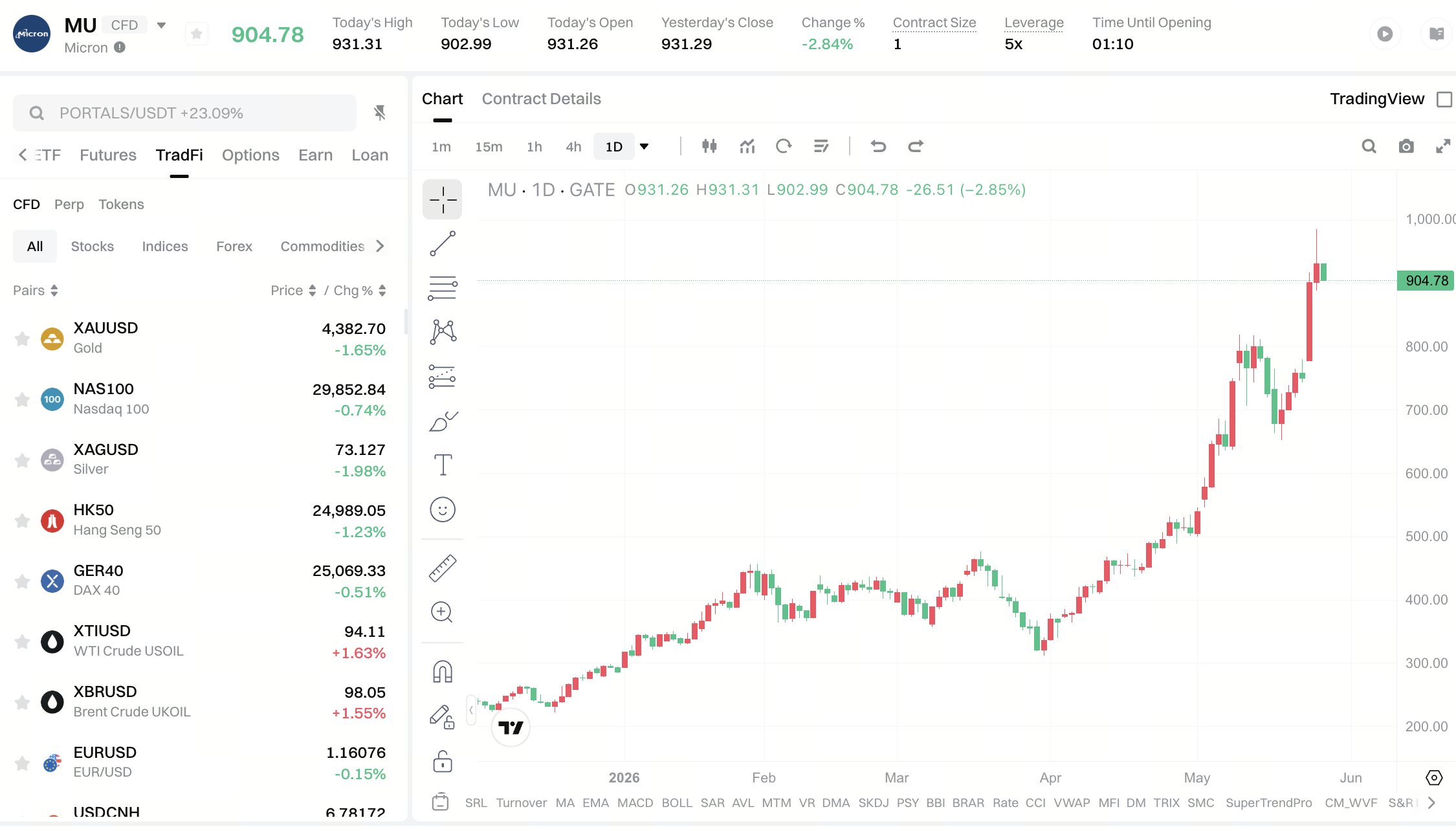
In addition to traditional securities accounts, some platforms have also begun offering U.S. stock related CFDs, synthetic assets, or on chain stock like products. The CFD model usually does not involve directly holding real shares. Instead, it tracks stock price changes through price contracts, so its trading structure differs in certain ways from traditional stocks.
At the same time, products such as Gate CFD, launched by Gate, are gradually expanding digital asset platforms’ coverage of U.S. stocks, ETFs, and global market assets. In addition to following the crypto asset market, users can also track selected overseas stock CFD products, including MU, on the same platform.
However, trading rules, leverage mechanisms, margin requirements, and regional restrictions can differ significantly across platforms. Before participating in these markets, it remains important to understand the product structure and risk mechanisms.
Micron’s core business essentially revolves around “memory chip design, wafer manufacturing, and enterprise sales.” Compared with ordinary electronics companies, memory chip companies are closer to high technology, capital intensive manufacturing systems.
First, Micron develops different types of memory chip architectures, including DRAM, NAND, and HBM. Then, wafer fabs use advanced semiconductor processes to manufacture the chips, which then move into packaging and testing. Finally, the products enter markets such as servers, smartphones, automotive electronics, and AI data centers.
Micron’s customers usually include large server manufacturers, cloud computing companies, consumer electronics companies, and businesses across the AI hardware value chain. Because AI GPUs and data centers require large amounts of high speed memory, server DRAM and HBM are gradually becoming important growth areas for Micron.
Unlike traditional manufacturing, the memory chip industry depends more heavily on technology iteration and capacity management. If market supply increases rapidly while end demand does not grow enough, chip prices usually fluctuate sharply, which makes the industry highly cyclical.
The development of large AI models is driving rapid growth in demand for HBM high bandwidth memory. Compared with traditional servers, AI GPUs need to continuously process massive amounts of data when training models, which creates much higher requirements for data reading speed and bandwidth.
Traditional DRAM can provide high speed caching, but the data throughput required for AI model training is far greater than that of ordinary computing tasks. As a result, GPUs need a memory system with higher bandwidth and lower latency. The core purpose of HBM is to improve data transmission efficiency between GPUs and memory.
Structurally, HBM is usually packaged more closely with the GPU. This shortens the data transmission distance and improves overall computing efficiency. As a result, demand for HBM from NVIDIA, AMD, and the AI server market continues to increase.
This trend means the expansion of AI infrastructure will not only drive growth in the GPU market, but also support rising demand for memory chip companies such as Micron.
In the AI infrastructure market, Micron mainly provides server DRAM, HBM, and enterprise SSD products. AI data centers need not only GPU computing power, but also large amounts of high speed memory and data storage systems.
AI model training usually consumes enormous data bandwidth, so servers need to continuously call on DRAM and HBM for data exchange. At the same time, enterprise SSDs are responsible for long term data storage and database management.
From the perspective of industry collaboration, GPU companies provide computing power, while memory chip companies such as Micron support data flow efficiency. AI data centers are therefore essentially a coordinated system of computing power and storage.
As global cloud computing and AI model scale continue to expand, the importance of high performance memory is also increasing. Micron is therefore gradually becoming an important part of the AI infrastructure value chain.
Micron’s semiconductor value chain mainly includes four parts: chip design, wafer manufacturing, packaging and testing, and end applications. Compared with ordinary software industries, the semiconductor industry depends much more on physical manufacturing capabilities and long term capital investment.
First, Micron completes the architecture design of its memory chips. Then, wafer fabs use advanced processes to manufacture the chips, and packaging and testing are used to verify product stability. Finally, the products enter markets such as servers, consumer electronics, automotive electronics, and AI systems.
The table below shows the main structure of Micron’s value chain:
| Stage | Main Role |
|---|---|
| Chip design | Memory architecture research and development |
| Wafer manufacturing | Chip production |
| Packaging and testing | Stability verification |
| End applications | AI, servers |
This structure means Micron is affected not only by end demand, but also by manufacturing costs, the equipment supply chain, and the global semiconductor cycle.
Micron, Samsung, and SK Hynix have long been among the world’s most important memory chip companies, while NVIDIA is a major player in the AI GPU market. As the AI market expands rapidly, cooperation between GPUs and high bandwidth memory is becoming increasingly important.
NVIDIA mainly provides GPU computing power, but AI GPUs require large amounts of high speed data exchange during operation, so HBM directly affects AI chip performance. Micron, Samsung, and SK Hynix are mainly responsible for providing HBM and server memory products.
From a market structure perspective, AI GPU companies and memory chip companies are not direct competitors. Instead, they work together within AI infrastructure. GPUs provide computing power, while HBM and DRAM support data flow efficiency.
Therefore, when the AI market expands, the GPU and high performance memory markets usually grow at the same time.
The memory chip industry has long had clear cyclical characteristics, so MU’s stock price usually fluctuates with changes in industry supply and demand. Compared with the software industry, memory chips are more easily affected by inventory, pricing, and changes in end demand.
When demand from servers, smartphones, and AI markets grows, DRAM and NAND prices usually rise, and corporate profitability improves at the same time. But if supply increases too quickly while end demand is insufficient, chip prices may fall rapidly.
Because the memory chip industry depends heavily on capacity and capital investment, inventory changes continue to affect the industry cycle. This is why MU is often viewed by the market as a typical semiconductor cyclical stock.
Although the AI market is driving growth in HBM demand, the DRAM and NAND markets themselves are still affected by the global electronics industry cycle.
Micron’s main risks include industry cycles, technology competition, and changes in the global supply chain. The memory chip industry requires long term investment in advanced processes and research and development, so capital expenditure is usually high.
At the same time, companies such as Samsung and SK Hynix have long competed in the global market, so shifts in market share continue to affect the industry structure. In particular, competition in high end markets such as HBM and advanced packaging is intensifying quickly.
Global trade policies, equipment restrictions, and geopolitics may also continue to affect the semiconductor value chain. Because semiconductors are a globalized industry, supply chain stability is very important for the memory chip sector.
In addition, if the expansion of AI infrastructure slows, demand in the high performance memory market may also be affected.
MU (Micron Technology) is one of the world’s most important memory chip companies. It mainly participates in the DRAM, NAND, and HBM high bandwidth memory markets and widely serves AI data centers, cloud computing, and the semiconductor value chain.
As demand for AI GPUs, servers, and high performance computing continues to grow, the importance of high speed memory is also rising. As a result, Micron is gradually becoming an important part of AI infrastructure.
However, the memory chip industry itself still has clear cyclical characteristics, so MU’s market performance is usually shaped by chip prices, inventory levels, end demand, and the global technology cycle.
MU is the stock ticker for Micron Technology. Micron is a large global memory chip company that mainly produces DRAM, NAND Flash, and HBM high bandwidth memory products.
DRAM is mainly used as high speed operating memory, while NAND focuses more on long term data storage. As a result, the two play clearly different roles in computing systems.
HBM high bandwidth memory improves GPU data transmission efficiency, so AI model training and AI data centers usually require large amounts of HBM products.
AI data centers require large amounts of server DRAM, HBM, and enterprise SSDs, so the expansion of AI infrastructure usually drives growth in memory chip demand.
The memory chip industry is strongly affected by supply and demand conditions and inventory changes, so chip price fluctuations usually affect MU’s earnings and market valuation.