L'industrie des semi-conducteurs a toujours été considérée comme un pilier essentiel du secteur technologique. Par conséquent, les fluctuations de la demande de puces IA, de GPU, de serveurs et de centres de données influencent directement les mouvements de l'indice des semi-conducteurs. La performance du cours de SOXS est également étroitement liée au cycle de l'industrie des puces.
Parce que SOXS est un ETF à effet de levier très volatil, sa performance dépend non seulement de la direction de l'indice, mais aussi du sentiment du marché, du rééquilibrage quotidien, de la volatilité et des flux de capitaux à court terme. SOXS est davantage conçu comme un instrument de trading à court terme que comme un actif de placement à long terme.
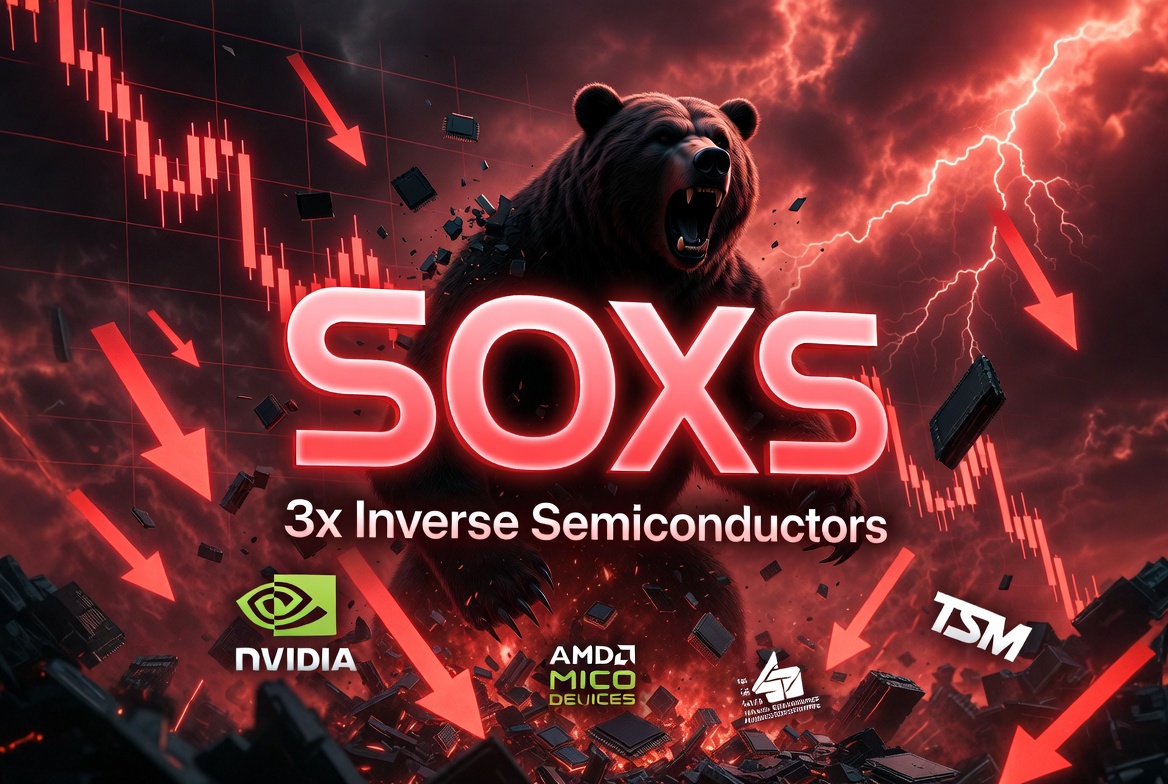
Qu'est-ce que SOXS (ETF triple short sur les semi-conducteurs) ?
SOXS est conçu pour amplifier les rendements quotidiens lors des baisses de l'indice des semi-conducteurs. Il suit généralement un indice lié aux semi-conducteurs et vise un rendement quotidien triple inverse.
Structurellement, SOXS ne vend pas directement à découvert des entreprises individuelles de puces. Il construit plutôt une exposition courte via des contrats de swap, des futures et d'autres produits dérivés. Lorsque le secteur des semi-conducteurs baisse, SOXS augmente théoriquement.
Son objectif principal est de fournir trois fois le rendement quotidien inverse de l'indice des semi-conducteurs. Ainsi, si l'indice baisse de 1 % en une journée, SOXS peut enregistrer un gain d'environ 3 %.
Cette structure implique que SOXS privilégie la volatilité du marché à court terme plutôt que le holding à long terme. Comme les rendements quotidiens sont recalculés, la valeur nette d'actifs à long terme peut diverger des attentes intuitives des utilisateurs.
Pourquoi SOXS évolue-t-il en sens inverse de l'indice des semi-conducteurs ?
La relation inverse découle de la structure de rendement court de l'ETF.
Les indices de semi-conducteurs sont généralement composés des principales entreprises de puces, y compris les fabricants de GPU, de CPU, de wafers et d'équipements pour semi-conducteurs. Par conséquent, la demande de puces IA, les marchés de serveurs et les cycles technologiques influencent tous la performance de l'indice.
D'abord, lorsque le secteur des semi-conducteurs baisse, la structure de produits dérivés inverses de SOXS génère simultanément des rendements. Plus la baisse de l'indice est forte, plus le gain théorique de SOXS est marqué.
Ensuite, le gestionnaire du fonds utilise des produits dérivés pour maintenir le ratio d'effet de levier cible. Plus les variations du marché sont importantes, plus le rééquilibrage est fréquent.
De plus, la panique du marché peut amplifier les flux de capitaux. Lors d'un repli technologique majeur, le volume de transactions de SOXS augmente souvent.
Finalement, le cours de SOXS présente une corrélation inverse nette avec l'indice des semi-conducteurs.
Le triple effet de levier de SOXS est une structure financière qui amplifie le rendement quotidien de l'indice.
D'abord, le fonds utilise des produits dérivés pour créer une exposition au marché supérieure à sa valeur nette d'actifs. Cet effet de levier amplifie les fluctuations du marché.
Lorsque l'indice des semi-conducteurs baisse, les rendements inverses de SOXS augmentent proportionnellement. Plus la baisse est forte, plus le gain théorique est important.
Le tableau ci-dessous illustre la structure de rendement théorique de SOXS :
| Variation quotidienne de l'indice des semi-conducteurs |
Variation théorique de SOXS |
| -1 % |
3 % |
| -2 % |
6 % |
| +1 % |
-3 % |
| +2 % |
-6 % |
Cette structure amplifie à la fois les rendements et les risques.
D'un point de vue trading, SOXS est plus adapté aux marchés à cycles courts et à forte volatilité qu'aux positions de tendance long terme.
Que signifie le mécanisme de rééquilibrage quotidien de SOXS ?
Le rééquilibrage quotidien remodèle en permanence la valeur nette d'actifs à long terme de l'ETF.
D'abord, SOXS vise un rendement triple inverse « quotidien », et non un rendement cumulé à long terme. Le fonds doit donc ajuster son effet de levier chaque jour.
Après la clôture du marché, le fonds recalcule les actifs nets et les positions en produits dérivés. Plus la volatilité de l'indice est élevée, plus la pression de rééquilibrage est forte.
Dans un marché instable, un écart de composition peut se produire. Même si l'indice reste stable dans le temps, la valeur nette d'actifs de SOXS peut s'éroder progressivement.
C'est ce qu'on appelle l'érosion due à la volatilité. Dans des environnements de forte volatilité, la valeur nette d'actifs des ETF à effet de levier s'écarte souvent des attentes intuitives.
Ainsi, SOXS convient au trading de risque à court terme, mais pas à la répartition des actifs à long terme.
Quelles sont les différences entre SOXS et les ETF de semi-conducteurs classiques ?
Les différences principales résident dans la direction du rendement et la structure de risque.
Les ETF de semi-conducteurs classiques suivent la croissance à long terme de l'industrie des puces. L'essor de l'IA, des serveurs et des semi-conducteurs les pousse généralement à la hausse.
SOXS, en revanche, est un ETF inverse à effet de levier. Lorsque le secteur des semi-conducteurs baisse, SOXS génère des rendements amplifiés.
Le tableau ci-dessous met en évidence les principales différences :
| Type |
ETF de semi-conducteurs classique |
SOXS |
| Direction du rendement |
Positive |
Inverse |
| Structure d'effet de levier |
Aucune |
Triple |
| Niveau de risque |
Moyen |
Élevé |
| Utilisation principale |
Allocation à long terme |
Trading à court terme |
Cette structure implique que SOXS se concentre sur le trading de volatilité et la couverture des risques.
Pourquoi la structure de risque de SOXS est-elle plus élevée que celle des ETF traditionnels ?
SOXS comporte un risque plus élevé en raison de la combinaison de l'effet de levier, des rendements inverses et d'un secteur très volatil.
L'industrie des semi-conducteurs est intrinsèquement cyclique. Le boom de l'IA, les variations de stocks de puces et la demande technologique mondiale génèrent tous de la volatilité.
D'abord, le triple effet de levier amplifie les mouvements du marché. Même une légère hausse de l'indice peut entraîner des pertes importantes pour SOXS.
Ensuite, le rééquilibrage quotidien peut éroder la valeur nette d'actifs à long terme. Dans des marchés volatils à haute fréquence, la valeur nette d'actifs de SOXS peut diminuer progressivement.
De plus, la panique du marché amplifie les fluctuations de cours. Les flux de capitaux rapides font que la volatilité de SOXS dépasse nettement celle des ETF classiques.
Cette structure rend SOXS approprié uniquement pour le trading à court terme avec une tolérance au risque élevée.
Scénarios d'utilisation de SOXS lors des baisses du secteur des semi-conducteurs
SOXS est généralement utilisé lors des replis des puces, sur des marchés à forte volatilité et pour la couverture des risques technologiques.
Certains traders couvrent le risque des actions de semi-conducteurs avec SOXS. Lorsque les actions de puces IA ou de GPU chutent fortement, SOXS peut théoriquement générer des rendements inverses.
Le trading de volatilité à court terme constitue une autre utilisation clé. Pendant les phases technologiques de forte volatilité, l'élasticité du cours de SOXS augmente souvent de manière significative.
Les traders institutionnels utilisent également SOXS pour gérer leur exposition au marché. Lorsque le secteur des semi-conducteurs entre en correction, le volume de transactions de SOXS augmente généralement.
Parallèlement, certaines plateformes multi-actifs proposent désormais des produits CFD liés à des ETF d'actions américaines. Des produits comme Gate CFD de Gate élargissent la couverture des ETF étrangers et des actifs à effet de levier sur les plateformes d'actifs numériques.
Cependant, il est important de noter que SOXS est déjà un ETF à effet de levier très volatil. Le combiner avec l'effet de levier des CFD augmente encore le risque global.
SOXS, en tant qu'ETF inverse à effet de levier du marché américain, peut généralement être négocié sur des plateformes de titres prenant en charge les actions américaines. Traditionnellement, les utilisateurs accèdent à ces ETF via des comptes de titres étrangers.
Récemment, la Commission chinoise de régulation des valeurs mobilières a réitéré que les institutions étrangères ne peuvent pas proposer illégalement des services d'ouverture de compte et de trading en Chine, et a poussé à la rectification des activités existantes. Cela a conduit certaines plateformes de courtage en ligne à ajuster leurs offres d'actions américaines.
Ce changement a incité de nombreux utilisateurs à explorer d'autres canaux pour les ETF d'actions américaines. Au-delà des comptes traditionnels, certaines plateformes proposent désormais des CFD sur actions, des CFD sur ETF ou des produits dérivés on-chain.
Le modèle CFD n'implique pas la détention directe de l'ETF réel ; il suit plutôt les mouvements de cours via des contrats. Certaines plateformes d'actifs numériques ont également commencé à étendre leurs services liés aux ETF d'actions américaines.
Par exemple, Gate CFD de Gate élargit progressivement la couverture des ETF étrangers et des actifs des marchés mondiaux sur les plateformes d'actifs numériques. Les utilisateurs peuvent désormais accéder à des produits dérivés d'ETF étrangers comme SOXS en plus des actifs crypto.
Néanmoins, il est crucial de se rappeler que les ETF à effet de levier présentent déjà une volatilité élevée. Les combiner avec des CFD ou un effet de levier supplémentaire amplifie encore le risque de marché.
Résumé
SOXS est un ETF à effet de levier qui suit un rendement quotidien triple inverse de l'indice des semi-conducteurs. Il est principalement utilisé pour le trading de repli du secteur des puces, la couverture des risques de marché et la gestion de la volatilité à court terme.
Sa structure principale repose sur des rendements inverses, l'amplification par effet de levier et le rééquilibrage quotidien, ce qui le rend plus risqué que les ETF classiques.
Compte tenu de la volatilité inhérente à l'industrie des semi-conducteurs, SOXS est mieux adapté au trading à cycles courts qu'à la répartition des actifs à long terme.
FAQ
Qu'est-ce que SOXS ?
SOXS est un ETF inverse à triple effet de levier sur les semi-conducteurs qui vise à fournir trois fois le rendement quotidien inverse de l'indice des semi-conducteurs.
Pourquoi SOXS augmente-t-il lorsque les actions de puces baissent ?
SOXS utilise des produits dérivés financiers pour construire une position short sur l'indice. Lorsque l'indice des semi-conducteurs baisse, SOXS augmente théoriquement.
Que signifie le triple effet de levier de SOXS ?
Le triple effet de levier signifie que si l'indice des semi-conducteurs baisse de 1 % en une journée, SOXS peut théoriquement gagner environ 3 %.
Pourquoi SOXS n'est-il pas adapté à une détention à long terme ?
Le rééquilibrage quotidien et l'écart de composition peuvent entraîner une érosion de la valeur nette d'actifs à long terme, en particulier dans des environnements de forte volatilité.
Quelle est la différence entre SOXS et un ETF de semi-conducteurs classique ?
Un ETF de semi-conducteurs classique suit la croissance à long terme de l'industrie, tandis que SOXS est un outil de trading inverse à effet de levier à court terme.