2026 MOODENG Price Prediction: In-Depth Data and Latest Market Dynamics Explained

Beginner
Quick Reads
Last Updated 2026-03-25 19:06:56
Reading Time: 1m
A comprehensive and objective review of MOODENG's 2026 price outlook, covering current market dynamics, technical analysis, and institutional opinions. This piece explores the potential for MOODENG to rebound, break out, or decline during 2026.

What Is MOODENG?


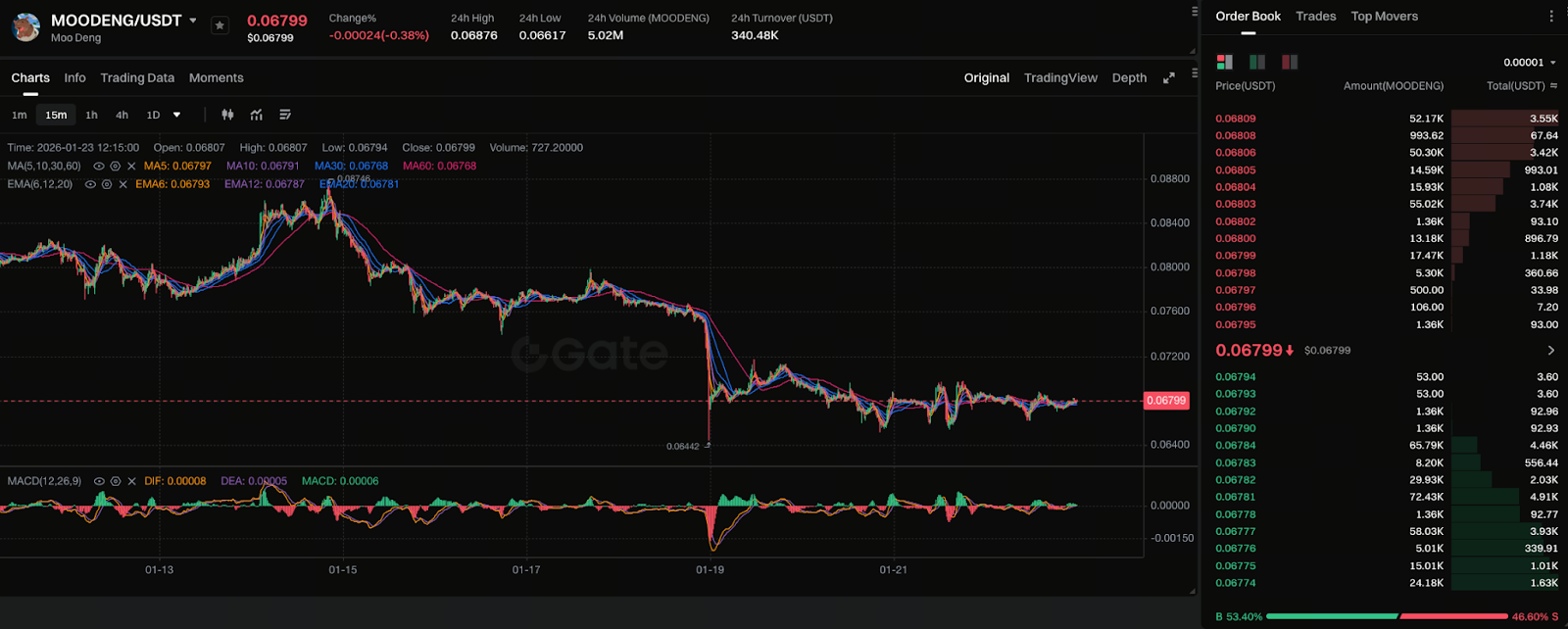
Image: https://www.gate.com/trade/MOODENG_USDT

MOODENG, also known as Moo Deng, is a meme coin built on Solana, featuring a red baby hippo as its mascot. Launched in September 2024, it quickly gained traction within the community. Unlike many purely entertainment-focused tokens, MOODENG claims to integrate charitable elements, aiming to connect community culture with broader social values.

Like most meme coins, MOODENG does not have a clear cash flow or revenue model. Its price is mainly influenced by market sentiment, social media buzz, liquidity events such as exchange listings, and overall market conditions.

2025–2026 Price Performance Review

Historical data indicates that MOODENG experienced significant volatility from late 2024 through early 2025. At times, the price surged sharply following exchange listings. Conversely, it pulled back after rumor clarifications or when technical indicators signaled an overbought condition.

According to the latest CoinMarketCap AI market update, MOODENG saw dramatic price swings from mid-2025 to early 2026. The price jumped 250% on false news before quickly retreating, underscoring the token’s strong sensitivity to sentiment.

2026 MOODENG Price Forecast Models

Market forecasts for MOODENG vary widely:

Conservative Forecast

Certain tools using technical indicators and medium- to short-term trends predict that MOODENG may remain near current lows in 2026 or see a slow upward trend, with limited annual volatility.

Neutral to Optimistic Forecast

Some external models suggest MOODENG could experience a modest rebound or even reach higher price levels in 2026—potentially peaking mid-year. However, these projections often rely on historical cycles and sentiment-driven analysis.

It’s important to note that predictions can vary significantly due to differences in modeling approaches and assumptions. Investors should compare multiple perspectives and exercise caution.

Key Drivers: Fundamentals and Market Sentiment

Listings on Multiple Exchanges

MOODENG has experienced short-term price surges and increased liquidity following listings on major exchanges. These events often act as catalysts for price movement in the short run.

Community and Social Media Momentum

As a meme coin, MOODENG’s price is highly sensitive to activity on social platforms and trending discussions. Notably, price spikes have coincided with surges in community engagement.

Technical Indicators and Market Sentiment

Technical analysis shows that MOODENG sometimes enters overbought zones, followed by sharp, volatile corrections. Both technical and sentiment indicators—such as the Fear & Greed Index—point to the difficulty in forecasting price movements.

Risk Warning: Volatility and Regulatory Factors

While meme coins may see rapid appreciation during bull markets, they remain extremely volatile and lack strong fundamental support. Regulatory changes also pose significant risks—authorities may classify such assets as high-risk speculative products, and your capital could face sharp drawdowns at any time.

How Should Investors Approach MOODENG’s 2026 Outlook?

If you are a long-term investor, consider the following:

  • Do not rely on a single prediction model—assess both fundamentals and community sentiment.
  • For meme coins, implement robust risk management, including stop-losses and position sizing.
  • Monitor exchange activity and on-chain data closely, such as the number of wallet addresses and trading volume trends.

Summary

In summary, there is no single figure that can represent the “2026 MOODENG Price Prediction.” MOODENG’s price is primarily driven by market sentiment, on-chain activity, and macroeconomic conditions. Different models provide varying outlooks, but all highlight the asset’s high-risk nature. Given its volatility, investors should carefully evaluate their decisions.

Author: Max
Disclaimer
* The information is not intended to be and does not constitute financial advice or any other recommendation of any sort offered or endorsed by Gate.
* This article may not be reproduced, transmitted or copied without referencing Gate. Contravention is an infringement of Copyright Act and may be subject to legal action.

Related Articles

What is Fartcoin? All You Need to Know About FARTCOIN
Intermediate

What is Fartcoin? All You Need to Know About FARTCOIN

Fartcoin (FARTCOIN) is a representative meme coin within the Solana ecosystem based on an AI-driven narrative. Its core concept originated from an experiment aimed at exploring the "boundaries between AI Agents and humor." More than just a digital asset with social attributes, the project deeply couples absurd humor culture with on-chain financial logic by integrating autonomous AI interaction models.
2026-04-04 22:01:19
Gold Price Forecast for the Next Five Years: 2026–2030 Trend Outlook and Investment Implications, Could It Reach $6,000?
Beginner

Gold Price Forecast for the Next Five Years: 2026–2030 Trend Outlook and Investment Implications, Could It Reach $6,000?

Analyze current gold price trends alongside authoritative five-year forecasts, integrating an evaluation of market risks and opportunities. This gives investors insight into the potential trajectory of gold prices and the main drivers expected to shape the market over the next five years.
2026-03-25 18:13:30
Aster vs Hyperliquid: Which Perp DEX Will Prevail?
Beginner

Aster vs Hyperliquid: Which Perp DEX Will Prevail?

Aster and Hyperliquid are the two representative protocols of the "purpose-built L1 path" within the current decentralized perpetual exchange (Perp DEX) sector. As a pioneer in the field, Hyperliquid has built a deep liquidity moat through its highly mature order book architecture and strong community consensus. Conversely, Aster, as a rising challenger, seeks to leapfrog the competition in high-performance trading through more aggressive multi-chain aggregation logic, private transaction modules, and an underlying execution environment optimized for 2026 market demands.
2026-03-24 11:58:33
AI-Native Settlement Layers: How United Stables Is Building the Next Financial Rail
Beginner

AI-Native Settlement Layers: How United Stables Is Building the Next Financial Rail

Stablecoins were originally designed as dollar substitutes within exchanges, primarily used for asset pricing and trade settlement. As on-chain financial ecosystems have matured, their role has expanded beyond simple payments to include collateral assets, cross-chain liquidity mediums, and unified settlement units. In particular, as AI systems and automated agents begin to participate directly in economic activity, demand has risen sharply for programmable value units capable of instant settlement. This shift is pushing stablecoins toward the role of foundational financial infrastructure.
2026-03-25 03:16:17
ASTER Tokenomics: Buybacks, Burns, and Staking as the Value Foundation of ASTER in 2026
Beginner

ASTER Tokenomics: Buybacks, Burns, and Staking as the Value Foundation of ASTER in 2026

ASTER is the native equity and governance token of the Aster ecosystem, with its core value built upon a radical "Deflationary Engine." Beyond serving as a governance tool, ASTER integrates multiple utilities including staking rewards, trading fee discounts, and liquidity incentives. Through its deep integration with the upcoming dedicated Layer 1 mainnet, it enables direct value capture from protocol cash flow to token holders.
2026-03-25 07:38:07
Hybrid Collateral Stablecoins: Inside United Stables' Stability and Yield Architecture
Beginner

Hybrid Collateral Stablecoins: Inside United Stables' Stability and Yield Architecture

In the early stages of the crypto market, traditional stablecoins mainly relied on single-reserve or single-collateral models. Their primary focus was price stability and payment convenience, which allowed them to become foundational tools for on-chain trading and capital flows. As the market has entered a more mature financial phase, however, this structure has begun to reveal limitations, including high concentration risk and the difficulty of balancing liquidity with yield. These constraints have driven the evolution toward multi-layer collateral and portfolio-based designs, such as the dual-layer hybrid collateral architecture proposed by United Stables, which seeks to redefine the underlying logic of stable assets.
2026-03-25 03:17:39