Bitcoin Pulls Back from $98,000 to $86,100: Cooling Momentum and Key Support Analysis

Last Updated 2026-03-25 17:24:15
Reading Time: 1m
Bitcoin surged to a peak of $98,000 before rapidly pulling back to $86,100, marking a noticeable slowdown in market momentum. This article offers an objective analysis of the factors driving the retracement, identifies critical support levels, and examines potential future trends.

Bitcoin Surges to $98,000: Uptrend Drivers and Market Context
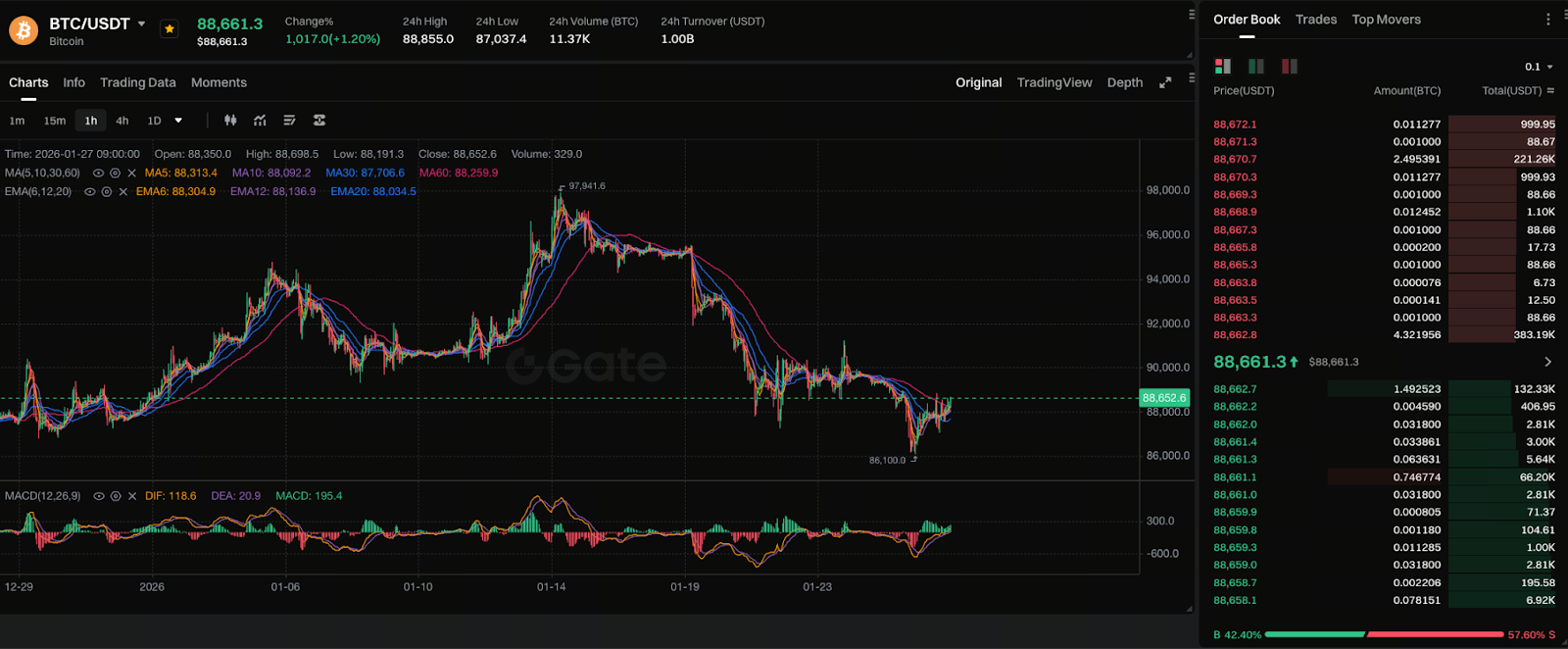

Chart: https://www.gate.com/trade/BTC_USDT

In early 2026, Bitcoin briefly hit $98,000, coming close to the highly anticipated $100,000 level. Several core factors fueled this rally:

  • Ongoing inflows from Bitcoin ETFs
  • Rising market risk appetite
  • Notable increases in on-chain active addresses and transaction volume
  • Technical breakout that attracted momentum traders

As Bitcoin approached this major psychological threshold, profit-taking became increasingly evident across the market.

Market Reversal: BTC Pulls Back to $86,100

After failing to sustain its highs, BTC saw a rapid decline, dropping to $86,100 over the past 24 hours—a new low for this correction cycle.

This level closely aligns with a previously watched short-term support zone, signaling that market momentum has shifted from “strongly bullish” to “neutral-to-weak.”

Pullback Drivers: Liquidations, Weak Volume, and Macro Risks

Bitcoin’s drop from $98,000 to $86,100 was not driven by a single factor, but resulted from a combination of several pressure points forming a multi-layered correction.

1. Liquidation Cascade Exacerbated the Selloff

The $94,000–$90,000 range saw the highest concentration of leveraged long positions in recent days. As prices fell, a chain reaction of liquidations accelerated the decline.

2. Low Trading Volume Weakened the Rally

As Bitcoin pushed toward $98,000, trading volume failed to expand, signaling insufficient bullish momentum and a lack of fresh capital entering the market.

3. Macro Headwinds Sparked Risk-Off Sentiment

Recent hawkish shifts in US policy put short-term pressure on global risk assets, naturally impacting Bitcoin’s price to the downside.

Technical Structure: Trendlines, Volume, and RSI

From a technical standpoint, the current correction shows clear structural signals:

Trendline: Break Below Short-Term Uptrend Channel

BTC has fallen below the uptrend line established since $82,000, undermining the short-term bullish structure.

RSI: Retreat from Overbought to Neutral

The RSI, which exceeded 70 at the peak, has now dropped to the 50–55 range, highlighting a clear loss of upside momentum.

Volume: Elevated Selling Volume Intensifies Pressure

Trading volume during the decline outpaced that of the prior rally, indicating that sellers are firmly in control.

Three Key Support Levels: $86,000, $84,000, $80,000

BTC is now approaching the first critical support level:

1. $86,000 (Current Support)

Bitcoin is consolidating in this range. If it stabilizes here, a short-term rebound toward $90,000 is possible.

2. $84,000 (Strong Support)

If $86,000 fails, $84,000 will be the next key level to watch.

3. $80,000 (Core Psychological Level)

If $84,000 is breached, the market is likely to test the critical $80,000 psychological threshold.

Market Outlook: Rebound, Range-Bound, or Deeper Correction?

BTC could follow one of three main scenarios in the near term:

Range-Bound Consolidation (Most Likely)

Bitcoin may trade sideways between $86,000 and $88,000, forming a new price-volume equilibrium.

Breaks $86,000, Weak US Equities → Tests $84,000 or $80,000

Continued macro headwinds would raise the risk of further downside.

Stabilization and Rebound: Retesting $90,000–$95,000

This outcome depends on another wave of strong ETF inflows.

Investor Strategy Recommendations (Long-Term / Short-Term)

Long-Term Investors

  • Monitor the $80,000–$86,000 range
  • Avoid emotional trading decisions
  • No need for holders to panic sell

Short-Term Traders

  • Set strict stop-loss orders
  • Avoid heavy positions in high-volatility zones
  • Consider swing trading on rebounds toward $89,000–$90,000
Author: Max
Disclaimer
* The information is not intended to be and does not constitute financial advice or any other recommendation of any sort offered or endorsed by Gate.
* This article may not be reproduced, transmitted or copied without referencing Gate. Contravention is an infringement of Copyright Act and may be subject to legal action.

Related Articles

What is Fartcoin? All You Need to Know About FARTCOIN
Intermediate

What is Fartcoin? All You Need to Know About FARTCOIN

Fartcoin (FARTCOIN) is a representative meme coin within the Solana ecosystem based on an AI-driven narrative. Its core concept originated from an experiment aimed at exploring the "boundaries between AI Agents and humor." More than just a digital asset with social attributes, the project deeply couples absurd humor culture with on-chain financial logic by integrating autonomous AI interaction models.
2026-04-04 22:01:19
Gold Price Forecast for the Next Five Years: 2026–2030 Trend Outlook and Investment Implications, Could It Reach $6,000?
Beginner

Gold Price Forecast for the Next Five Years: 2026–2030 Trend Outlook and Investment Implications, Could It Reach $6,000?

Analyze current gold price trends alongside authoritative five-year forecasts, integrating an evaluation of market risks and opportunities. This gives investors insight into the potential trajectory of gold prices and the main drivers expected to shape the market over the next five years.
2026-03-25 18:13:30
Aster vs Hyperliquid: Which Perp DEX Will Prevail?
Beginner

Aster vs Hyperliquid: Which Perp DEX Will Prevail?

Aster and Hyperliquid are the two representative protocols of the "purpose-built L1 path" within the current decentralized perpetual exchange (Perp DEX) sector. As a pioneer in the field, Hyperliquid has built a deep liquidity moat through its highly mature order book architecture and strong community consensus. Conversely, Aster, as a rising challenger, seeks to leapfrog the competition in high-performance trading through more aggressive multi-chain aggregation logic, private transaction modules, and an underlying execution environment optimized for 2026 market demands.
2026-03-24 11:58:33
AI-Native Settlement Layers: How United Stables Is Building the Next Financial Rail
Beginner

AI-Native Settlement Layers: How United Stables Is Building the Next Financial Rail

Stablecoins were originally designed as dollar substitutes within exchanges, primarily used for asset pricing and trade settlement. As on-chain financial ecosystems have matured, their role has expanded beyond simple payments to include collateral assets, cross-chain liquidity mediums, and unified settlement units. In particular, as AI systems and automated agents begin to participate directly in economic activity, demand has risen sharply for programmable value units capable of instant settlement. This shift is pushing stablecoins toward the role of foundational financial infrastructure.
2026-03-25 03:16:17
ASTER Tokenomics: Buybacks, Burns, and Staking as the Value Foundation of ASTER in 2026
Beginner

ASTER Tokenomics: Buybacks, Burns, and Staking as the Value Foundation of ASTER in 2026

ASTER is the native equity and governance token of the Aster ecosystem, with its core value built upon a radical "Deflationary Engine." Beyond serving as a governance tool, ASTER integrates multiple utilities including staking rewards, trading fee discounts, and liquidity incentives. Through its deep integration with the upcoming dedicated Layer 1 mainnet, it enables direct value capture from protocol cash flow to token holders.
2026-03-25 07:38:07
Hybrid Collateral Stablecoins: Inside United Stables' Stability and Yield Architecture
Beginner

Hybrid Collateral Stablecoins: Inside United Stables' Stability and Yield Architecture

In the early stages of the crypto market, traditional stablecoins mainly relied on single-reserve or single-collateral models. Their primary focus was price stability and payment convenience, which allowed them to become foundational tools for on-chain trading and capital flows. As the market has entered a more mature financial phase, however, this structure has begun to reveal limitations, including high concentration risk and the difficulty of balancing liquidity with yield. These constraints have driven the evolution toward multi-layer collateral and portfolio-based designs, such as the dual-layer hybrid collateral architecture proposed by United Stables, which seeks to redefine the underlying logic of stable assets.
2026-03-25 03:17:39