In a multi-virtual-machine network, computation, data interaction, and state updates between different execution environments all consume resources. A unified medium of value is therefore needed for pricing and incentive distribution. BLEND is designed precisely to solve this problem, allowing complex execution logic to be effectively coordinated through an economic model.
This issue usually involves three layers: fee mechanisms, incentive distribution, and governance structure. Together, these elements form BLEND’s functional system within the Fluent ecosystem.
What Is the BLEND Token?
BLEND can be understood as the native utility asset of the Fluent network. Its core function is to connect the execution layer with the economic layer.
At the mechanism level, BLEND is used to pay transaction fees, participate in governance decisions, and distribute network incentives. Every computation that takes place on Fluent, whether it is single-virtual-machine execution or a cross-virtual-machine call, is settled in value through this token.
Structurally, BLEND does more than serve as gas. It also supports value transfer and system coordination, allowing different execution modules to operate within a unified economic framework.
The significance of this design is that Fluent’s Blended Execution architecture can price resources through a single token, thereby improving overall system efficiency.
How BLEND Is Used for Transaction Fees
The fee mechanism is the most fundamental use of BLEND.
At the mechanism level, when users initiate transactions or execute smart contracts on the Fluent network, they need to pay fees in BLEND. These fees correspond to the costs generated by computing resources, storage operations, and cross-virtual-machine calls.
Structurally, because Fluent supports coordinated execution across multiple virtual machines, the complexity of different operations can vary significantly. As a result, the fee model needs to reflect the execution path and the resources consumed. For example, cross-VM calls are usually more complex than single-VM execution, so they cost more.
The significance of this mechanism is that it regulates resource usage through dynamic fees, allowing the network to remain stable in a complex execution environment while preventing resource abuse.
How the Incentive Mechanism Drives the Fluent Network
The incentive mechanism determines whether the network can continue operating sustainably.
At the mechanism level, BLEND is used to reward execution nodes, validation participants, and ecosystem contributors. These rewards come from transaction fees and preset incentive pools, compensating participants for the computing and verification services they provide.
Structurally, Fluent’s multi-virtual-machine architecture means that different nodes take on different responsibilities, so incentive distribution must match each role’s function. For example, execution nodes are responsible for computation, while validation nodes are responsible for checking results.
| Participant Role |
Incentive Source |
| Execution nodes |
Transaction fees |
| Validation nodes |
Network rewards |
| Developers |
Ecosystem incentives |
| User participants |
Airdrops and rewards |
The significance of this mechanism is that economic returns attract participants, helping maintain network security and execution efficiency.
What Role Does BLEND Play in Governance?
The governance mechanism gives the token decision-making power.
At the mechanism level, BLEND holders can participate in protocol governance, including decisions on network parameter adjustments, resource allocation, and ecosystem development direction. This is usually carried out through on-chain voting.
Structurally, governance rights are linked to token holdings, allowing participants to influence the network’s path of evolution through their holdings. This mechanism enables the system to make dynamic adjustments in a decentralized environment.
The significance of this design is that Fluent can remain open while still gaining the ability to evolve on its own.
How Are BLEND’s Total Supply and Allocation Mechanism Designed?
BLEND’s supply structure has been clearly disclosed by official sources. Its total supply is 1 billion tokens, distributed through a multi-tier allocation mechanism to support network development and ecosystem expansion.
At the mechanism level, token allocation is organized around ecosystem growth, core contributors, and market circulation. Ecosystem incentives account for the largest share, reflecting that the network sees developer and application growth as its main driving force.
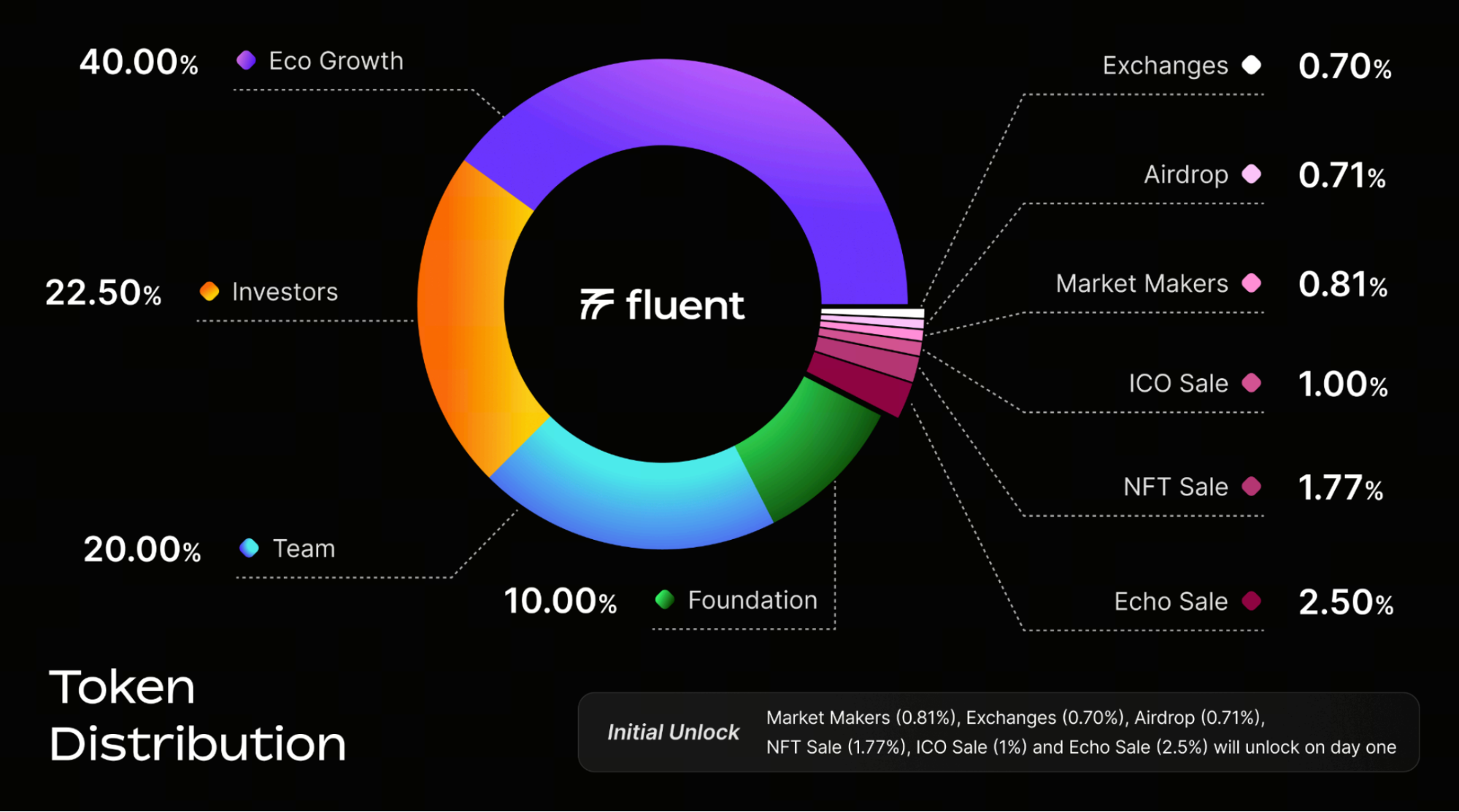
Structurally, BLEND’s allocation follows a layered design:
| BLEND Allocation Category |
BLEND Share |
| Ecosystem Growth |
40.00% |
| Investors |
22.50% |
| Team |
20.00% |
| Foundation |
10.00% |
| Echo Sale |
2.50% |
| NFT Sale |
1.77% |
| ICO Sale |
1.00% |
| Market Makers |
0.81% |
| Airdrop |
0.71% |
| Exchanges |
0.70% |
Overall, ecosystem growth takes the largest share and is used to support developers and application expansion. The team and investor allocations are also relatively high, helping sustain long-term development. Circulation-related allocations are smaller and are used to support the early market and liquidity.
The significance of this structure is that, by controlling initial circulation and strengthening ecosystem incentives, Fluent can gradually build network effects under its multi-virtual-machine execution system.
What Are BLEND’s Use Cases in the Ecosystem?
Use cases determine the token’s practical value.
At the mechanism level, BLEND can be used to pay execution fees, participate in governance, receive ecosystem incentives, and interact with the network. In a multi-virtual-machine environment, these scenarios often involve complex cross-execution paths.
Structurally, BLEND’s flow within the ecosystem connects users, contracts, and infrastructure, allowing different modules to form coordinated relationships. For example, in cross-VM applications, the token may be consumed and distributed across multiple execution stages.
The significance of this design is that BLEND has multiple uses within the network, improving overall usage efficiency and value-bearing capacity.
Summary
Through fee payments, incentive distribution, and governance participation, BLEND builds the economic foundation of the Fluent network, allowing its multi-virtual-machine execution system to operate within a unified value framework.
FAQ
What Is the Core Use of the BLEND Token?
It is used to pay transaction fees, incentivize node participation, and participate in protocol governance.
Is BLEND Used for All Execution Operations?
Yes. All computation and interaction activities are priced in value through BLEND.
What Is BLEND’s Total Supply?
The total supply is 1 billion tokens, distributed through a multi-tier structure.
Which Category Receives the Largest BLEND Allocation?
Ecosystem growth receives the largest allocation at 40%, and is used to drive network expansion.
What Is BLEND’s Core Value in Fluent?
As a unified medium of value, it connects the execution layer with the incentive mechanism, enabling the network to form a sustainable economic system.







