Ethereum Price Outlook: Will ETH Retest the $4,000 Support?

Beginner
Quick Reads
Last Updated 2026-03-28 19:30:41
Reading Time: 1m
The ETH funding rate has recently shifted into negative territory, intensifying capital outflows. The price continues to test the $4,000 psychological level. This analysis offers a concise overview of the current landscape and potential market directions.

1. Recent Market Review
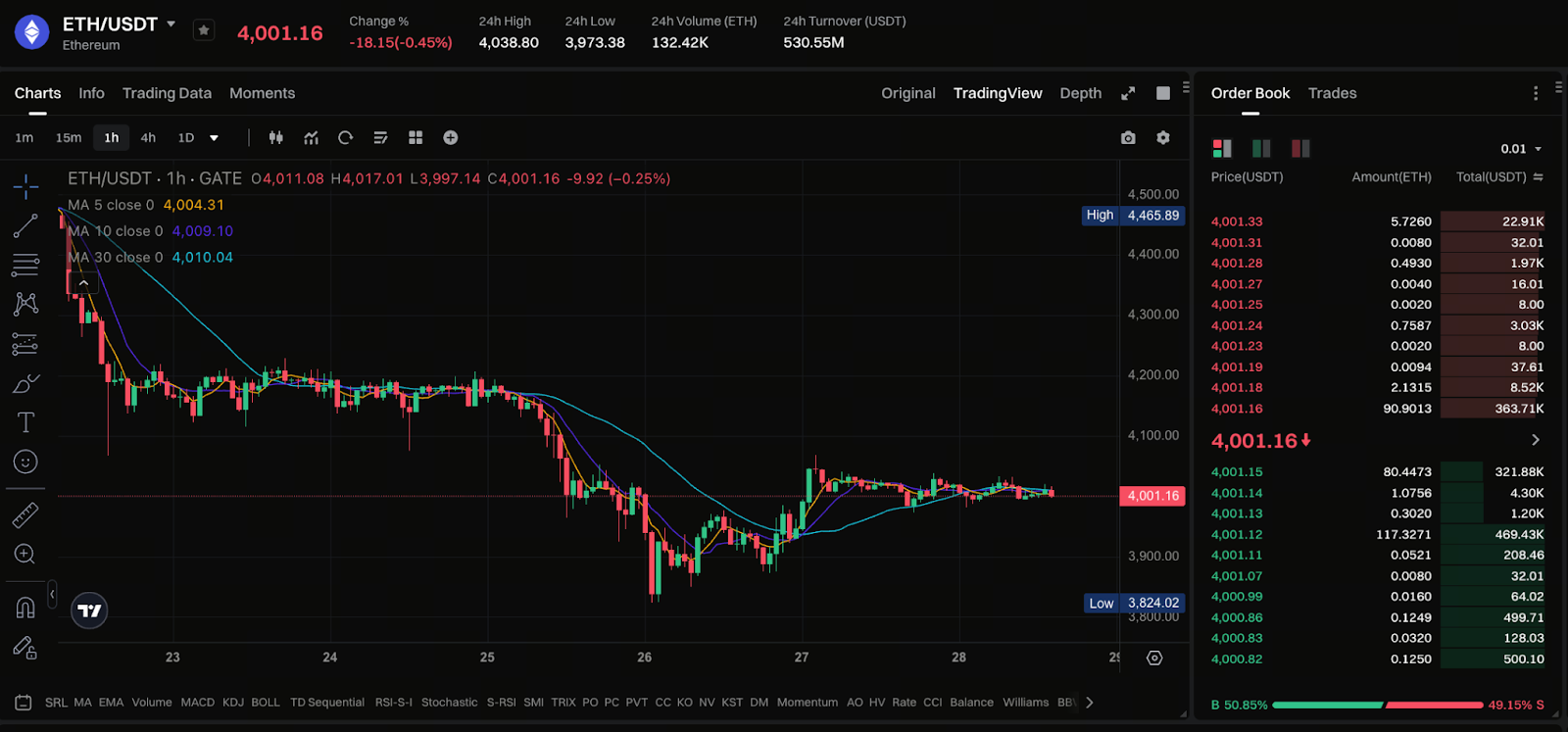

Chart: https://www.gate.com/trade/ETH_USDT

Over the past several days, Ethereum has repeatedly approached the $4,000 psychological threshold without achieving a decisive breakout. ETH currently trades around $4,150. Last week, its funding rate dropped significantly and has turned negative again this week. Meanwhile, U.S.-listed Ethereum ETFs saw consecutive net redemptions totaling hundreds of millions of dollars. This signals increasing caution among institutional investors.

Market tension has heightened further as ETH fell below the $4,000 support, triggering a wave of long liquidations and resulting in large-scale forced liquidations. These combined signals suggest the market is at a pivotal turning point, urging investors to remain alert.

2. Funding Rate and Capital Flow Indicators

The funding rate is a core metric in perpetual futures trading. When positive, longs pay shorts; when negative, shorts pay longs, reflecting bearish sentiment. Recently, ETH’s funding rate has flipped negative, indicating a strengthening bearish bias.

ETH’s 8-hour average funding rate stands at 0.0039%. However, this varies across platforms, with some showing positive rates and others negative. This underscores the divergence between long and short sentiment.

On the capital flow front, U.S.-listed ETH ETFs recorded an all-time high redemption this week—nearly $795 million in net outflows—highlighting diminished institutional confidence.

In summary, both the funding rate and capital flows are warning of potentially sustained downward pressure from short sellers.

3. Key Technical Support and Resistance Analysis

  • Support: The critical level is the $4,000 psychological threshold. Continued breakdowns may shift short-term support to the 100-day simple moving average (SMA) near $3,700, or as low as the $3,500–$3,600 range.
  • Resistance: For bullish momentum to resume, the price must clear both the 20-day and 50-day SMAs before challenging the $4,500 region.
  • Indicators: The Relative Strength Index (RSI) is currently in a weak range. There is room for further decline. The Stochastic Oscillator has entered oversold conditions at times, though a swift rebound is not guaranteed.

Given this volatility, Ethereum will likely trade within the $3,700–$4,500 range unless a significant influx of new capital or policy stimulus drives a breakout.

4. Long/Short Dynamics and Risk Advisory

Bearish scenario (further downside possible):

  • Negative funding rates indicate short sellers are dominant;
  • Continued ETF net outflows show weakening institutional confidence;
  • Elevated risk of long liquidations—breaking below $4,000 could accelerate the drop.

Bullish scenario (rebound potential):

  • If $4,000 support holds in the short term, short covering rallies could spark a rebound;
  • Large holders may start accumulating at lower levels;
  • Any shift in ETF or institutional attitude—such as new policy, regulatory clarity, network upgrades, or major Ethereum ecosystem events—could trigger a reversal.

Risk advisory:

  • Crypto assets are highly volatile; never base decisions on a single indicator;
  • If the broader macro environment deteriorates—such as changes in the U.S. Dollar Index, policy rates, or global sentiment—ETH will likely be impacted as well;
  • Consider managing your position sizes, setting stop-loss orders, and avoiding chasing rallies.

5. Mid- to Long-Term Outlook Summary

In the medium to long term, Ethereum’s fundamentals remain strong: active network ecosystem, Layer 2 expansion, robust DeFi/NFT/payment usage, and staking mechanisms. Some institutions, for example, have raised their year-end price targets to $7,500.

However, short-term stability above $4,000 is a key inflection point for future trends. If ETH fails to hold $4,000, it could test $3,500 or even lower. Conversely, if support holds and a rally follows, Ethereum could challenge the $4,500 resistance level or move higher.

Author: Max
Disclaimer
* The information is not intended to be and does not constitute financial advice or any other recommendation of any sort offered or endorsed by Gate.
* This article may not be reproduced, transmitted or copied without referencing Gate. Contravention is an infringement of Copyright Act and may be subject to legal action.

Related Articles

What is Fartcoin? All You Need to Know About FARTCOIN
Intermediate

What is Fartcoin? All You Need to Know About FARTCOIN

Fartcoin (FARTCOIN) is a representative meme coin within the Solana ecosystem based on an AI-driven narrative. Its core concept originated from an experiment aimed at exploring the "boundaries between AI Agents and humor." More than just a digital asset with social attributes, the project deeply couples absurd humor culture with on-chain financial logic by integrating autonomous AI interaction models.
2026-04-04 22:01:19
Gold Price Forecast for the Next Five Years: 2026–2030 Trend Outlook and Investment Implications, Could It Reach $6,000?
Beginner

Gold Price Forecast for the Next Five Years: 2026–2030 Trend Outlook and Investment Implications, Could It Reach $6,000?

Analyze current gold price trends alongside authoritative five-year forecasts, integrating an evaluation of market risks and opportunities. This gives investors insight into the potential trajectory of gold prices and the main drivers expected to shape the market over the next five years.
2026-03-25 18:13:30
Aster vs Hyperliquid: Which Perp DEX Will Prevail?
Beginner

Aster vs Hyperliquid: Which Perp DEX Will Prevail?

Aster and Hyperliquid are the two representative protocols of the "purpose-built L1 path" within the current decentralized perpetual exchange (Perp DEX) sector. As a pioneer in the field, Hyperliquid has built a deep liquidity moat through its highly mature order book architecture and strong community consensus. Conversely, Aster, as a rising challenger, seeks to leapfrog the competition in high-performance trading through more aggressive multi-chain aggregation logic, private transaction modules, and an underlying execution environment optimized for 2026 market demands.
2026-03-24 11:58:33
AI-Native Settlement Layers: How United Stables Is Building the Next Financial Rail
Beginner

AI-Native Settlement Layers: How United Stables Is Building the Next Financial Rail

Stablecoins were originally designed as dollar substitutes within exchanges, primarily used for asset pricing and trade settlement. As on-chain financial ecosystems have matured, their role has expanded beyond simple payments to include collateral assets, cross-chain liquidity mediums, and unified settlement units. In particular, as AI systems and automated agents begin to participate directly in economic activity, demand has risen sharply for programmable value units capable of instant settlement. This shift is pushing stablecoins toward the role of foundational financial infrastructure.
2026-03-25 03:16:17
Aerodrome Tokenomics: How ve(3,3) Powers Base's Most Profitable DEX
Beginner

Aerodrome Tokenomics: How ve(3,3) Powers Base's Most Profitable DEX

AERO is the native token of Aerodrome Finance, a core decentralized exchange and liquidity protocol in the Base ecosystem. It is primarily used for liquidity incentives and ecosystem operations. veAERO is a governance NFT that users receive by locking AERO, representing both voting power and the right to share protocol revenue. Through a dual track structure of AERO as a utility token and veAERO as a governance credential, Aerodrome separates liquidity usage value from long term governance power, allowing participants to act as liquidity providers, governance decision makers, and revenue sharers within the same system.
2026-03-25 06:40:31
The ve(3,3) Flywheel Explained: How AERO Tokenomics Powers Aerodrome’s DeFi Economy
Beginner

The ve(3,3) Flywheel Explained: How AERO Tokenomics Powers Aerodrome’s DeFi Economy

In the competition for DeFi liquidity, high-inflation mining alone is no longer enough to build lasting advantages. Aerodrome applies the ve(3,3) economic model to redesign token emissions, voting mechanisms, and revenue distribution, creating a liquidity flywheel centered on governance and cash flow. This article examines AERO tokenomics, the veAERO locking mechanism, and protocol revenue models to explain how Aerodrome builds a sustainable DeFi economic system.
2026-03-25 06:41:58





