Euler Finance (EUL): From Restructuring to Surge — Beginner’s Guide and Investment Highlights

Beginner
Quick Reads
Last Updated 2026-03-28 15:32:36
Reading Time: 1m
Euler Finance (EUL) has transitioned to the modular Euler V2, driving substantial growth in deposits and lending activity. Protocol expansion causes EUL’s price and market capitalization to fluctuate. This article offers an overview of Euler’s core mechanisms, an analysis of recent metrics, and a discussion of risk considerations. It serves as a concise guide for newcomers to evaluate the right time to participate.

Euler Overview


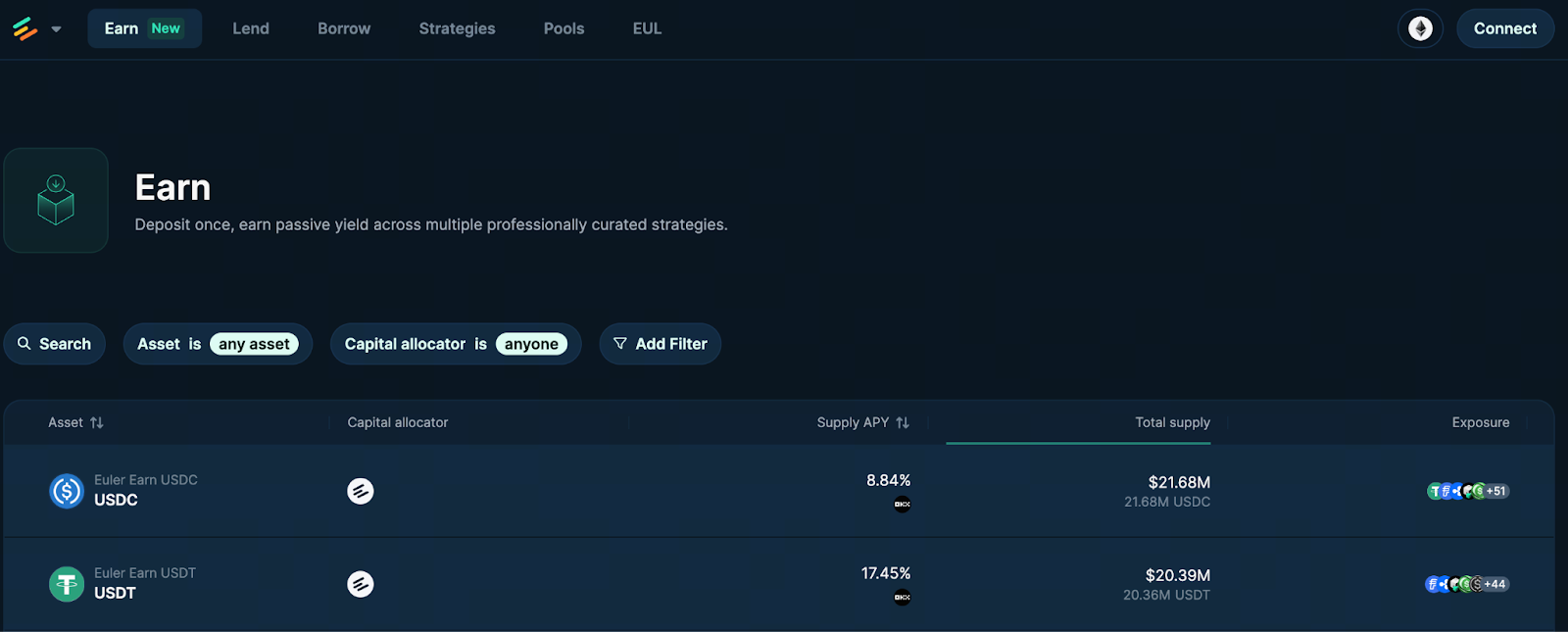
Image source: https://app.euler.finance/earn?network=ethereum

Euler Finance is a decentralized lending protocol built on Ethereum that focuses on providing a secure, flexible environment for long-tail asset lending. Unlike conventional DeFi lending platforms, Euler enables a broader range of tokens to participate in its lending markets and supports community self-governance through its EUL governance token. Euler stands out in the DeFi space because it introduces innovative risk isolation mechanisms and achieves efficient capital utilization.

Key Features: Modularity and Customization

The latest release, Euler V2, introduces a modular framework and the Euler Vault Kit (EVK) concept. This system allows anyone to create independent lending vaults and freely adjust parameters based on risk appetite, interest rate models, or asset types. This decentralized approach empowers developers and strategy traders to design custom lending markets, overcoming the limitations of single liquidity pools.

Recent Metrics and Price Performance

With the rollout of V2 and ecosystem expansion, Euler’s total value locked (TVL) and lending volumes have surged. Recent market data shows EUL trading in the $8–$10 range, with strong gains since the start of the year. As volumes on major exchanges grow, EUL’s market cap continues to rise, reflecting market confidence in its long-term prospects.

Trade EUL here: https://www.gate.com/trade/EUL_USDT

Token and Governance Model

EUL serves as Euler’s governance token, granting holders voting rights on protocol upgrades, parameter changes, and fund allocations. The governance system offers high transparency, and community participation is steadily increasing. For long-term holders, active governance not only deepens understanding of the project but may also provide future ecosystem incentives or fee-sharing opportunities.

Getting Started and Application Scenarios

Users can connect their wallets (such as MetaMask) to the official app to deposit or borrow; developers can leverage the Euler Vault Kit to deploy custom vaults and implement advanced lending strategies. For example, institutional investors can create dedicated stablecoin vaults, while quant teams can maximize capital efficiency through automated strategies.

Security and Risk Notice

Euler’s design incorporates robust risk controls. However, the protocol has experienced security incidents in the past. Stay vigilant about smart contract risks and any changes to liquidation mechanisms. Beginners should start with small trial amounts. Gradually scale up while keeping up with official security audits and announcements.

Investment Guidance and Outlook

Euler Finance (EUL) has captured market attention with its modular design, flexible architecture, and open ecosystem. As more projects build on Euler, the protocol’s use cases will continue to expand. New investors should take a phased approach, monitor governance updates and market trends, and carefully evaluate risk when exploring DeFi lending opportunities.

Author: Max
Disclaimer
* The information is not intended to be and does not constitute financial advice or any other recommendation of any sort offered or endorsed by Gate.
* This article may not be reproduced, transmitted or copied without referencing Gate. Contravention is an infringement of Copyright Act and may be subject to legal action.

Related Articles

What is Fartcoin? All You Need to Know About FARTCOIN
Intermediate

What is Fartcoin? All You Need to Know About FARTCOIN

Fartcoin (FARTCOIN) is a representative meme coin within the Solana ecosystem based on an AI-driven narrative. Its core concept originated from an experiment aimed at exploring the "boundaries between AI Agents and humor." More than just a digital asset with social attributes, the project deeply couples absurd humor culture with on-chain financial logic by integrating autonomous AI interaction models.
2026-04-04 22:01:19
Gold Price Forecast for the Next Five Years: 2026–2030 Trend Outlook and Investment Implications, Could It Reach $6,000?
Beginner

Gold Price Forecast for the Next Five Years: 2026–2030 Trend Outlook and Investment Implications, Could It Reach $6,000?

Analyze current gold price trends alongside authoritative five-year forecasts, integrating an evaluation of market risks and opportunities. This gives investors insight into the potential trajectory of gold prices and the main drivers expected to shape the market over the next five years.
2026-03-25 18:13:30
Aster vs Hyperliquid: Which Perp DEX Will Prevail?
Beginner

Aster vs Hyperliquid: Which Perp DEX Will Prevail?

Aster and Hyperliquid are the two representative protocols of the "purpose-built L1 path" within the current decentralized perpetual exchange (Perp DEX) sector. As a pioneer in the field, Hyperliquid has built a deep liquidity moat through its highly mature order book architecture and strong community consensus. Conversely, Aster, as a rising challenger, seeks to leapfrog the competition in high-performance trading through more aggressive multi-chain aggregation logic, private transaction modules, and an underlying execution environment optimized for 2026 market demands.
2026-03-24 11:58:33
AI-Native Settlement Layers: How United Stables Is Building the Next Financial Rail
Beginner

AI-Native Settlement Layers: How United Stables Is Building the Next Financial Rail

Stablecoins were originally designed as dollar substitutes within exchanges, primarily used for asset pricing and trade settlement. As on-chain financial ecosystems have matured, their role has expanded beyond simple payments to include collateral assets, cross-chain liquidity mediums, and unified settlement units. In particular, as AI systems and automated agents begin to participate directly in economic activity, demand has risen sharply for programmable value units capable of instant settlement. This shift is pushing stablecoins toward the role of foundational financial infrastructure.
2026-03-25 03:16:17
Aerodrome Tokenomics: How ve(3,3) Powers Base's Most Profitable DEX
Beginner

Aerodrome Tokenomics: How ve(3,3) Powers Base's Most Profitable DEX

AERO is the native token of Aerodrome Finance, a core decentralized exchange and liquidity protocol in the Base ecosystem. It is primarily used for liquidity incentives and ecosystem operations. veAERO is a governance NFT that users receive by locking AERO, representing both voting power and the right to share protocol revenue. Through a dual track structure of AERO as a utility token and veAERO as a governance credential, Aerodrome separates liquidity usage value from long term governance power, allowing participants to act as liquidity providers, governance decision makers, and revenue sharers within the same system.
2026-03-25 06:40:31
The ve(3,3) Flywheel Explained: How AERO Tokenomics Powers Aerodrome’s DeFi Economy
Beginner

The ve(3,3) Flywheel Explained: How AERO Tokenomics Powers Aerodrome’s DeFi Economy

In the competition for DeFi liquidity, high-inflation mining alone is no longer enough to build lasting advantages. Aerodrome applies the ve(3,3) economic model to redesign token emissions, voting mechanisms, and revenue distribution, creating a liquidity flywheel centered on governance and cash flow. This article examines AERO tokenomics, the veAERO locking mechanism, and protocol revenue models to explain how Aerodrome builds a sustainable DeFi economic system.
2026-03-25 06:41:58





