Gate Futures Trading Explained: How to Use Position Data to Gauge Market Sentiment

Beginner
Quick Reads
Last Updated 2026-03-24 20:59:04
Reading Time: 1m
This article uses Gate Exchange as an example to illustrate how position size and long-short ratio data in contract trading reflect market sentiment. It aims to help beginners understand the relationship between changes in position structure and price volatility.

I. Why Position Data Is More Important Than Price

In the derivatives market, price is only the surface—capital flow is the real driver. Many new traders focus solely on K-line price movements and overlook a more critical question: How much capital is actually entering or leaving the market?

The position data available in Gate’s contract trading feature helps traders gauge market participation, not just track price changes.

II. What Is Open Interest?

Open interest refers to the total number of contracts that remain open and have not yet been closed in the current market.

When open interest increases, it typically means:

  • New capital is flowing into the market
  • Bulls and bears are building new positions

When open interest decreases, it indicates:

  • Positions are being closed out
  • Market activity is declining

On Gate’s contract trading interface, users can monitor these metrics in real time to assess whether the market is active.

III. Long/Short Ratio Data in Gate Contract Trading
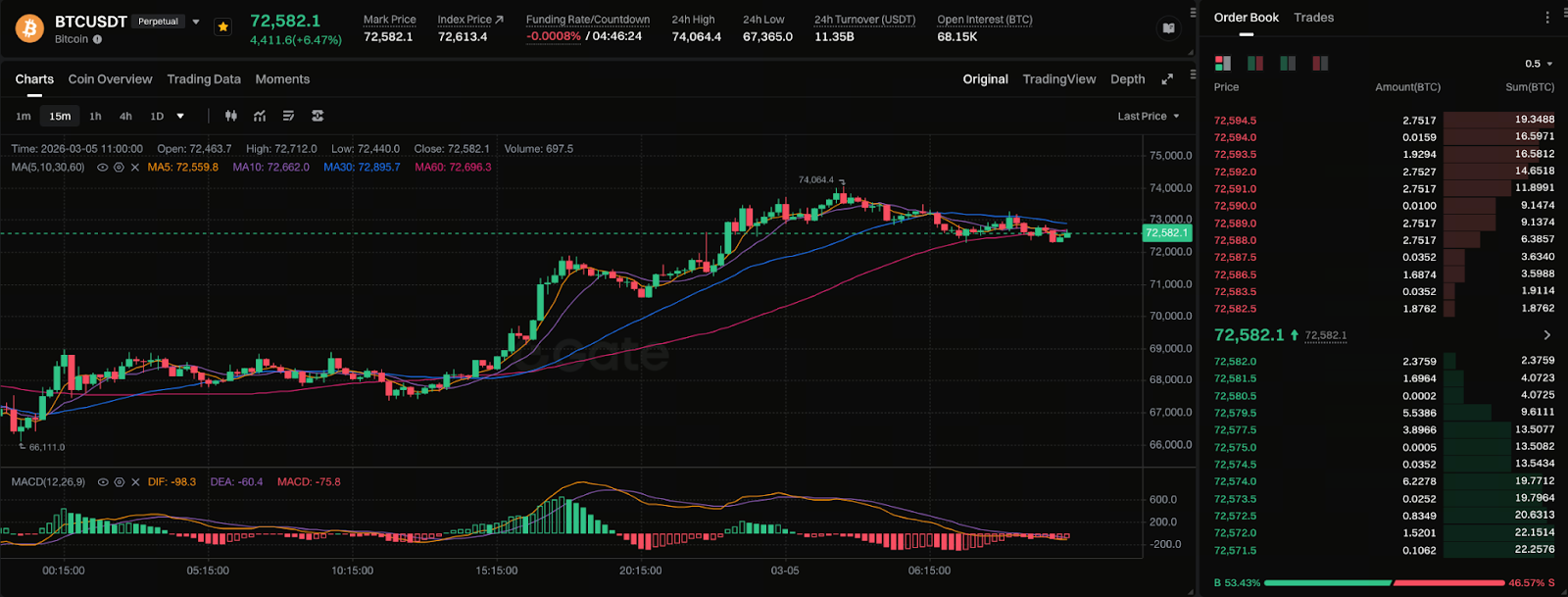
Long/Short Ratio Data in Gate Contract Trading
Image: https://www.gate.com/futures/USDT/BTC_USDT

The long/short ratio shows the proportion of traders with long positions compared to those with short positions.

For example:

  • A high long/short ratio signals a bullish market bias
  • A low long/short ratio signals a bearish market bias

However, keep in mind:

Extreme long/short ratios often indicate highly concentrated sentiment, which can lead to sudden reversals. Gate’s contract trading feature provides transparent data to help users spot these structural shifts.

IV. The Relationship Between Position Changes and Price Action

There are several classic patterns between position data and price movements:

  • Price rises + positions increase → Capital is aggressively going long, trend may strengthen
  • Price rises + positions decrease → Shorts are covering, possibly a technical rebound
  • Price falls + positions increase → Shorts are adding, trend continuation is likely
  • Price falls + positions decrease → Longs are stopping out, possibly near a short-term bottom

Understanding these combinations helps you avoid relying solely on price for market judgments.

V. Common Market Sentiment Signals

In the Gate contract market, pay close attention to the following scenarios:

  • Open interest surges rapidly
  • Long/short ratio reaches extreme levels
  • Divergence between price and position data

These patterns often suggest that market sentiment is at an extreme. Still, data serves only as a reference and should not be used as the sole trading signal.

VI. How Beginners Can Use Position Data Effectively

For new traders, consider these guidelines:

  1. Treat position data as supplementary—never as your only reference
  2. Combine it with price trend analysis; avoid interpreting data in isolation
  3. Focus on the speed of data changes, not just absolute numbers
  4. Avoid chasing trades blindly during periods of extreme sentiment

The transparency of Gate’s contract trading data provides traders with an additional layer of insight. By focusing on capital structure—not just price swings—you’ll develop a more mature trading perspective.

Author: Max
Disclaimer
* The information is not intended to be and does not constitute financial advice or any other recommendation of any sort offered or endorsed by Gate.
* This article may not be reproduced, transmitted or copied without referencing Gate. Contravention is an infringement of Copyright Act and may be subject to legal action.

Related Articles

What is Fartcoin? All You Need to Know About FARTCOIN
Intermediate

What is Fartcoin? All You Need to Know About FARTCOIN

Fartcoin (FARTCOIN) is a representative meme coin within the Solana ecosystem based on an AI-driven narrative. Its core concept originated from an experiment aimed at exploring the "boundaries between AI Agents and humor." More than just a digital asset with social attributes, the project deeply couples absurd humor culture with on-chain financial logic by integrating autonomous AI interaction models.
2026-04-04 22:01:19
Gold Price Forecast for the Next Five Years: 2026–2030 Trend Outlook and Investment Implications, Could It Reach $6,000?
Beginner

Gold Price Forecast for the Next Five Years: 2026–2030 Trend Outlook and Investment Implications, Could It Reach $6,000?

Analyze current gold price trends alongside authoritative five-year forecasts, integrating an evaluation of market risks and opportunities. This gives investors insight into the potential trajectory of gold prices and the main drivers expected to shape the market over the next five years.
2026-03-25 18:13:30
Aster vs Hyperliquid: Which Perp DEX Will Prevail?
Beginner

Aster vs Hyperliquid: Which Perp DEX Will Prevail?

Aster and Hyperliquid are the two representative protocols of the "purpose-built L1 path" within the current decentralized perpetual exchange (Perp DEX) sector. As a pioneer in the field, Hyperliquid has built a deep liquidity moat through its highly mature order book architecture and strong community consensus. Conversely, Aster, as a rising challenger, seeks to leapfrog the competition in high-performance trading through more aggressive multi-chain aggregation logic, private transaction modules, and an underlying execution environment optimized for 2026 market demands.
2026-03-24 11:58:33
AI-Native Settlement Layers: How United Stables Is Building the Next Financial Rail
Beginner

AI-Native Settlement Layers: How United Stables Is Building the Next Financial Rail

Stablecoins were originally designed as dollar substitutes within exchanges, primarily used for asset pricing and trade settlement. As on-chain financial ecosystems have matured, their role has expanded beyond simple payments to include collateral assets, cross-chain liquidity mediums, and unified settlement units. In particular, as AI systems and automated agents begin to participate directly in economic activity, demand has risen sharply for programmable value units capable of instant settlement. This shift is pushing stablecoins toward the role of foundational financial infrastructure.
2026-03-25 03:16:17
Aerodrome Tokenomics: How ve(3,3) Powers Base's Most Profitable DEX
Beginner

Aerodrome Tokenomics: How ve(3,3) Powers Base's Most Profitable DEX

AERO is the native token of Aerodrome Finance, a core decentralized exchange and liquidity protocol in the Base ecosystem. It is primarily used for liquidity incentives and ecosystem operations. veAERO is a governance NFT that users receive by locking AERO, representing both voting power and the right to share protocol revenue. Through a dual track structure of AERO as a utility token and veAERO as a governance credential, Aerodrome separates liquidity usage value from long term governance power, allowing participants to act as liquidity providers, governance decision makers, and revenue sharers within the same system.
2026-03-25 06:40:31
Hybrid Collateral Stablecoins: Inside United Stables' Stability and Yield Architecture
Beginner

Hybrid Collateral Stablecoins: Inside United Stables' Stability and Yield Architecture

In the early stages of the crypto market, traditional stablecoins mainly relied on single-reserve or single-collateral models. Their primary focus was price stability and payment convenience, which allowed them to become foundational tools for on-chain trading and capital flows. As the market has entered a more mature financial phase, however, this structure has begun to reveal limitations, including high concentration risk and the difficulty of balancing liquidity with yield. These constraints have driven the evolution toward multi-layer collateral and portfolio-based designs, such as the dual-layer hybrid collateral architecture proposed by United Stables, which seeks to redefine the underlying logic of stable assets.
2026-03-25 03:17:39





