Gate Launchpad Beginner’s Guide: Comprehensive Understanding of Kodiak (KDK) Subscription Mechanics

Beginner
Quick Reads
Last Updated 2026-03-26 19:24:31
Reading Time: 1m
Gate Launchpad serves as a primary gateway for newcomers interested in new token launches. In this round, Kodiak (KDK) supports dual-currency subscription with USDT and GUSD, and distributes tokens through a full 100% unlock. This article offers a comprehensive, beginner-friendly overview of how Gate Launchpad works, details the KDK subscription rules, and outlines the participation process to help users gain a clear understanding and make informed decisions.

Who Should Use Gate Launchpad?

Gate Launchpad isn’t just built for high-frequency traders. Its design makes it ideal for everyday users who want an easy way to access new projects. Unlike on-chain IDOs, Gate Launchpad removes the need for complex wallet setups or cross-chain operations. Participation only requires account verification.

For those new to the crypto market, Gate Launchpad acts as a standardized entry point for new tokens. It lets users learn about token launches step by step in a controlled environment.

Core Features of the Current Kodiak (KDK) Subscription
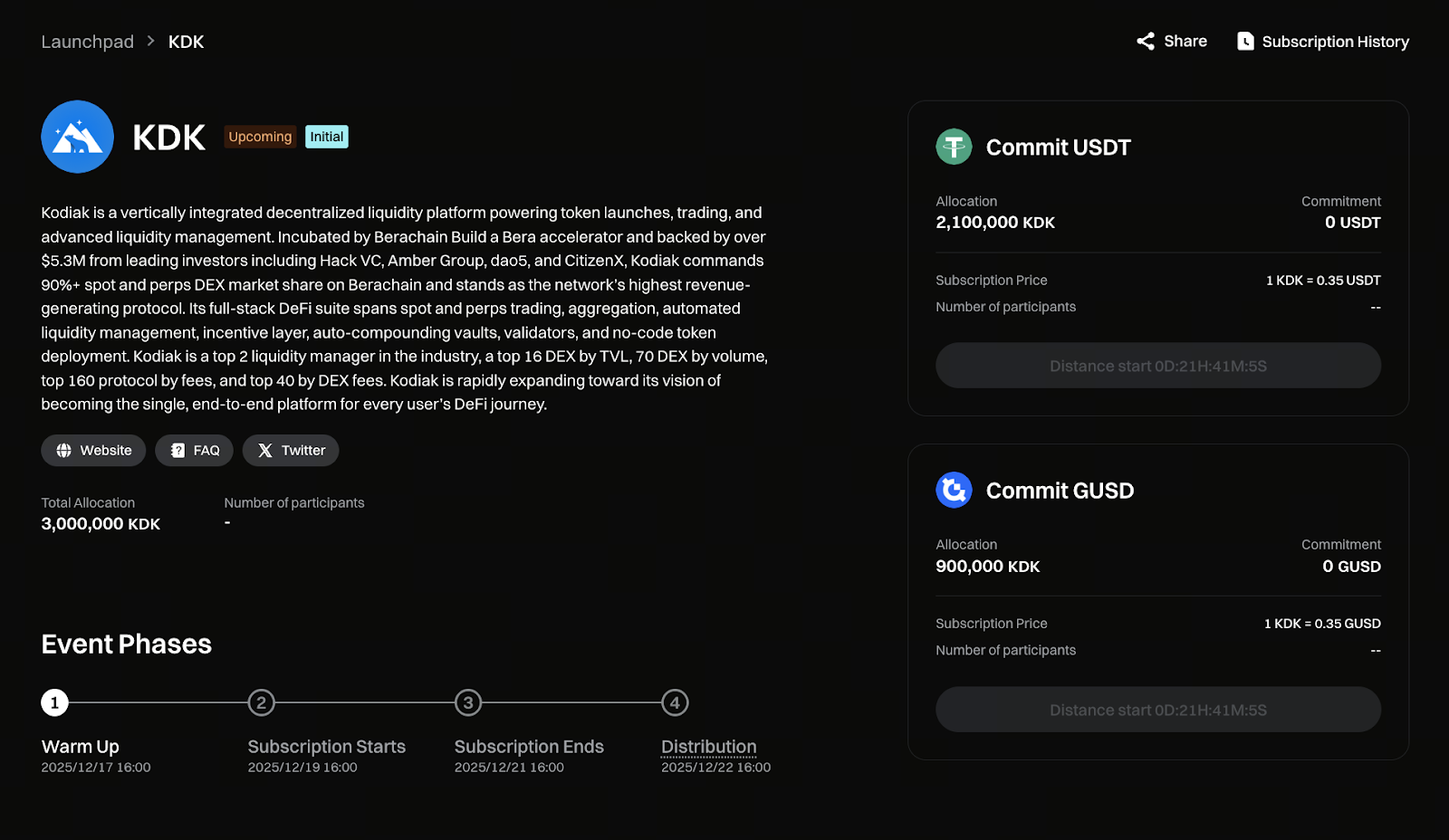

Image: https://www.gate.com/launchpad/2362

The fifth round of Gate Launchpad, featuring Kodiak (KDK), introduces several notable features.

First, all tokens are distributed fully unlocked. If you successfully subscribe, you’ll receive the entire token allocation at once, eliminating uncertainty from vesting periods.

Second, the platform supports both USDT and GUSD, so you can choose the asset that best fits your portfolio.

Finally, clear individual subscription caps help level the playing field between large and smaller participants.

Together, these features define the core participation logic for this round of Gate Launchpad.

How Gate Launchpad Calculates and Allocates Funds

Many first-time users mistakenly think that investing more guarantees a bigger allocation. In fact, Gate Launchpad focuses on your average staked amount.

The system takes multiple snapshots of your staked balance throughout the subscription period and calculates the hourly average. The earlier you stake and the longer your funds remain locked, the higher your average and, as a result, the larger your token allocation.

This approach encourages ongoing participation instead of last-minute deposits.

Common Mistakes Beginners Make with Gate Launchpad

New users often fall into three main traps when using Gate Launchpad.

1. Assuming the subscription amount equals final returns. In reality, subscribing only qualifies you for a share of the distribution. The actual number of tokens you receive depends on total participation.

2. Overlooking key rules, such as individual caps and pool-specific restrictions.

3. Setting unrealistic expectations for new token prices and ignoring the volatility risks in early-stage projects.

Understanding these pitfalls helps users approach Gate Launchpad more rationally.

Kodiak (KDK): Project Positioning and Ecosystem Value

Kodiak is a core liquidity protocol in the Berachain ecosystem. It offers spot trading, perpetual contracts, and automated liquidity management. Kodiak dominates the DEX market on Berachain and has built a comprehensive product suite.

For Gate Launchpad users, real-world use cases are a key factor when evaluating new tokens. Kodiak provides a solid foundation in this regard.

Practical Tips Before Joining Gate Launchpad

If you’re new to Gate Launchpad, approach it as a learning experience, not just a way to make quick profits. Start with small amounts to get familiar with the subscription process, token distribution, and what happens after listing. This approach is often more valuable than chasing short-term gains.

Also, monitor overall market conditions and avoid increasing your exposure during periods of excessive market hype.

Summary: Using Gate Launchpad as a Long-Term Strategy

Gate Launchpad’s value goes beyond any single project. It provides a repeatable, transparent mechanism for joining new token launches. This round, featuring Kodiak (KDK), showcases strong rule design and project maturity.

For users aiming to enter the crypto market steadily, Gate Launchpad offers a practical path for both learning and hands-on participation.

Author: Max
Disclaimer
* The information is not intended to be and does not constitute financial advice or any other recommendation of any sort offered or endorsed by Gate.
* This article may not be reproduced, transmitted or copied without referencing Gate. Contravention is an infringement of Copyright Act and may be subject to legal action.

Related Articles

What is Fartcoin? All You Need to Know About FARTCOIN
Intermediate

What is Fartcoin? All You Need to Know About FARTCOIN

Fartcoin (FARTCOIN) is a representative meme coin within the Solana ecosystem based on an AI-driven narrative. Its core concept originated from an experiment aimed at exploring the "boundaries between AI Agents and humor." More than just a digital asset with social attributes, the project deeply couples absurd humor culture with on-chain financial logic by integrating autonomous AI interaction models.
2026-04-04 22:01:19
Gold Price Forecast for the Next Five Years: 2026–2030 Trend Outlook and Investment Implications, Could It Reach $6,000?
Beginner

Gold Price Forecast for the Next Five Years: 2026–2030 Trend Outlook and Investment Implications, Could It Reach $6,000?

Analyze current gold price trends alongside authoritative five-year forecasts, integrating an evaluation of market risks and opportunities. This gives investors insight into the potential trajectory of gold prices and the main drivers expected to shape the market over the next five years.
2026-03-25 18:13:30
Aster vs Hyperliquid: Which Perp DEX Will Prevail?
Beginner

Aster vs Hyperliquid: Which Perp DEX Will Prevail?

Aster and Hyperliquid are the two representative protocols of the "purpose-built L1 path" within the current decentralized perpetual exchange (Perp DEX) sector. As a pioneer in the field, Hyperliquid has built a deep liquidity moat through its highly mature order book architecture and strong community consensus. Conversely, Aster, as a rising challenger, seeks to leapfrog the competition in high-performance trading through more aggressive multi-chain aggregation logic, private transaction modules, and an underlying execution environment optimized for 2026 market demands.
2026-03-24 11:58:33
AI-Native Settlement Layers: How United Stables Is Building the Next Financial Rail
Beginner

AI-Native Settlement Layers: How United Stables Is Building the Next Financial Rail

Stablecoins were originally designed as dollar substitutes within exchanges, primarily used for asset pricing and trade settlement. As on-chain financial ecosystems have matured, their role has expanded beyond simple payments to include collateral assets, cross-chain liquidity mediums, and unified settlement units. In particular, as AI systems and automated agents begin to participate directly in economic activity, demand has risen sharply for programmable value units capable of instant settlement. This shift is pushing stablecoins toward the role of foundational financial infrastructure.
2026-03-25 03:16:17
ASTER Tokenomics: Buybacks, Burns, and Staking as the Value Foundation of ASTER in 2026
Beginner

ASTER Tokenomics: Buybacks, Burns, and Staking as the Value Foundation of ASTER in 2026

ASTER is the native equity and governance token of the Aster ecosystem, with its core value built upon a radical "Deflationary Engine." Beyond serving as a governance tool, ASTER integrates multiple utilities including staking rewards, trading fee discounts, and liquidity incentives. Through its deep integration with the upcoming dedicated Layer 1 mainnet, it enables direct value capture from protocol cash flow to token holders.
2026-03-25 07:38:07
Hybrid Collateral Stablecoins: Inside United Stables' Stability and Yield Architecture
Beginner

Hybrid Collateral Stablecoins: Inside United Stables' Stability and Yield Architecture

In the early stages of the crypto market, traditional stablecoins mainly relied on single-reserve or single-collateral models. Their primary focus was price stability and payment convenience, which allowed them to become foundational tools for on-chain trading and capital flows. As the market has entered a more mature financial phase, however, this structure has begun to reveal limitations, including high concentration risk and the difficulty of balancing liquidity with yield. These constraints have driven the evolution toward multi-layer collateral and portfolio-based designs, such as the dual-layer hybrid collateral architecture proposed by United Stables, which seeks to redefine the underlying logic of stable assets.
2026-03-25 03:17:39