Gate Metals Hub: New Perspectives on Trading and Allocation in Volatile Markets

Last Updated 2026-03-27 13:50:17
Reading Time: 4m
As global economic uncertainty rises, precious metals return to the spotlight in the marketplace. This article examines the macroeconomic factors that drive gold and silver prices, providing an in-depth look at Perpetual Futures trading tools and widely used strategies. The goal is to help investors build more adaptable trading mindsets amid market volatility.

Evolving Safe-Haven Strategies in a Changing Global Landscape

When markets contend with rising inflation, slowing economic growth, or escalating geopolitical tensions, capital often gravitates toward relatively stable asset classes—gold and silver being among the most prominent. These assets have long served as key instruments for wealth preservation and as indicators of market risk sentiment.

Precious metals are not immune to downturns. As economic outlooks improve or market sentiment turns optimistic, capital may shift to riskier assets, putting downward pressure on gold and silver prices. Consequently, their performance is closely linked to broader economic conditions.

Key Drivers of Gold and Silver Prices

The precious metals market is shaped by a complex interplay of factors rather than any single event. The primary drivers include:

  1. Macroeconomic Indicators

Fluctuations in inflation, interest rates, and employment figures directly influence asset allocation decisions, fueling price volatility in precious metals.

  1. Monetary Policy Direction

Central bank policy shifts—especially toward monetary easing or tightening—can have a pronounced impact on gold prices.

  1. Geopolitical Developments

Geopolitical conflicts or unexpected crises typically heighten demand for safe havens, channeling capital into the precious metals market.

These factors interact dynamically, producing distinct cycles of market volatility over time.

Greater Flexibility: Perpetual Futures in Action
Greater Flexibility: Perpetual Futures in Action

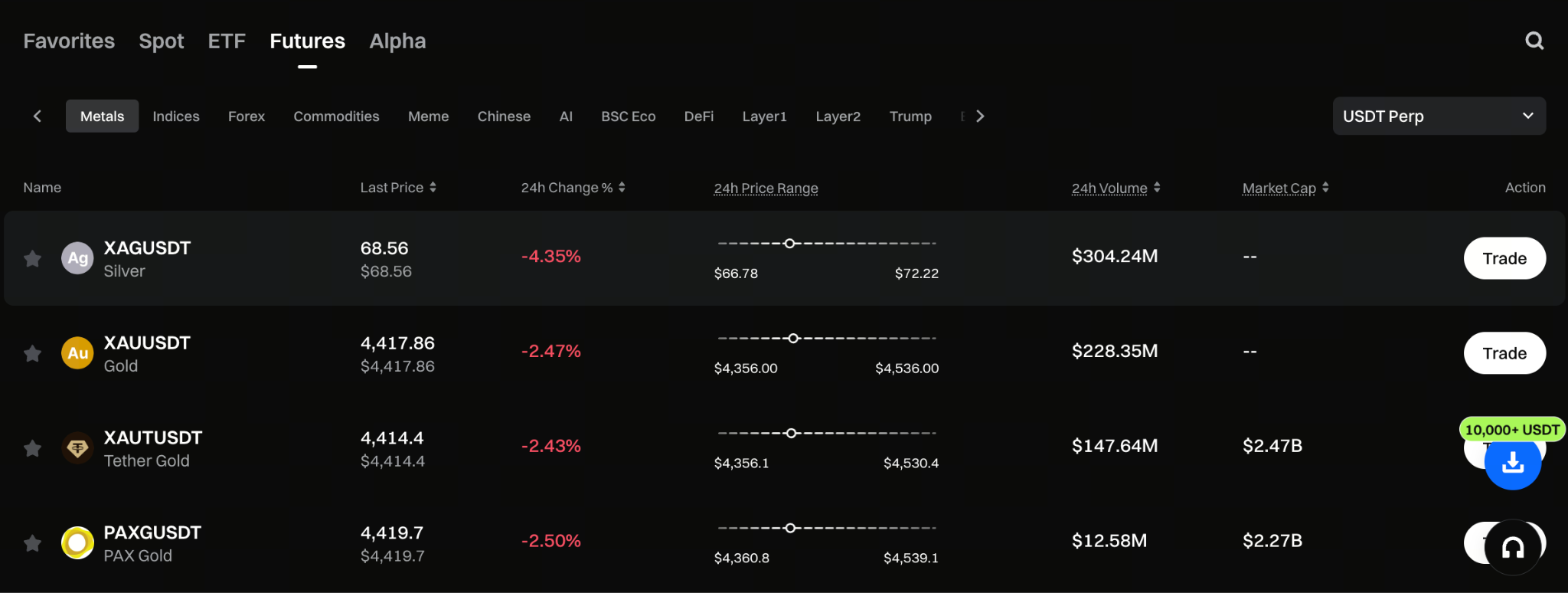
In fast-moving markets, flexible trading tools are essential. Gate’s Metals section offers perpetual futures, allowing investors to access the precious metals market without time constraints.

Unlike traditional futures, perpetual futures have no expiration date, giving traders the freedom to adjust holding periods as market conditions evolve. Whether pursuing short-term trades or medium-term strategies, all can be managed within the same instrument.

USDT settlement further streamlines fund management, enabling traders to quickly adjust capital and positions during periods of heightened volatility.

Start trading now in the Gate Metals section: https://www.gate.com/price/futures/category-metals/usdt

Advantages and Risks of Perpetual Futures

Perpetual futures attract attention for their high flexibility and diverse applications. Their main advantage lies in unrestricted holding periods—eliminating delivery concerns—and the ability to maximize capital efficiency through leverage. However, leverage also magnifies potential risks, making disciplined capital management essential. In volatile markets, prudent use of leverage and careful position sizing are key to sustaining long-term performance.

Risk Control: The Pillar of Trading Stability

As markets become more volatile, risk management takes center stage. A robust trading system employs multiple risk control mechanisms.

A dynamic margin system adjusts capital requirements in real time to buffer against extreme market moves. Auto close position features enable immediate stop-losses when risk thresholds are breached. Funding rates reflect changes in market sentiment and impact the cost of holding positions.

Together, these mechanisms form the backbone of trading security, empowering investors to pursue returns while maintaining risk discipline.

Multi-Faceted Trading Strategies for Volatile Markets

In the precious metals market, traders deploy a range of strategies to adapt to shifting conditions.

  1. Short-Term Trading

Seizing short-term price movements for rapid entry and exit, often with strict stop-loss and take-profit parameters.

  1. Trend Following

Establishing positions in the direction of prevailing trends and expanding profits as trends continue.

  1. Asset Hedging

Allocating precious metals to mitigate overall portfolio volatility.

  1. Arbitrage

Leveraging price discrepancies across markets or instruments to pursue low-risk returns.

By applying these strategies flexibly, traders can identify optimal approaches for varying market environments.

Conclusion

In a world of persistent economic and market uncertainty, precious metals remain a vital component of asset allocation. Their price dynamics reflect macro trends and provide diverse trading opportunities. By utilizing flexible tools like perpetual futures—combined with robust risk management and strategic planning—investors can navigate market volatility with greater confidence. In an era where uncertainty is the norm, building a disciplined and adaptive trading system is crucial for long-term success.

Author:  Allen
Disclaimer
* The information is not intended to be and does not constitute financial advice or any other recommendation of any sort offered or endorsed by Gate.
* This article may not be reproduced, transmitted or copied without referencing Gate. Contravention is an infringement of Copyright Act and may be subject to legal action.

Related Articles

What is Fartcoin? All You Need to Know About FARTCOIN
Intermediate

What is Fartcoin? All You Need to Know About FARTCOIN

Fartcoin (FARTCOIN) is a representative meme coin within the Solana ecosystem based on an AI-driven narrative. Its core concept originated from an experiment aimed at exploring the "boundaries between AI Agents and humor." More than just a digital asset with social attributes, the project deeply couples absurd humor culture with on-chain financial logic by integrating autonomous AI interaction models.
2026-04-04 22:01:19
Gold Price Forecast for the Next Five Years: 2026–2030 Trend Outlook and Investment Implications, Could It Reach $6,000?
Beginner

Gold Price Forecast for the Next Five Years: 2026–2030 Trend Outlook and Investment Implications, Could It Reach $6,000?

Analyze current gold price trends alongside authoritative five-year forecasts, integrating an evaluation of market risks and opportunities. This gives investors insight into the potential trajectory of gold prices and the main drivers expected to shape the market over the next five years.
2026-03-25 18:13:30
Aster vs Hyperliquid: Which Perp DEX Will Prevail?
Beginner

Aster vs Hyperliquid: Which Perp DEX Will Prevail?

Aster and Hyperliquid are the two representative protocols of the "purpose-built L1 path" within the current decentralized perpetual exchange (Perp DEX) sector. As a pioneer in the field, Hyperliquid has built a deep liquidity moat through its highly mature order book architecture and strong community consensus. Conversely, Aster, as a rising challenger, seeks to leapfrog the competition in high-performance trading through more aggressive multi-chain aggregation logic, private transaction modules, and an underlying execution environment optimized for 2026 market demands.
2026-03-24 11:58:33
AI-Native Settlement Layers: How United Stables Is Building the Next Financial Rail
Beginner

AI-Native Settlement Layers: How United Stables Is Building the Next Financial Rail

Stablecoins were originally designed as dollar substitutes within exchanges, primarily used for asset pricing and trade settlement. As on-chain financial ecosystems have matured, their role has expanded beyond simple payments to include collateral assets, cross-chain liquidity mediums, and unified settlement units. In particular, as AI systems and automated agents begin to participate directly in economic activity, demand has risen sharply for programmable value units capable of instant settlement. This shift is pushing stablecoins toward the role of foundational financial infrastructure.
2026-03-25 03:16:17
Aerodrome Tokenomics: How ve(3,3) Powers Base's Most Profitable DEX
Beginner

Aerodrome Tokenomics: How ve(3,3) Powers Base's Most Profitable DEX

AERO is the native token of Aerodrome Finance, a core decentralized exchange and liquidity protocol in the Base ecosystem. It is primarily used for liquidity incentives and ecosystem operations. veAERO is a governance NFT that users receive by locking AERO, representing both voting power and the right to share protocol revenue. Through a dual track structure of AERO as a utility token and veAERO as a governance credential, Aerodrome separates liquidity usage value from long term governance power, allowing participants to act as liquidity providers, governance decision makers, and revenue sharers within the same system.
2026-03-25 06:40:31
The ve(3,3) Flywheel Explained: How AERO Tokenomics Powers Aerodrome’s DeFi Economy
Beginner

The ve(3,3) Flywheel Explained: How AERO Tokenomics Powers Aerodrome’s DeFi Economy

In the competition for DeFi liquidity, high-inflation mining alone is no longer enough to build lasting advantages. Aerodrome applies the ve(3,3) economic model to redesign token emissions, voting mechanisms, and revenue distribution, creating a liquidity flywheel centered on governance and cash flow. This article examines AERO tokenomics, the veAERO locking mechanism, and protocol revenue models to explain how Aerodrome builds a sustainable DeFi economic system.
2026-03-25 06:41:58





