Lighter: Building a Verifiable Order Book for Decentralized Perpetual Trading

Beginner
Quick Reads
Last Updated 2026-03-26 10:22:18
Reading Time: 1m
Lighter is a perpetual contract trading protocol built on Ethereum. Utilizing a dedicated zk-rollup and a verifiable matching engine, it seeks to overcome persistent performance, security, and fairness bottlenecks in decentralized order books. Backed by significant funding, accelerating trading volumes, and the recent introduction of the LIT token mechanism, Lighter is steadily carving out its niche in the decentralized derivatives market.

Rethinking the Core Architecture of Decentralized Perpetual Contracts

(Source: lighter)

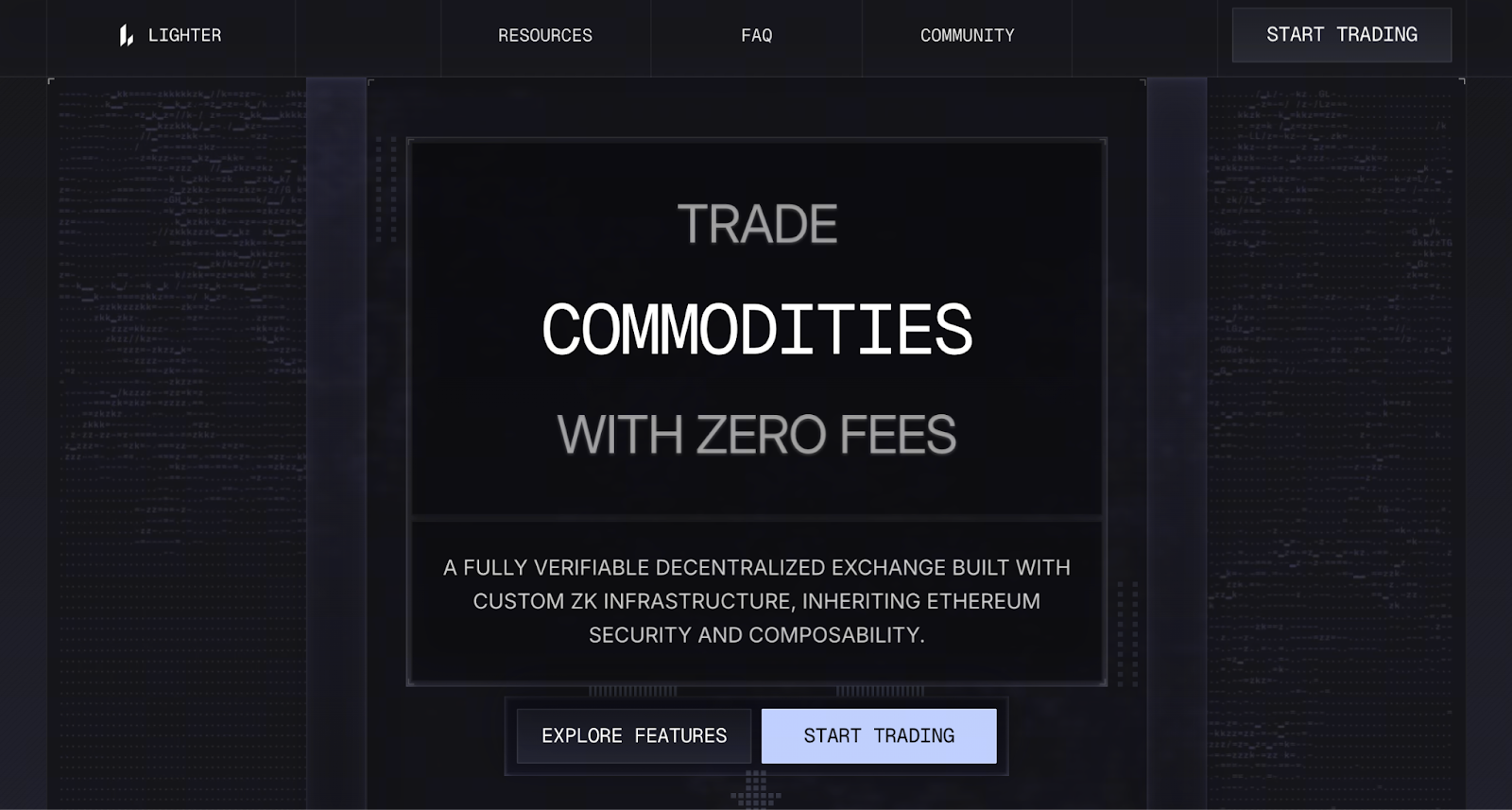
While most decentralized derivatives protocols still rely on the AMM model, Lighter takes a different path by returning to an order book design that closely resembles traditional financial markets. Built on Ethereum, the protocol leverages a dedicated zk-rollup architecture, enabling order matching, clearing, and state updates to remain decentralized while delivering high efficiency and verifiability.

Lighter’s primary goal is to make order book trading viable for high-frequency, institutional-grade perpetual contract markets—without sacrificing security.

How a Verifiable Matching Engine Elevates Market Fairness

Unlike traditional centralized exchanges, Lighter’s matching and clearing processes are fully transparent—not a black box. Every trade follows publicly defined rules, and cryptographic proofs are submitted to Ethereum for on-chain verification.

This structure allows market participants to confirm that:

  • Matching results remain free from manipulation
  • Clearing logic executes strictly according to protocol rules
  • The price discovery process is completely auditable

For professional traders who demand fairness and transparency, these features set Lighter apart from conventional DEX architectures.

Performance Engineered for High-Frequency and Institutional Trading

Lighter’s system architecture prioritizes ultra-low latency and high throughput. The platform handles a massive volume of order placements and cancellations within milliseconds, fully supporting the demands of high-frequency trading strategies.

At the same time, Lighter’s highly optimized infrastructure delivers zero maker and taker fees for retail traders, while institutional clients drive the platform’s main revenue streams—creating a transparent and sustainable business model.

Liquidity Sources and Market Making Mechanisms

Lighter’s primary liquidity comes from the Lighter Liquidity Pool. When users deposit funds, the system utilizes these assets to implement market-making strategies, providing substantial depth to the order book.

Liquidity providers earn revenue through:

  • Counterparty trading profits
  • Funding rate income
  • Clearing-related fees

This approach embeds liquidity within the protocol itself, rather than relying solely on external market makers.

Funding Background and Rising Market Attention

In November 2025, Lighter secured approximately $68 million in funding, reaching a valuation near $1.5 billion. The round was led by Founders Fund and Ribbit Capital, with participation from Haun Ventures, Robinhood, and others. After the funding, platform trading volume surged, at times overtaking several competitors. Since the official token has not yet launched, the active points program has fueled strong anticipation for a future airdrop.

LIT Token Value Capture and Distribution Model

According to official disclosures, all value created by the Lighter ecosystem will be returned to LIT token holders. Platform revenue is fully traceable on-chain in real time and is allocated between ecosystem growth initiatives and token buybacks based on market dynamics.

The token distribution is structured as follows:

50% Allocated to the Ecosystem

  • 25% comes from the 2025 points season and will be distributed by airdrop
  • The remaining 25% is reserved for future points programs, partnerships, and ecosystem development

50% Allocated to Team and Investors

  • 26% for the team, 24% for investors
  • Both allocations have a one-year lock-up, followed by linear vesting over three years

Real-World Use Cases for LIT

LIT is more than just a value token—it’s deeply integrated into the trading and infrastructure ecosystem. Its functions include:

  • Staking for participation in various tiers of trading and validation services
  • Serving as the fee token for market data access and price verification
  • Enabling a more decentralized trading and validation framework

The team has also made it clear: the future of finance lies at the intersection of TradFi and DeFi, with verifiable and composable infrastructure as the foundation.

To learn more about Web3, register here: https://www.gate.com/

Conclusion

From technology roadmap and funding scale to tokenomics, Lighter demonstrates a fundamentally different development strategy from most perpetual DEXs. Rather than chasing short-term hype, Lighter aims to build a robust, long-term trading infrastructure that balances efficiency, security, and transparency. As ZK technology matures, institutional involvement grows, and the LIT token goes live, Lighter’s potential to become a cornerstone of the decentralized derivatives market will be a key trend to watch in the years ahead.

Author: Allen
Disclaimer
* The information is not intended to be and does not constitute financial advice or any other recommendation of any sort offered or endorsed by Gate.
* This article may not be reproduced, transmitted or copied without referencing Gate. Contravention is an infringement of Copyright Act and may be subject to legal action.

Related Articles

What is Fartcoin? All You Need to Know About FARTCOIN
Intermediate

What is Fartcoin? All You Need to Know About FARTCOIN

Fartcoin (FARTCOIN) is a representative meme coin within the Solana ecosystem based on an AI-driven narrative. Its core concept originated from an experiment aimed at exploring the "boundaries between AI Agents and humor." More than just a digital asset with social attributes, the project deeply couples absurd humor culture with on-chain financial logic by integrating autonomous AI interaction models.
2026-04-04 22:01:19
Gold Price Forecast for the Next Five Years: 2026–2030 Trend Outlook and Investment Implications, Could It Reach $6,000?
Beginner

Gold Price Forecast for the Next Five Years: 2026–2030 Trend Outlook and Investment Implications, Could It Reach $6,000?

Analyze current gold price trends alongside authoritative five-year forecasts, integrating an evaluation of market risks and opportunities. This gives investors insight into the potential trajectory of gold prices and the main drivers expected to shape the market over the next five years.
2026-03-25 18:13:30
Aster vs Hyperliquid: Which Perp DEX Will Prevail?
Beginner

Aster vs Hyperliquid: Which Perp DEX Will Prevail?

Aster and Hyperliquid are the two representative protocols of the "purpose-built L1 path" within the current decentralized perpetual exchange (Perp DEX) sector. As a pioneer in the field, Hyperliquid has built a deep liquidity moat through its highly mature order book architecture and strong community consensus. Conversely, Aster, as a rising challenger, seeks to leapfrog the competition in high-performance trading through more aggressive multi-chain aggregation logic, private transaction modules, and an underlying execution environment optimized for 2026 market demands.
2026-03-24 11:58:33
AI-Native Settlement Layers: How United Stables Is Building the Next Financial Rail
Beginner

AI-Native Settlement Layers: How United Stables Is Building the Next Financial Rail

Stablecoins were originally designed as dollar substitutes within exchanges, primarily used for asset pricing and trade settlement. As on-chain financial ecosystems have matured, their role has expanded beyond simple payments to include collateral assets, cross-chain liquidity mediums, and unified settlement units. In particular, as AI systems and automated agents begin to participate directly in economic activity, demand has risen sharply for programmable value units capable of instant settlement. This shift is pushing stablecoins toward the role of foundational financial infrastructure.
2026-03-25 03:16:17
ASTER Tokenomics: Buybacks, Burns, and Staking as the Value Foundation of ASTER in 2026
Beginner

ASTER Tokenomics: Buybacks, Burns, and Staking as the Value Foundation of ASTER in 2026

ASTER is the native equity and governance token of the Aster ecosystem, with its core value built upon a radical "Deflationary Engine." Beyond serving as a governance tool, ASTER integrates multiple utilities including staking rewards, trading fee discounts, and liquidity incentives. Through its deep integration with the upcoming dedicated Layer 1 mainnet, it enables direct value capture from protocol cash flow to token holders.
2026-03-25 07:38:07
Hybrid Collateral Stablecoins: Inside United Stables' Stability and Yield Architecture
Beginner

Hybrid Collateral Stablecoins: Inside United Stables' Stability and Yield Architecture

In the early stages of the crypto market, traditional stablecoins mainly relied on single-reserve or single-collateral models. Their primary focus was price stability and payment convenience, which allowed them to become foundational tools for on-chain trading and capital flows. As the market has entered a more mature financial phase, however, this structure has begun to reveal limitations, including high concentration risk and the difficulty of balancing liquidity with yield. These constraints have driven the evolution toward multi-layer collateral and portfolio-based designs, such as the dual-layer hybrid collateral architecture proposed by United Stables, which seeks to redefine the underlying logic of stable assets.
2026-03-25 03:17:39