OpenSea’s Next Chapter: From NFT Marketplace Leader to a Multichain Governance Ecosystem

Beginner
Quick Reads
Last Updated 2026-03-27 10:27:21
Reading Time: 1m
OpenSea, once known primarily as the world’s largest NFT marketplace, is now entering the next era of multi-chain governance and protocol development. With the introduction of its native token SEA, the OS2 modular architecture, and robust cross-chain support, OpenSea is transforming from a simple trading platform into a foundational infrastructure for multi-chain NFTs.

OpenSea: Transforming the Gateway to the NFT World
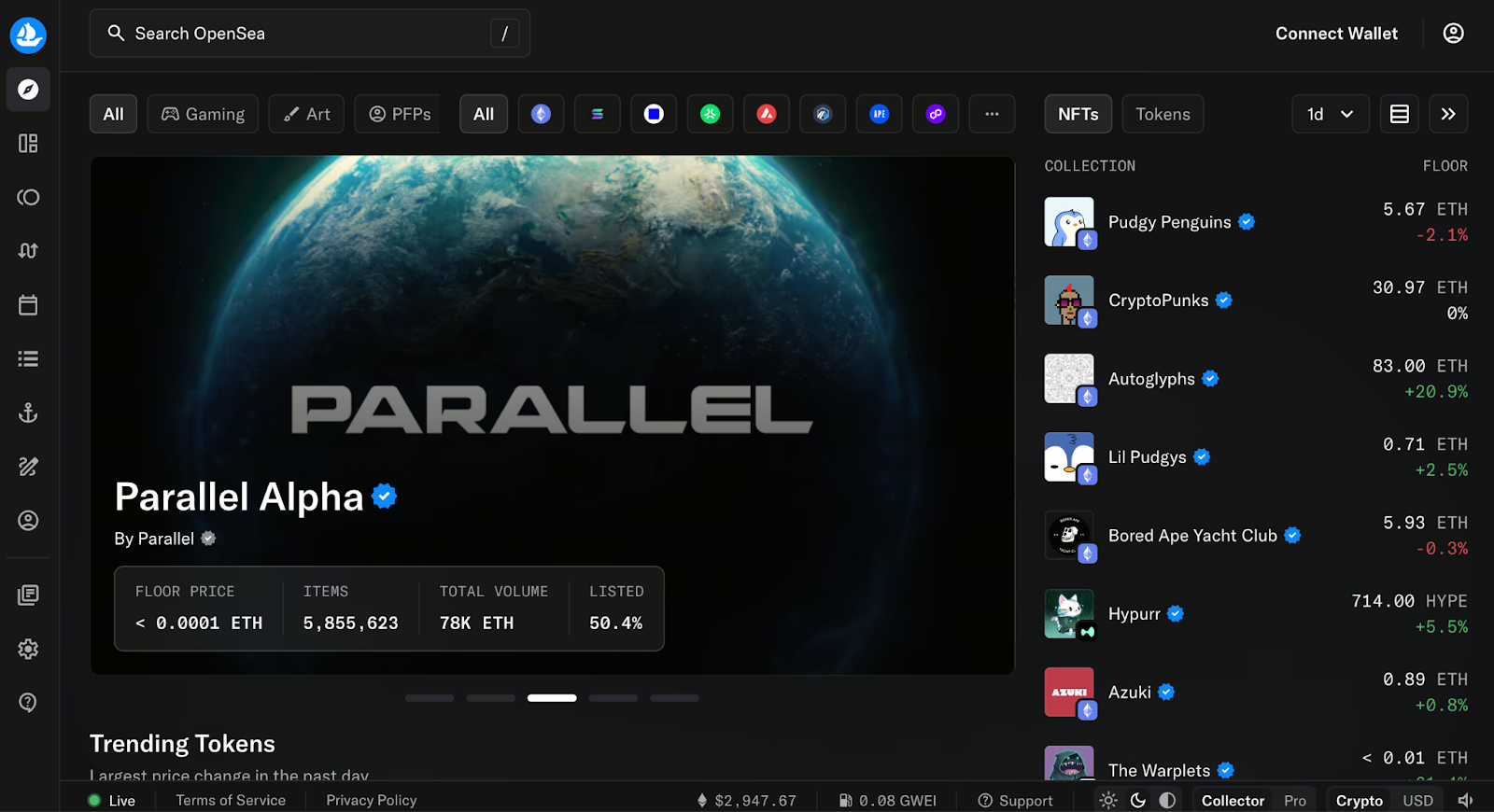

(Source: OpenSea)

Since launching in 2017, OpenSea has become synonymous with the global NFT marketplace. Collectors, artists, and gamers have all leveraged the platform to freely trade digital art, virtual land, in-game items, domain names, and other assets using cryptocurrency wallets.

OpenSea’s core mission is to make entry into the NFT world as intuitive as possible for everyone, lowering barriers and empowering both creators and collectors with greater freedom.

Diverse Assets and Cross-Chain Support: Creating a Truly Open NFT Ecosystem

OpenSea’s growth has never been confined to a single blockchain or asset type. The platform supports leading public blockchains like Ethereum, Polygon, and Solana, allowing users to manage cross-chain assets in familiar environments. Its interface retains the usability of Web2 platforms, so even newcomers with no blockchain experience can quickly mint, trade, and manage NFTs.

One standout feature is gas-free minting (lazy minting), which dramatically lowers the entry barrier for creators and helps them avoid missing opportunities due to high transaction fees. Smart contracts execute every transaction, allowing users to control their assets directly and supporting the decentralized spirit of NFT markets.

SEA Token: Turning the Platform into a Community-Governed Protocol

OpenSea’s next chapter is a shift from a centralized platform to a protocol shaped by its community, with the SEA token at the core of this evolution. SEA holders can vote on governance issues and propose directions for protocol upgrades, fee policies, and creator incentives. This transition makes OpenSea more than just a marketplace—it becomes a community-driven NFT ecosystem built collaboratively by its users.

Half of the SEA token supply will be allocated to the community through airdrops, incentives, and task rewards. OpenSea also pledges to use 50% of its platform revenue to buy back SEA, creating a positive cycle that links token value to platform usage. Gamified features like treasure chests and blue-chip NFT incentives further boost engagement, so governance participation is more than just voting—users can actively contribute to ecosystem growth.

OS2: Modular NFT Platform for the Multi-Chain Era

OpenSea continues to upgrade its foundational technology, with OS2 at the heart of this transformation. OS2’s modular smart contract architecture enables rapid adaptation to technological changes and allows targeted feature upgrades without a full system overhaul. The platform now supports over 19 public blockchains, streamlining the complexity of cross-chain NFT transfers. Enhanced contracts have reduced gas costs, making minting, trading, and managing NFTs more efficient and cost-effective. On the security side, OS2 strengthens self-custody, ensuring users always control their assets and reinforcing the platform’s commitment to decentralization.

To learn more about Web3, click to register: https://www.gate.com/

Conclusion

OpenSea has evolved beyond a simple NFT trading platform. It is becoming a multi-chain ecosystem where creation, governance, trading, protocol upgrades, and cross-chain interoperability are connected by OS2 and SEA. With gas-free minting, gamified incentives, and modular smart contract architecture, OpenSea is redefining NFT utility and enabling creators and collectors to generate value in a more open, interactive environment. As Web3 rapidly evolves, OpenSea’s latest phase is solidifying its role as a foundational layer in NFT infrastructure.

Author: Allen
Disclaimer
* The information is not intended to be and does not constitute financial advice or any other recommendation of any sort offered or endorsed by Gate.
* This article may not be reproduced, transmitted or copied without referencing Gate. Contravention is an infringement of Copyright Act and may be subject to legal action.

Related Articles

AI-Native Settlement Layers: How United Stables Is Building the Next Financial Rail
Beginner

AI-Native Settlement Layers: How United Stables Is Building the Next Financial Rail

Stablecoins were originally designed as dollar substitutes within exchanges, primarily used for asset pricing and trade settlement. As on-chain financial ecosystems have matured, their role has expanded beyond simple payments to include collateral assets, cross-chain liquidity mediums, and unified settlement units. In particular, as AI systems and automated agents begin to participate directly in economic activity, demand has risen sharply for programmable value units capable of instant settlement. This shift is pushing stablecoins toward the role of foundational financial infrastructure.
2026-03-25 03:16:17
DePIN Identity Network and Real World Applications: How Humanity Protocol Brings on-chain Identity Into the Physical World
Beginner

DePIN Identity Network and Real World Applications: How Humanity Protocol Brings on-chain Identity Into the Physical World

Most Web3 identity systems remain confined to on-chain environments and struggle to achieve meaningful adoption in real world settings. Through a DePIN architecture and physical verification hardware, Humanity Protocol aims to bring decentralized identity into access control systems, hospitality, public services, and offline events, allowing on-chain identity to function not just as a digital credential, but as foundational infrastructure for real world access.
2026-03-25 07:40:53
Gold Price Forecast for the Next Five Years: 2026–2030 Trend Outlook and Investment Implications, Could It Reach $6,000?
Beginner

Gold Price Forecast for the Next Five Years: 2026–2030 Trend Outlook and Investment Implications, Could It Reach $6,000?

Analyze current gold price trends alongside authoritative five-year forecasts, integrating an evaluation of market risks and opportunities. This gives investors insight into the potential trajectory of gold prices and the main drivers expected to shape the market over the next five years.
2026-03-25 18:13:30
Aster vs Hyperliquid: Which Perp DEX Will Prevail?
Beginner

Aster vs Hyperliquid: Which Perp DEX Will Prevail?

Aster and Hyperliquid are the two representative protocols of the "purpose-built L1 path" within the current decentralized perpetual exchange (Perp DEX) sector. As a pioneer in the field, Hyperliquid has built a deep liquidity moat through its highly mature order book architecture and strong community consensus. Conversely, Aster, as a rising challenger, seeks to leapfrog the competition in high-performance trading through more aggressive multi-chain aggregation logic, private transaction modules, and an underlying execution environment optimized for 2026 market demands.
2026-03-24 11:58:33
Aerodrome Tokenomics: How ve(3,3) Powers Base's Most Profitable DEX
Beginner

Aerodrome Tokenomics: How ve(3,3) Powers Base's Most Profitable DEX

AERO is the native token of Aerodrome Finance, a core decentralized exchange and liquidity protocol in the Base ecosystem. It is primarily used for liquidity incentives and ecosystem operations. veAERO is a governance NFT that users receive by locking AERO, representing both voting power and the right to share protocol revenue. Through a dual track structure of AERO as a utility token and veAERO as a governance credential, Aerodrome separates liquidity usage value from long term governance power, allowing participants to act as liquidity providers, governance decision makers, and revenue sharers within the same system.
2026-03-25 06:40:31
The ve(3,3) Flywheel Explained: How AERO Tokenomics Powers Aerodrome’s DeFi Economy
Beginner

The ve(3,3) Flywheel Explained: How AERO Tokenomics Powers Aerodrome’s DeFi Economy

In the competition for DeFi liquidity, high-inflation mining alone is no longer enough to build lasting advantages. Aerodrome applies the ve(3,3) economic model to redesign token emissions, voting mechanisms, and revenue distribution, creating a liquidity flywheel centered on governance and cash flow. This article examines AERO tokenomics, the veAERO locking mechanism, and protocol revenue models to explain how Aerodrome builds a sustainable DeFi economic system.
2026-03-25 06:41:58





