Ripple Launches $750 Million Share Buyback at $50 Billion Valuation

Beginner
Quick Reads
Last Updated 2026-03-24 16:46:42
Reading Time: 1m
Blockchain payment company Ripple is executing a stock buyback program valued at up to $750 million, lifting the company's total valuation to around $50 billion. The buyback will proceed via a tender offer, enabling select investors and employees to sell their holdings. This move also highlights Ripple's capital strategy and long-term positioning in the private market.

Ripple Announces Stock Buyback Program

Ripple Announces Stock Buyback Program (Source: Ripple)

Ripple, a leading blockchain payments company, has launched a stock buyback program with a maximum value of $750 million. Sources indicate this buyback places Ripple’s valuation at approximately $50 billion. The initiative will be executed through a tender offer, allowing select investors and employees to sell their shares back to the company. The buyback process is expected to continue through April.

Buyback Program Builds on Previous Capital Initiatives

This latest buyback is not Ripple’s first. In October 2025, Ripple proposed a $1 billion share buyback, valuing the company at $40 billion. However, limited participation resulted as some private shareholders opted not to sell.

In November, Ripple completed a strategic financing round of about $500 million, with the company’s valuation again at $40 billion. Institutional investors in this round included Fortress Investment Group, Citadel Securities, Pantera Capital, Galaxy Digital, Brevan Howard, and Marshall Wace.

No Immediate IPO Plans

Despite ongoing speculation about a potential public listing, Ripple’s management currently does not plan to pursue an initial public offering (IPO).

President Monica Long has stated that Ripple’s financial position remains strong, making the company more inclined to grow through the private market rather than entering the public market prematurely. She emphasized Ripple’s focus on expansion through mergers, acquisitions, and product innovation.

Continued Growth Through M&A

Ripple has actively expanded its business through acquisitions and investments, evolving from a cross-border payments platform into a provider of broader crypto financial infrastructure.

Key transactions include:

  • Acquisition of Hidden Road, valued at approximately $1.25 billion

  • Purchase of stablecoin platform Rail for $200 million

Ripple reports that it has invested roughly $4 billion in the crypto industry ecosystem through investments, acquisitions, and strategic partnerships.

Expanding Presence in Asia-Pacific
Expanding Presence in Asia-Pacific (Source: Ripple)

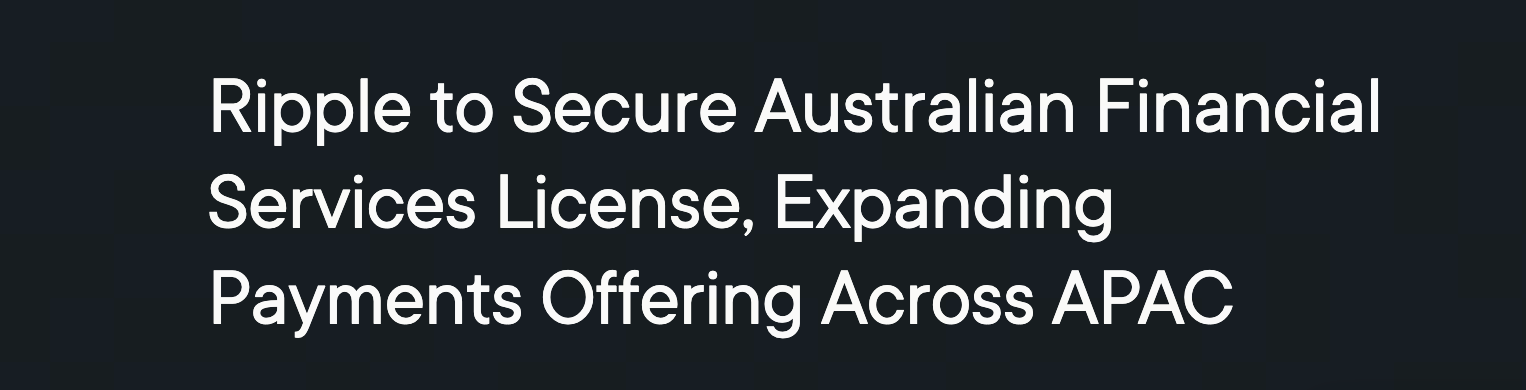
In addition to acquiring fintech firms, Ripple continues to broaden its global regulatory and market footprint. Earlier this week, the company announced plans to acquire BC Payments, which will secure an Australian Financial Services License (AFSL) and further expand Ripple’s business in the Asia-Pacific region. This move underscores Ripple’s commitment to building a globally compliant payments network.

Cross-Border Payments Business Maintains Momentum

Ripple recently disclosed that its payments network has processed over $100 billion in cumulative transaction volume. The company notes that an increasing number of fintech firms are leveraging stablecoins to address liquidity shortages and settlement inefficiencies in cross-border payments, and Ripple’s infrastructure is steadily gaining market adoption. As global financial institutions deepen their interest in blockchain payment solutions, Ripple’s cross-border payments business continues to grow.

Conclusion

Ripple’s $750 million stock buyback program highlights its capital strategy in the private market and signals confidence in its long-term outlook. By strengthening its business portfolio through acquisitions, investments, and global market expansion, Ripple is building a robust blockchain financial infrastructure. Despite ongoing volatility and uncertainty in the crypto market, rising demand for cross-border payments and stablecoin applications suggests Ripple’s impact in the global digital payments sector will continue to expand.

Author:  Allen
Disclaimer
* The information is not intended to be and does not constitute financial advice or any other recommendation of any sort offered or endorsed by Gate.
* This article may not be reproduced, transmitted or copied without referencing Gate. Contravention is an infringement of Copyright Act and may be subject to legal action.

Related Articles

What is Fartcoin? All You Need to Know About FARTCOIN
Intermediate

What is Fartcoin? All You Need to Know About FARTCOIN

Fartcoin (FARTCOIN) is a representative meme coin within the Solana ecosystem based on an AI-driven narrative. Its core concept originated from an experiment aimed at exploring the "boundaries between AI Agents and humor." More than just a digital asset with social attributes, the project deeply couples absurd humor culture with on-chain financial logic by integrating autonomous AI interaction models.
2026-04-04 22:01:19
Gold Price Forecast for the Next Five Years: 2026–2030 Trend Outlook and Investment Implications, Could It Reach $6,000?
Beginner

Gold Price Forecast for the Next Five Years: 2026–2030 Trend Outlook and Investment Implications, Could It Reach $6,000?

Analyze current gold price trends alongside authoritative five-year forecasts, integrating an evaluation of market risks and opportunities. This gives investors insight into the potential trajectory of gold prices and the main drivers expected to shape the market over the next five years.
2026-03-25 18:13:30
Aster vs Hyperliquid: Which Perp DEX Will Prevail?
Beginner

Aster vs Hyperliquid: Which Perp DEX Will Prevail?

Aster and Hyperliquid are the two representative protocols of the "purpose-built L1 path" within the current decentralized perpetual exchange (Perp DEX) sector. As a pioneer in the field, Hyperliquid has built a deep liquidity moat through its highly mature order book architecture and strong community consensus. Conversely, Aster, as a rising challenger, seeks to leapfrog the competition in high-performance trading through more aggressive multi-chain aggregation logic, private transaction modules, and an underlying execution environment optimized for 2026 market demands.
2026-03-24 11:58:33
AI-Native Settlement Layers: How United Stables Is Building the Next Financial Rail
Beginner

AI-Native Settlement Layers: How United Stables Is Building the Next Financial Rail

Stablecoins were originally designed as dollar substitutes within exchanges, primarily used for asset pricing and trade settlement. As on-chain financial ecosystems have matured, their role has expanded beyond simple payments to include collateral assets, cross-chain liquidity mediums, and unified settlement units. In particular, as AI systems and automated agents begin to participate directly in economic activity, demand has risen sharply for programmable value units capable of instant settlement. This shift is pushing stablecoins toward the role of foundational financial infrastructure.
2026-03-25 03:16:17
Aerodrome Tokenomics: How ve(3,3) Powers Base's Most Profitable DEX
Beginner

Aerodrome Tokenomics: How ve(3,3) Powers Base's Most Profitable DEX

AERO is the native token of Aerodrome Finance, a core decentralized exchange and liquidity protocol in the Base ecosystem. It is primarily used for liquidity incentives and ecosystem operations. veAERO is a governance NFT that users receive by locking AERO, representing both voting power and the right to share protocol revenue. Through a dual track structure of AERO as a utility token and veAERO as a governance credential, Aerodrome separates liquidity usage value from long term governance power, allowing participants to act as liquidity providers, governance decision makers, and revenue sharers within the same system.
2026-03-25 06:40:31
Hybrid Collateral Stablecoins: Inside United Stables' Stability and Yield Architecture
Beginner

Hybrid Collateral Stablecoins: Inside United Stables' Stability and Yield Architecture

In the early stages of the crypto market, traditional stablecoins mainly relied on single-reserve or single-collateral models. Their primary focus was price stability and payment convenience, which allowed them to become foundational tools for on-chain trading and capital flows. As the market has entered a more mature financial phase, however, this structure has begun to reveal limitations, including high concentration risk and the difficulty of balancing liquidity with yield. These constraints have driven the evolution toward multi-layer collateral and portfolio-based designs, such as the dual-layer hybrid collateral architecture proposed by United Stables, which seeks to redefine the underlying logic of stable assets.
2026-03-25 03:17:39





