As DeFi trading continues to grow, users swapping tokens on-chain must consider not only price, but also high gas costs and potential slippage. During periods of network congestion, transaction fees can rise sharply, making small trades especially uneconomical. At the same time, because transactions are publicly visible in the mempool, they are vulnerable to front-running and sandwich attacks, both common forms of MEV that can worsen execution prices.
Against this backdrop, improving execution efficiency has become a key focus in the evolution of DeFi infrastructure. The Fusion mechanism introduced by 1inch is designed to address gas costs, slippage, and MEV risks in on-chain swaps. By introducing a new execution model, it delivers a more efficient trading experience and pushes decentralized trading toward lower costs and higher performance.
What Is 1inch Fusion?
1inch Fusion is a smart swap mechanism that allows users to complete token exchanges by submitting an order request, while the actual on-chain execution is handled by third-party participants. In this setup, users do not need to pay gas fees directly, as they would in a traditional swap. Instead, the execution party covers these costs.
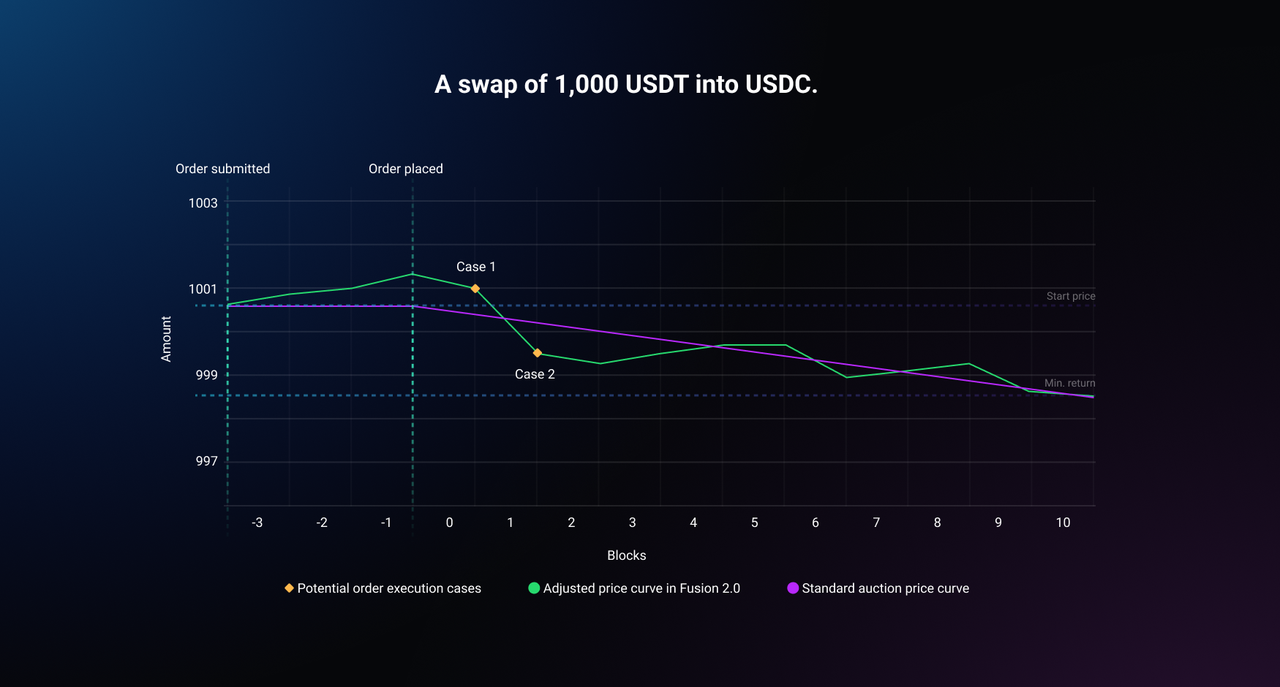
At its core, Fusion combines quote aggregation with order execution. Users simply define their swap conditions, and the system automatically finds the optimal execution path, which is then carried out by a resolver. This reduces operational complexity and makes the entire process more efficient.
How Does 1inch Fusion Work?
In the Fusion model, once a user submits an order, it is not immediately sent on-chain. Instead, Resolvers within the network compete to execute the order. These Resolvers are typically professional market makers or liquidity providers who submit quotes based on the order’s conditions and compete for execution rights.
Once a Resolver wins the bid, it handles the on-chain transaction and pays the required gas fees. Because multiple Resolvers compete for each order, this market-driven mechanism improves pricing quality and increases the likelihood of favorable execution. For users, the process is simpler, while execution becomes more efficient.
Why Can 1inch Fusion Offer Gasless Swaps?
The so-called “gasless” feature of 1inch Fusion does not eliminate gas costs entirely. Instead, it shifts the responsibility for paying gas fees to Resolvers. On-chain execution still requires gas, but users do not pay it directly.
This approach significantly reduces users’ upfront costs, especially when network fees are high. For smaller trades in particular, it helps prevent transaction fees from eroding profits, improving overall capital efficiency.
How Does 1inch Fusion Reduce Slippage and MEV Risks?
In traditional DEX models, user orders are publicly visible in the mempool, making them easy targets for arbitrage bots. Through front-running or sandwich attacks, these bots can interfere with transactions and lead to worse execution prices.
Fusion minimizes the time orders are exposed to the public market by allowing Resolvers to compete off-chain before execution. This reduces the likelihood of MEV exploitation. At the same time, competition among Resolvers helps secure better pricing, which also reduces slippage. As a result, Fusion improves both cost efficiency and execution quality.
How Is 1inch Fusion Different From a Standard Swap?
In a traditional swap, users must pay gas fees themselves and directly face slippage risks during on-chain execution. With Fusion, these complexities are handled by Resolvers, allowing users to focus only on the final outcome.
This makes Fusion feel closer to a centralized exchange experience. Users do not need to worry about gas fees or route optimization, making it a more user-friendly option for those seeking convenience and cost efficiency.
What Does 1inch Fusion Mean for Users?
For DeFi users, the biggest advantage of 1inch Fusion is the lower barrier to entry for on-chain trading. In the past, gas fees and slippage could heavily influence trading decisions. Fusion improves both cost control and execution quality through its optimized model.
This enhancement is significant for the broader adoption of DeFi. It makes decentralized trading more accessible to everyday users and brings its efficiency closer to that of centralized platforms, helping lay the groundwork for future growth.
Conclusion: How 1inch Fusion Improves On-Chain Trading
1inch Fusion uses a competitive Resolver-based execution model to shift transaction costs to professional participants, helping users reduce gas expenses and minimize slippage. Compared to traditional swaps, it delivers a better trading experience without increasing complexity.
As DeFi infrastructure continues to evolve, execution efficiency is becoming a defining factor in user experience. By optimizing execution paths and reducing MEV risks, 1inch Fusion provides a more efficient solution for on-chain swaps and further strengthens 1inch’s position in the DEX aggregation space.
FAQs
Is 1inch Fusion truly gasless?
Not entirely. Gas fees still exist, but they are paid by Resolvers instead of users.
Why is 1inch Fusion more efficient than a standard swap?
Because it uses Resolver competition to optimize execution paths, reduce user costs, and minimize slippage and MEV risks.
Is 1inch Fusion safe?
Fusion reduces MEV risks by limiting order exposure in the public mempool, but users should still be aware of general smart contract and on-chain risks.
Who is 1inch Fusion suitable for?
It is especially suitable for users who want to lower gas costs, reduce slippage, and improve overall trading efficiency on-chain.







