Gate for AI: A Next-Generation Trading Framework for AI Agents
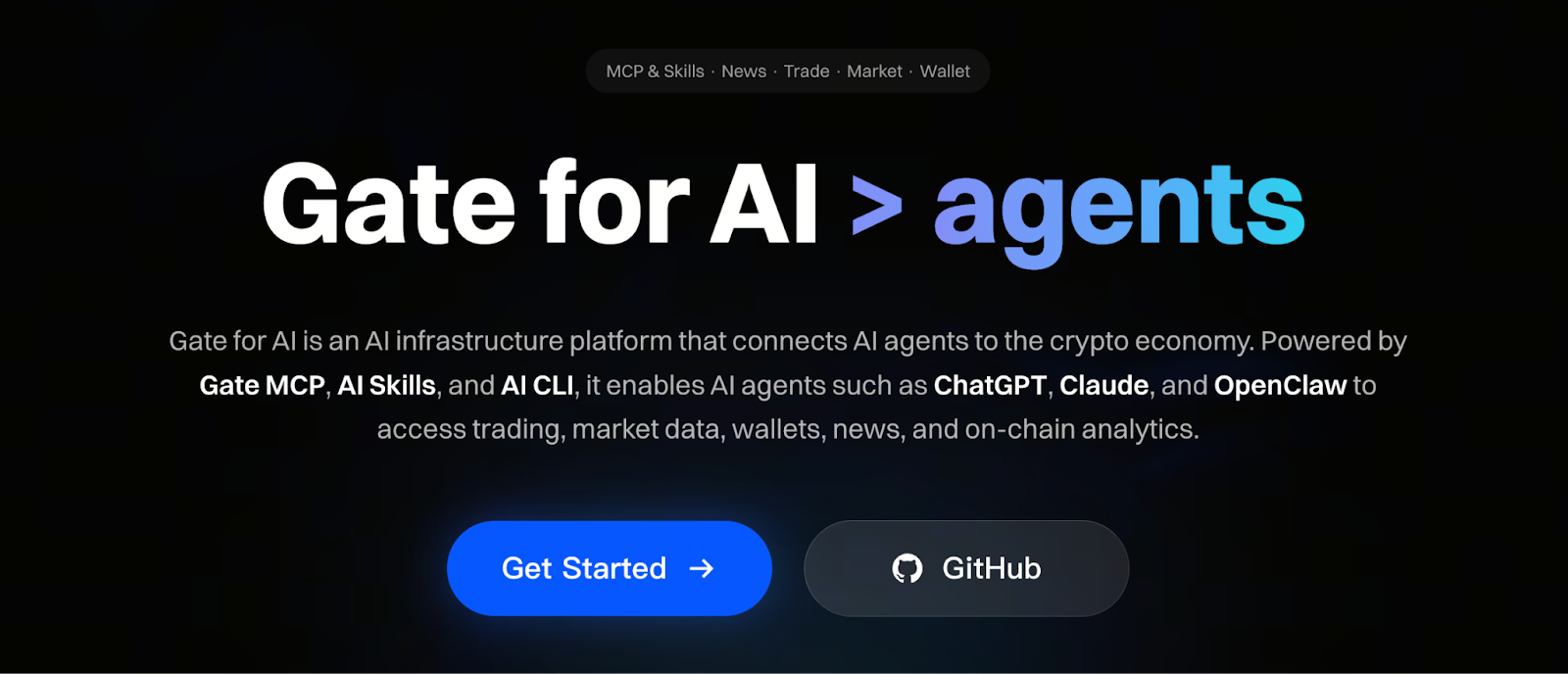
Traditional crypto trading platforms have been designed primarily for human users, with features like trading interfaces, charting tools, and asset management dashboards. However, as AI technology advances, the market is seeing new demands—specifically, enabling AI to directly engage in market analysis and trading operations.
Gate's Gate for AI is an intelligent trading infrastructure built for this emerging trend. Rather than serving as a single trading tool, it provides a comprehensive technical framework that empowers AI agents to perform data analysis, strategy evaluation, and trade execution within one unified system. By integrating core functional modules, Gate for AI consolidates capabilities that were previously fragmented across different systems, allowing AI to manage the entire trading process on a single platform.
Five Core Capabilities: Building a Complete Trading Ecosystem
Gate for AI is engineered to merge multiple layers of market functionality, giving AI simultaneous access to diverse market data and trading tools—enabling strategies to operate in conditions that closely mirror real-world markets. The architecture is anchored by five essential capabilities, systematically establishing a robust AI trading ecosystem.
1. Centralized Trading Capability
Gate for AI connects directly to the platform’s spot trading, derivatives contracts, wealth management products, and new asset issuance features. Leveraging the exchange’s mature matching and liquidity systems, AI can execute orders in a live trading environment and support more sophisticated strategy combinations, such as arbitrage, trend trading, or multi-market allocation.
2. On-Chain Trading Capability
Beyond centralized markets, the system also supports decentralized trading scenarios. AI can conduct swaps, on-chain perpetual contract trading, or meme token transactions across various blockchain networks, taking advantage of on-chain liquidity and price discrepancies to unlock broader strategic opportunities.
3. Wallet and Signature System
Gate for AI integrates wallet creation, private key management, and authorization signature capabilities. Within the scope of user permissions, AI can automatically transfer assets or interact with smart contracts, streamlining on-chain operations and providing the foundational infrastructure for automated trading and strategy execution.
The platform supplies structured market news, price updates, and event analysis, enabling AI to stay up-to-date with market developments. With continuously refreshed data sources, AI can swiftly adjust trading strategies to respond to market volatility.
5. On-Chain Data Query Capability
Gate for AI aggregates multiple on-chain data sources, allowing AI to perform in-depth analysis of tokens, project developments, address activity, and transaction history. Through multidimensional data analysis, AI gains a comprehensive understanding of market structures, providing a solid foundation for strategic decision-making.
Skills Hub: Streamlining Strategy Configuration
A key innovation of Gate for AI is the Skills Hub—a strategy module configuration center that lets users easily assign trading capabilities to AI agents.
Within the Skills Hub, a variety of trading strategies are available as modules, including market scanning, price range evaluation, arbitrage opportunity detection, and risk analysis. Users can build complete trading logic simply by selecting and combining different modules, with no programming experience required.
This modular approach lowers the barrier to entry while preserving strategic flexibility. AI can continuously monitor the market based on preset strategies, and automatically execute trades or adjust positions when conditions are met.
For example, if the market shows potential liquidation signals or abnormal funding rates, AI can automatically assess arbitrage opportunities according to the strategy, open trading positions under authorized conditions, and implement risk control mechanisms.
Additionally, users can interact with AI using natural language—such as asking whether a particular asset is suitable for establishing a position. The system consolidates market trends, liquidity, and risk data to generate structured analysis reports, and executes trades upon user confirmation.
Dual-Layer Technical Architecture: MCP and Skills
To balance versatility and strategic depth, Gate for AI adopts a dual-layer architecture: MCP and Skills.
MCP (Standardized Tool Interface) handles fundamental functions such as market data queries, account management, order operations, and on-chain data access. This layer provides a unified API, enabling different AI systems to quickly integrate and leverage platform features.
On top of this, the Skills layer delivers advanced strategic capabilities. It integrates multiple data sources and analytical models into strategy modules, enabling AI to perform high-level tasks such as arbitrage analysis, risk assessment, or strategy generation.
This dual-layer structure ensures Gate for AI offers both broad compatibility and strategic scalability, meeting the needs of users and developers at all levels.
The Industry Impact of AI Trading Infrastructure
The launch of Gate for AI signals a shift as crypto trading platforms move toward AI-native architectures. Previously, exchanges focused on providing operational interfaces; under this new paradigm, core platform capabilities are transformed into infrastructure that AI can directly access.
This approach enables AI to move beyond analysis, actively participating in market decision-making and trade execution. With integrated market functions and strategy modules, AI agents can complete market research and strategy deployment in less time. Meanwhile, the modular Skills Hub design allows more users to engage in intelligent trading, lowering technical barriers and expanding AI’s role in financial markets.
Learn more about Gate for AI: https://www.gate.com/gate-for-ai
Conclusion
As artificial intelligence becomes increasingly embedded in financial markets, the role of trading platforms is undergoing a transformation. Gate for AI unites trading, data, and strategy capabilities to establish an intelligent trading infrastructure that AI agents can access directly. With its five core capability domains, Skills Hub strategy modules, and MCP + Skills dual-layer architecture, Gate for AI enables AI to complete the full cycle from market research and strategy analysis to trade execution. This approach not only boosts trading efficiency but also lays a new technological foundation for the future of intelligent financial markets. As more strategy modules and features are introduced, AI’s presence in the crypto market will only grow more significant—making Gate for AI a key driver of this evolution.