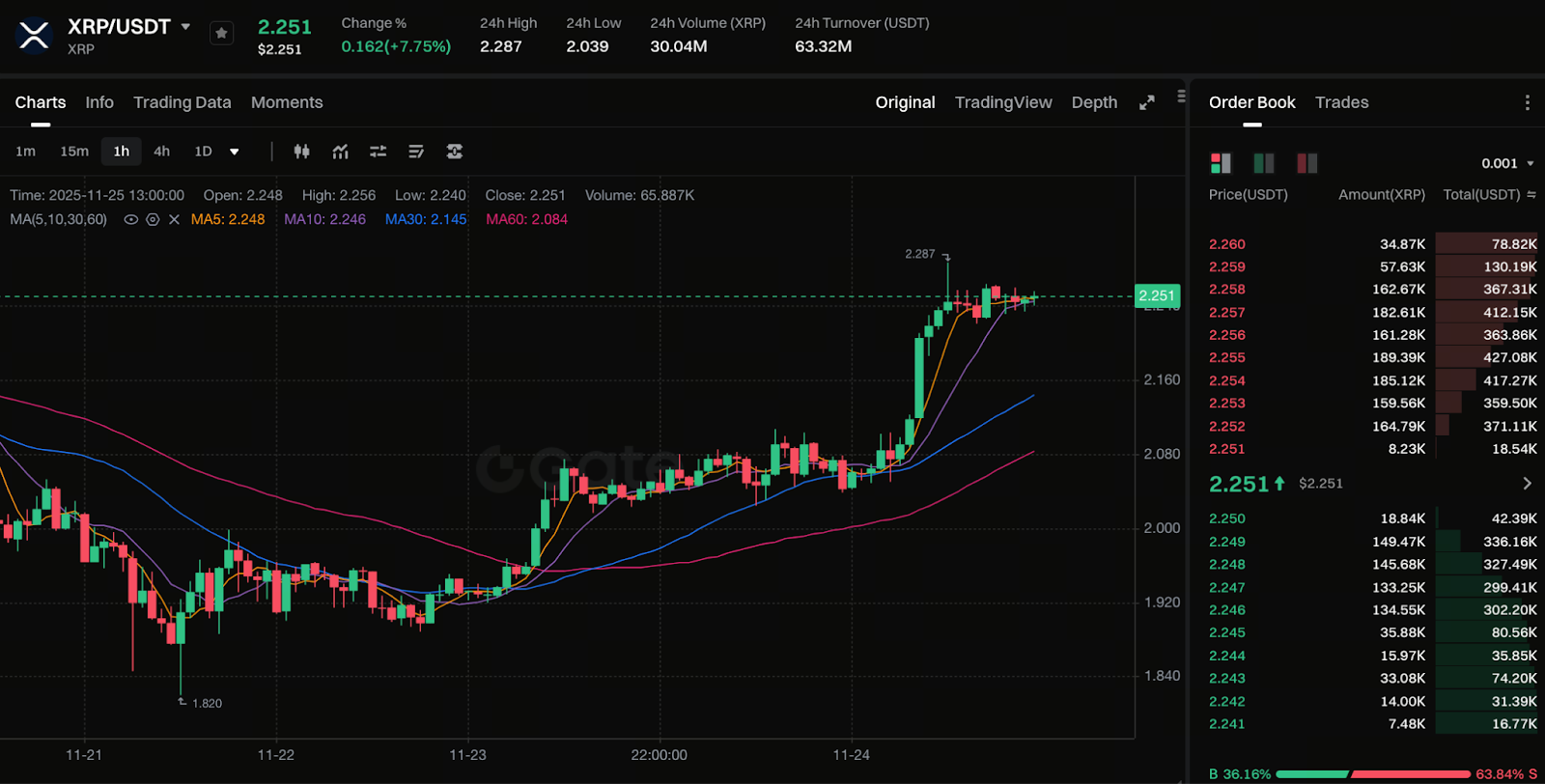
Image: https://www.gate.com/trade/XRP_USDT
As demand for ETF (Exchange-Traded Fund) products surges in the crypto market, analysts have conducted in-depth modeling on XRP’s (Ripple) potential trajectory post-ETF launch. Crypto analyst Diana published an “XRP ETF Launch Impact Model” on X, which has attracted significant market attention. According to her model, XRP could reach a price range of $7 to $24 within 60 days of an ETF launch.
Model Insights: How Did Diana Arrive at $24?
Diana’s model is rooted in supply-absorption mathematics. By simulating capital inflows from ETF issuers (fund companies) purchasing XRP and factoring in the scarcity of liquid supply in the market, she forecasts potential price movements.
She evaluated scenarios with 5 to 20 ETFs launching simultaneously, each with initial capital of $10 million to $45 million. This puts the total inflow in a range from roughly $50 million to $900 million.
How Inflow Size and ETF Quantity Shape Impact
Diana’s model shows that if 20 ETFs launch with maximum seed capital, total inflows could approach $900 million, exerting the greatest absorption effect on XRP’s circulating supply. Such substantial institutional buying would sharply reduce the available market float, leading to upward pressure on price as supply tightens.
The model projects XRP to fluctuate between $3.00 and $15.00 within 30 days of launch. After 60 days, the price could potentially reach as high as $24.00.
XRP Circulating Supply Squeeze: Why Does the Price Surge?
Diana notes that ETF issuers must purchase actual XRP for the underlying exposure of their products, making their demand for XRP direct and impactful. As these issuers continue to buy, the available circulating supply is locked or diminished, resulting in a “liquidity squeeze.” This dynamic of shrinking supply combined with ongoing capital inflows forms the core of her bullish price projection.
Why Does Actual Price Diverge from the Model?
The model’s forecast is highly aggressive, yet real-world XRP prices have not yet reflected this momentum. Current data show that even after the successful launch of the “Canary XRP ETF,” XRP still trades around $2.14—far below the model’s projected range.
Diana explains that this initial weakness is typical during the ETF rollout phase, because:
- Early ETF buyers are often traders or speculators who buy before launch and take profits shortly after listing;
- Large institutional capital doesn’t enter all at once on launch day. Institutions typically invest in phases, after conducting compliance reviews, obtaining internal approvals, and completing allocation cycles.
- Consequently, volatility and price adjustments often occur in the weeks or months following an ETF’s debut, before sustained, fundamental capital inflows begin.
This pattern mirrors the experience seen with Bitcoin ETFs. For example, there was temporary volatility and a subsequent rally after the 2024 Bitcoin ETF launch.
Potential Risks and Uncertainties to Consider
Despite the model’s optimism, investors should not overlook these key risks:
- Lower-than-expected inflows: If seed capital is limited or some funds fail to buy XRP at scale, actual inflows could fall well short of the most bullish scenario.
- Circulating supply estimate errors: The model assumes a fixed range for XRP’s circulating supply, but real-world figures could be larger (or smaller), affecting the supply squeeze.
- Market sentiment: The ETF rollout may trigger “buy the rumor, sell the news” speculation, causing sharp price swings in the short term.
- Regulatory and compliance risk: ETF issuers must navigate regulatory scrutiny. Delays or failures in ETF launches could severely diminish their impact on XRP.
- Macro and crypto market risk: Broader crypto volatility, macroeconomic shifts, and interest rate policy could all affect sustained capital flows into XRP.
Guidance for Investors: Assessment and Action
- Long-term XRP bulls should monitor ETF launch progress, as well as the number of ETFs and deployment of seed capital.
- If you have conviction in Diana’s large-scale inflow scenario, consider building a position gradually at lower price levels (using a gradual approach).
- Conservative investors and traders should watch for early-stage volatility, using stop-loss and take-profit strategies when necessary.
- Ultimately, base every investment decision on your own risk tolerance and independent research. Avoid making concentrated investments based solely on model projections.
Conclusion
Diana’s “XRP ETF Launch Impact Model” offers a compelling, forward-looking perspective: under the most optimistic conditions, XRP could reach $24 within 60 days of an ETF debut. However, listing timelines, actual capital inflows, and the occurrence of a supply squeeze remain uncertain. Investors face both an exciting opportunity and a need for caution. The prudent approach is to keep a close watch on ETF developments. Align any actions with your own risk profile in an environment characterized by high volatility and opportunity.







