The city council of Haverhill, Massachusetts is set to consider a ban on cryptocurrency ATMs following a proposal for an ordinance introduced on March 17.
According to Haverhill City Council’s agenda, the government body is scheduled to review a crypto ATM ordinance introduced by Mayor Melinda E. Barrett. The proposal would amend the city code to prohibit cryptocurrency ATMs, an ordinance which received a unanimous 11 votes in the council’s March 17 meeting.
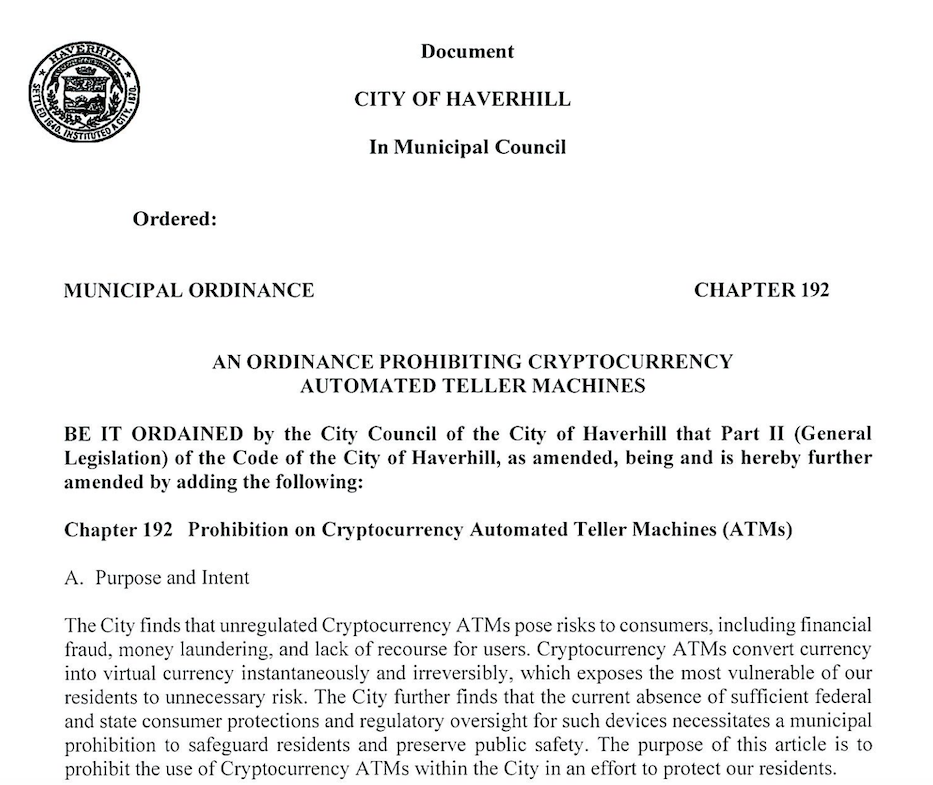
_Source: _Haverhill City Council
The ordinance cited potential risks to Haverhill residents due to “financial fraud, money laundering and lack of recourse” for ATM users. The city said the absence of state and federal regulations necessitated local authorities stepping in. If passed, all crypto kiosks and ATMs would need to be removed from the city within 60 days or face a $300 a day fine.
Haverhill‘s proposed action is just one of many examples of jurisdictions across the US introducing bans on crypto ATMs in response to scams and other illegal activities. In February, a Minnesota lawmaker introduced a bill that could ban crypto kiosks, building on a 2024 law that imposed restrictions on ATM operators.
**Related: **__Crypto gains political clout among 80% of UK young voters
According to data reported by CoinATMRadar and crypto ATM operator Bitcoin Depot, there could be eight or more machines in the Haverhill area. Cointelegraph reached out to Mayor Barrett’s office for comment but had not received a response at the time of publication.
Bitcoin Depot stock declines as company shakes up leadership
As one of the largest crypto ATM operators in the US, the share price of Bitcoin Depot stock (BTM) has declined since 2025, dropping by more than 90% in the past six months. As of Tuesday, the stock was trading at $2.06 on the Nasdaq.
In additional to the potential ordinance in Haverhill, Bitcoin Depot faced Connecticut banking regulators issuing a temporary cease-and-desist order in March, effectively suspending its money transmission license. Authorities in Iowa and Massachusetts have also sued the company for allegedly facilitating crypto scams.
Last week, Bitcoin Depot announced that Scott Buchanan had stepped down as CEO, having served at the role for less than three months. Board member and former MoneyGram CEO Alex Holmes replaced Buchanan as CEO and chair.
Cointelegraph reached out to Bitcoin Depot for comment on the Haverhill ordinance but had not received a response at the time of publication.
**Magazine: **__Are DeFi devs liable for the illegal activity of others on their platforms?
Cointelegraph is committed to independent, transparent journalism. This news article is produced in accordance with Cointelegraph’s Editorial Policy and aims to provide accurate and timely information. Readers are encouraged to verify information independently. Read our Editorial Policy https://cointelegraph.com/editorial-policy
- #Cryptocurrencies
- #Law
- #ATM
- #Government
- #Scams
- #Regulation
Disclaimer: The information on this page may come from third parties and does not represent the views or opinions of Gate. The content displayed on this page is for reference only and does not constitute any financial, investment, or legal advice. Gate does not guarantee the accuracy or completeness of the information and shall not be liable for any losses arising from the use of this information. Virtual asset investments carry high risks and are subject to significant price volatility. You may lose all of your invested principal. Please fully understand the relevant risks and make prudent decisions based on your own financial situation and risk tolerance. For details, please refer to
Disclaimer.
Related Articles
The Senate Banking Committee will move the “CLARITY Act” off the agenda for the week of April 20.
The CLARITY Act was not included in the April 20 agenda for consideration by Tim Scott, Chairman of the Senate Banking Committee. Senator Tom Tillis is set to release the latest draft, which includes compromise provisions related to stablecoin yield rates. Coinbase has switched to support, while the banking group still opposes the measure. The bill must pass multiple steps before it can become law.
MarketWhisper2h ago
Bank of England governor warns: Global stablecoin standards are lagging, calls for a unified regulatory framework
Bank of England Governor Andrew Bailey said at an IIF event that the effective functioning of stablecoins depends on users’ confidence in full redemption mechanisms, calling for the development of international standards. The United States has meanwhile released the GENIUS Act, requiring stablecoin issuers to meet compliance requirements. In South Korea, Circle’s CEO said there are no plans to launch a won-pegged stablecoin, and that the company is currently watching local legislative debates.
MarketWhisper2h ago
Cato Institute Recommends U.S. Eliminate Capital Gains Tax on Cryptocurrencies to Promote Monetary Competition
The Cato Institute urges the U.S. to abolish capital gains taxes on cryptocurrencies to simplify tax filing and enhance monetary competition. This move aims to encourage cryptocurrency use in transactions by lessening tax-related complexities.
GateNews2h ago
Senator Warren Presses Musk on X Money Risks, Citing Stablecoin Concerns and Regulatory Gaps
Senator Elizabeth Warren has asked Elon Musk for details on X Money, a payments feature for X, raising concerns about stablecoin risks, regulatory issues, financial stability, and data privacy, with a response due by April 21, 2026.
GateNews2h ago
South Korea’s Ministry of Economy and Finance announces a pilot for a “Blockchain Treasury,” launching in Sejong City in the fourth quarter
On April 16, the Ministry of Economy and Finance of South Korea announced that the “pilot project to use blockchain digital currency to execute treasury funds” has been selected as the regulatory sandbox program hosted by the National Affairs Coordination Office for 2026. According to the Ministry of Economy and Finance’s notice, the pilot program allows government agencies to use blockchain “deposit tokens” to execute part of their commercial promotion expenses, replacing the current government procurement card. The plan is to prioritize launching in Sejong City in the fourth quarter of 2026, and expand the scope afterward based on an assessment of the results.
MarketWhisper3h ago


