Google Stock usually refers to Alphabet Inc. Class A Common Stock, commonly identified by the ticker GOOGL. Because Google is one of the most widely followed technology businesses, users may compare different ways to access its stock price movement, including Gate Stocks, traditional brokerage accounts, and other stock-related products.
Gate Stocks gives eligible users a crypto-native route to supported U.S. stock and ETF exposure using USDT settlement. That structure can simplify the funding path for users who already hold USDT, but it also means users should review product rules, rights treatment, transfer limitations, regional eligibility, and order details before making any decision.
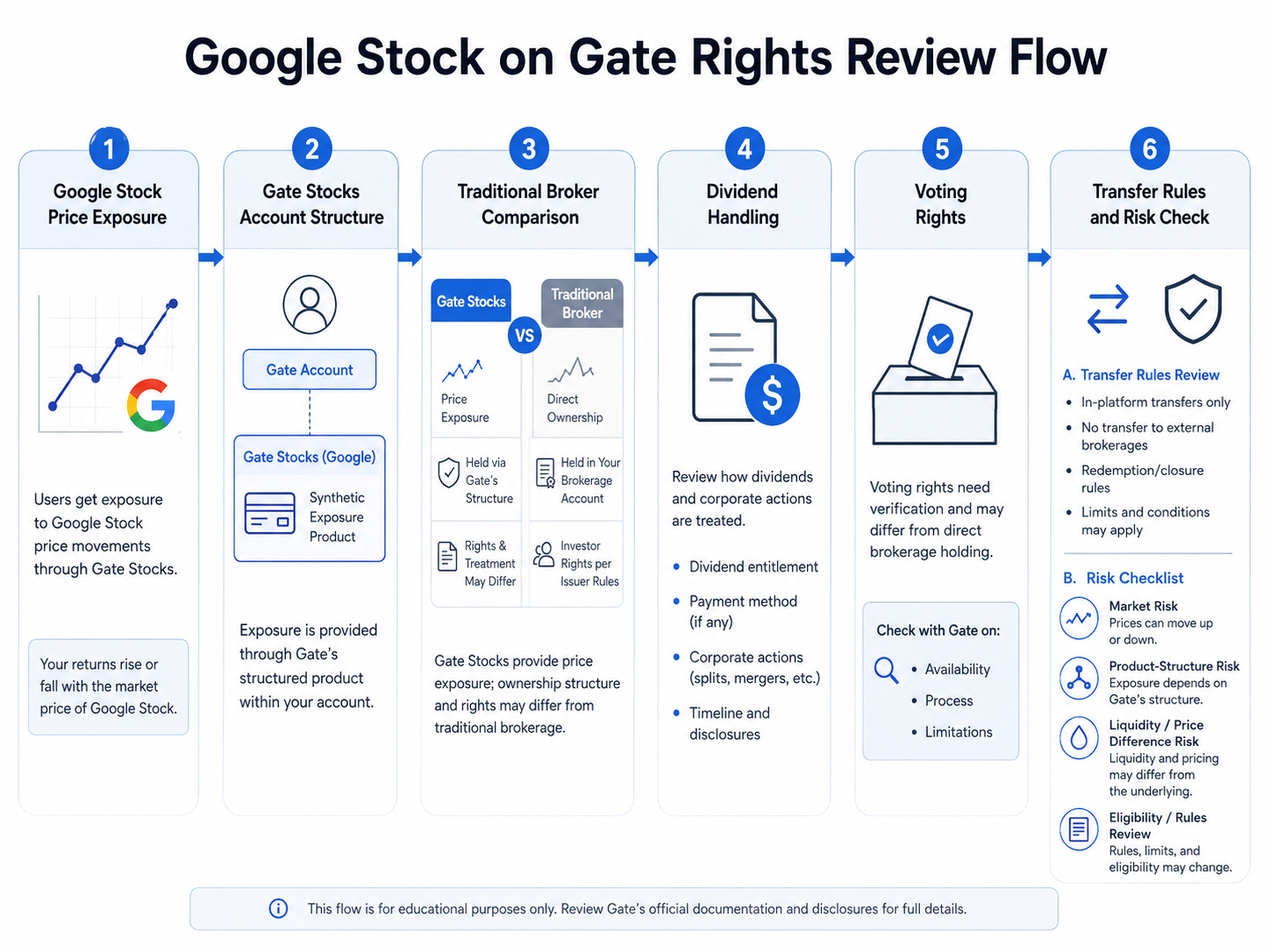
What Is the Key Difference Between Buying Google Stock on Gate and Buying It Through a Traditional Broker?
The key difference is the product structure behind the user experience. Buying Google Stock on Gate means accessing Google Stock (GOOGL) through Gate Stocks, where eligible users can use USDT as the funding and settlement asset for supported U.S. stock exposure. A traditional broker usually follows a securities account model where users deposit fiat currency, trade through brokerage infrastructure, and may receive broader shareholder services depending on the broker, market, custody arrangement, and jurisdiction.
This difference matters because the surface action may look similar, but the surrounding rules are not always the same. In both cases, users may participate in Google Stock price movements. However, account setup, settlement asset, order interface, reporting format, rights handling, and transfer options may differ. Users who want to understand the basic funding process can review the related tutorial on buying Google Stock with USDT on Gate, while broader product context is covered in the explanation of Gate Stocks trading.
Before using either route, users should check the live product information as of June 2026. Supported stocks, eligibility rules, fees, trading hours, order types, and product notices may change. The order screen should be reviewed carefully before confirmation, especially when using USDT to access a stock that is normally traded in U.S. dollars through traditional securities markets.
| Preparation Item |
What to Check Before Buying Google Stock on Gate |
| Stock name and ticker |
Confirm Alphabet Inc. Class A Common Stock and ticker GOOGL |
| Product type |
Gate Stocks price exposure through Gate’s stock trading structure |
| Settlement asset |
Confirm USDT funding and settlement rules as of June 2026 |
| Dividend rule verification |
Check latest Gate Stocks dividend and corporate action rules |
| Voting rights verification |
Confirm whether voting participation is supported under current product rules |
| Transfer rule verification |
Do not assume external broker transfer unless current rules clearly support it |
| Regional eligibility |
Confirm whether Gate Stocks is available for the user’s account and location |
| Risk review |
Review market, product, liquidity, platform, USDT, and regulatory risks |
These preparation points matter because buying Google Stock on Gate is not only about finding the ticker. Users also need to understand the account environment, product-rule dependency, and rights structure before placing an order.
How Are Dividends Handled for Users Holding Google Stock on Gate?
Dividend handling should be verified from Gate’s latest official product rules before trading. As of June 2026, Gate Stocks materials describe economic rights and corporate action treatment as important parts of the product structure, including possible handling of cash dividends, stock dividends, stock splits, and reverse splits according to product rules. However, users should not assume that dividend timing, calculation, tax treatment, reinvestment, or statement presentation will be identical to a traditional broker.
For Google Stock specifically, users should first verify whether Alphabet Inc. has a dividend event that applies to the relevant share class and whether that event is handled under Gate Stocks rules as of June 2026. Dividend treatment may depend on the issuer’s action, the product structure, custody and brokerage arrangements, platform rules, account eligibility, and applicable tax or withholding requirements. A traditional broker may provide formal dividend records, tax forms, and corporate action notices in a more conventional securities-account format, while Gate Stocks may present related information through its own account and product interface.
The safest reading is that dividends are an economic-rights topic, not a reason to assume full shareholder equivalence. Users can review the broader discussion of economic rights and shareholder rights on Gate Stocks to understand why dividend exposure, corporate actions, and shareholder participation should be separated. Before buying Google Stock on Gate, users should check the live rules and any notices shown for GOOGL as of June 2026.
Do Users Holding Google Stock on Gate Have Shareholder Voting Rights?
Voting rights may not be the same as holding shares directly through a traditional broker, and users should refer to Gate’s latest product rules for the current rights structure. In a traditional brokerage model, voting participation may be available through proxy materials, custodian arrangements, and broker-supported corporate governance workflows. Even there, the exact experience can vary depending on the broker, share custody model, market, account type, and user location.
When users buy Google Stock on Gate, the primary user-facing value is access to Google Stock price exposure through Gate Stocks. Shareholder voting rights should not be assumed unless current Gate product rules clearly provide a supported voting process. This is especially important for a company such as Alphabet, where different share classes can have different voting characteristics in traditional markets. Users should confirm that they are viewing Google Stock (GOOGL), understand the underlying share class, and check whether any voting-related service is available under Gate Stocks rules as of June 2026.
Voting is different from price exposure. A user may participate in the price movement of Google Stock without receiving the same governance participation experience as a direct securities account holder. For users who require shareholder voting participation, proxy voting workflows, meeting materials, or formal governance involvement, a traditional brokerage account may be more suitable. For users focused on USDT-settled stock price exposure, Gate Stocks may be relevant, provided they understand the rights limitations and product conditions.
Why May Gate’s Google Stock Price Differ from the Exchange Price?
Gate’s Google Stock price may differ from a traditional exchange quote because product structure, liquidity, execution timing, spreads, market access arrangements, trading hours, reference pricing, and order routing can affect the final displayed or executed price. A traditional exchange quote is usually shown in the context of a specific venue, market session, bid-ask spread, and order book. Gate Stocks uses its own product interface and stock trading structure, so users should compare the live Gate order screen with their expectations before confirming any transaction.
Price differences should not be described as manipulation or as a guaranteed arbitrage opportunity. They can occur for normal market-structure reasons. For example, a buy order may execute at a different level from a recently viewed reference quote if the market moves quickly, if liquidity changes, if the bid-ask spread widens, or if the order type behaves differently from what the user expected. During volatile periods, earnings events, macro news, market open, market close, or periods with reduced liquidity, execution differences may become more noticeable.
Users should review the asset name, ticker, order type, estimated USDT cost, quantity, fee, spread, market status, and any notices before confirming an order. The broader comparison of Gate Stocks, traditional brokers, and stock CFDs can help users understand why different access models may produce different user experiences. As of June 2026, all price-related information should be checked in the live Gate interface before trading.
Can Users Transfer Google Stock from Gate to Another Broker?
Users should not assume that positions held through Gate Stocks can be transferred to an external brokerage account unless Gate’s official product rules clearly support such transfers. Traditional brokerage accounts may allow account transfers, share transfers, or custody transfers under specific rules, but those workflows depend on broker support, market infrastructure, account eligibility, receiving broker acceptance, and regulatory requirements. Gate Stocks should not automatically be treated as identical to a direct brokerage account for outbound transfers.
For Google Stock on Gate, the practical question is whether the user can only buy, hold, sell, and manage the position inside Gate Stocks, or whether any external brokerage transfer route is supported as of June 2026. If the current product rules do not clearly support outbound transfer, users should plan around the possibility that exiting the position may require selling through Gate Stocks rather than transferring the position to another broker. This can matter for users who need long-term custody flexibility, formal securities account consolidation, or broker-specific reporting.
Transfer rules are also relevant to tax records, estate planning, institutional workflows, and portfolio administration. Users who need formal securities-account statements, broker-to-broker transfers, direct share custody, or broader brokerage services should compare Gate Stocks with traditional brokers before trading. Users can also review USDT stock trading on Gate without a brokerage account for context on how the Gate account flow differs from a conventional brokerage setup.
When Is Buying Google Stock on Gate More Suitable, and When Is a Traditional Broker More Suitable?
Buying Google Stock on Gate may be more suitable for users who already hold USDT, want access to supported stock price exposure through Gate, prefer a crypto-native account environment, and want a simplified route from digital assets to selected U.S. stock exposure. This does not make Gate Stocks a replacement for all brokerage needs. It means the product may match users who value USDT settlement, account simplicity, and access through an existing Gate environment, subject to eligibility and current rules as of June 2026.
A traditional broker may be more suitable for users who need full brokerage services, direct securities account infrastructure, broader market tools, formal tax documents, detailed statements, broker-to-broker transfer options, margin products, advisory services, or shareholder voting participation. Traditional brokers may also be more appropriate for users who require conventional custody, corporate action workflows, long-term administrative records, or direct integration with banking and tax reporting systems.
| Comparison Dimension |
Buying Google Stock on Gate |
Buying Google Stock Through a Traditional Broker |
| Access method |
Gate account and Gate Stocks eligibility |
Brokerage account and securities-market access |
| Price exposure |
Google Stock price exposure through Gate Stocks |
Direct market access through broker infrastructure |
| Settlement asset |
USDT, subject to Gate rules as of June 2026 |
Usually fiat currency, commonly USD for U.S. stocks |
| Dividend handling |
Based on Gate Stocks product rules |
Based on broker, custodian, issuer, and tax rules |
| Voting rights |
Should be verified under Gate product rules |
May be supported through proxy voting workflows |
| Transfer options |
Do not assume external transfer unless supported |
Broker transfer may be available under applicable rules |
| Trading hours |
Check Gate Stocks supported hours as of June 2026 |
Based on exchange and broker-supported sessions |
| Statements and reporting |
Gate account records and product interface |
Brokerage statements and tax-reporting documents |
| Product-rule dependency |
High, users must check current Gate rules |
Also rule-based, but within traditional brokerage structure |
| Risk profile |
Market risk plus product, USDT, platform, and eligibility risks |
Market risk plus broker, custody, execution, and regulatory risks |
The comparison shows that the choice is not simply about which route gives exposure to Google Stock. It is about the surrounding account structure, rights treatment, settlement asset, reporting needs, and transfer flexibility. Users should match the access method to their own operational requirements and risk tolerance.
What Risks Should Users Understand Before Buying Google Stock on Gate?
Buying Google Stock on Gate involves market risk. Google Stock (GOOGL) may rise or fall because of Alphabet’s business performance, advertising revenue, cloud growth, artificial intelligence spending, regulatory developments, competition, interest rates, earnings results, macroeconomic data, and broader technology-sector conditions. Past price movement does not indicate future results.
Stock-specific risk also applies. Alphabet is a large technology company, but its share price can still be affected by product changes, legal investigations, antitrust rulings, platform policy shifts, capital expenditure, management decisions, or changes in investor expectations. Users should understand the company-specific exposure before buying Google Stock on Gate.
Product-structure risk is separate from stock-market risk. Gate Stocks has its own rules for account access, settlement, dividends, corporate actions, order types, trading hours, rights treatment, and transfer handling. Liquidity risk and price difference risk may appear when execution conditions differ from the reference price a user expects. Platform risk may arise from account access issues, system maintenance, interface errors, operational interruptions, or service changes. Regulatory and regional eligibility risk also matters because access to stock products may vary by user location and compliance status as of June 2026.
USDT-related risk should not be ignored. Since Gate Stocks uses USDT settlement, users should understand stablecoin depegging risk, transfer risk, network selection risk, and the difference between holding a stablecoin balance and holding fiat currency in a brokerage account. Dividend and rights interpretation risk also applies because users may misunderstand economic rights, voting rights, or corporate action treatment. Transfer limitation risk is important if users later expect to move the position to an external broker.
Summary
Buying Google Stock on Gate gives eligible users a way to access Google Stock price exposure through Gate Stocks with USDT settlement. The main point is not only how to buy, but also how the product differs from buying through a traditional broker. Users should understand account setup, settlement asset, dividend treatment, voting rights, price differences, transfer rules, eligibility, and risk factors as of June 2026.
Gate Stocks may be relevant for users who already hold USDT and want supported U.S. stock exposure inside a crypto-native account environment. Traditional brokers may be more suitable for users who need broader brokerage services, formal securities statements, direct custody workflows, transfer options, or shareholder voting participation. Neither route removes market risk, and users should check the latest Gate product rules before trading.
FAQs
Is the Google Stock bought on Gate a real stock?
Buy Google Stock on Gate means accessing Google Stock through Gate Stocks, which is described as a stock trading service rather than a stock CFD or tokenized stock product. Users should still understand that the account structure, rights handling, and transfer rules may differ from a traditional broker as of June 2026.
Can I hold Google Stock on Gate for the long term?
Google Stock on Gate may be held if holding is supported under current Gate Stocks rules, account eligibility, and regional access conditions as of June 2026. Users who plan to hold for a long period should review dividend handling, corporate action rules, transfer limitations, platform records, and product-rule changes before relying on the position for long-term planning.
Do I receive dividends when holding Google Stock on Gate?
Buy Google Stock on Gate does not mean users should assume dividend handling is identical to a traditional brokerage account. Dividend treatment should be verified through Gate’s latest product rules as of June 2026, including whether any dividend event applies to Alphabet Inc. Class A Common Stock and how Gate Stocks handles related economic rights.
Do I get voting rights when buying Google Stock on Gate?
Buy Google Stock on Gate should not be automatically understood as receiving the same voting rights as direct brokerage-held shares. Voting rights may not be the same as holding shares directly through a traditional broker, and users should refer to Gate’s latest product rules for the current rights structure as of June 2026.
Can I transfer my Google Stock position from Gate to another broker?
Users should not assume a Google Stock position held through Gate Stocks can be transferred to another broker unless Gate’s official product rules clearly support such transfers as of June 2026. If external transfer is not supported, users may need to sell through Gate Stocks rather than move the position into a traditional brokerage account.
Why may the Google Stock price on Gate differ from the exchange price?
Google Stock pricing on Gate may differ from a traditional exchange quote because of product structure, liquidity, execution timing, spreads, market access, trading hours, reference pricing, and order-screen conditions. Users should always review the live order details before confirming a trade.
Stock investing involves market risk, and prices may fluctuate significantly. Please make decisions carefully based on your own risk tolerance.







