Buy NVIDIA Stock with USDT: Complete Gate Tutorial

Last Updated 2026-06-18 07:50:22
Reading Time: 2m
NVIDIA Corporation (NASDAQ: NVDA) is one of the most closely monitored publicly traded companies in the global AI and semiconductor sectors, and has been one of the best-performing tech stocks in the U.S. equity market in recent years. Through Gate's Stock Service, users can directly trade NVIDIA shares using USDT, without the need to open a separate traditional brokerage account, and can manage both digital assets and global stock holdings on a single platform.

What You Need to Buy NVIDIA Stock on Gate

Before buying NVIDIA stock with USDT, you need a Gate account, stock trading permissions, and sufficient USDT balance. Depending on your account status, product rules, and location, identity verification (KYC) and other access requirements may apply.

You should also verify that Gate Stock services are available in your region and note that NVIDIA trades under the ticker NVDA. Since access rules vary by region, always refer to the official Gate page for the latest information.

If you’re new to the product, it helps to first understand how Gate Stock works and the basics of real stock trading.

Requirement Purpose Check This
Gate Account Access stock services Confirm account status
Identity Verification Get trading permissions Complete KYC
USDT Balance Used for stock settlement Confirm available funds
Product Availability NVDA support Check live page
Regional Eligibility Meet access rules Confirm local regulations

Step 1: How to Deposit USDT on Gate

Gate Stock settles in USDT, so make sure your account has enough USDT before buying NVIDIA stock.

You can get USDT by depositing on-chain, trading on the spot market, or transferring between accounts. After depositing, the funds typically require network confirmations before they’re ready for stock trading.

When depositing on-chain, double-check the correct network and deposit address, and verify the asset type to avoid losing funds due to mistakes.

Once your funds are ready, head to the Gate Stock section to find NVIDIA.

Step 2: How to Find NVIDIA Stock

In the Gate Stock section, you can search by ticker or company name. Enter the Stock page and use the ticker NVDA to find NVIDIA.
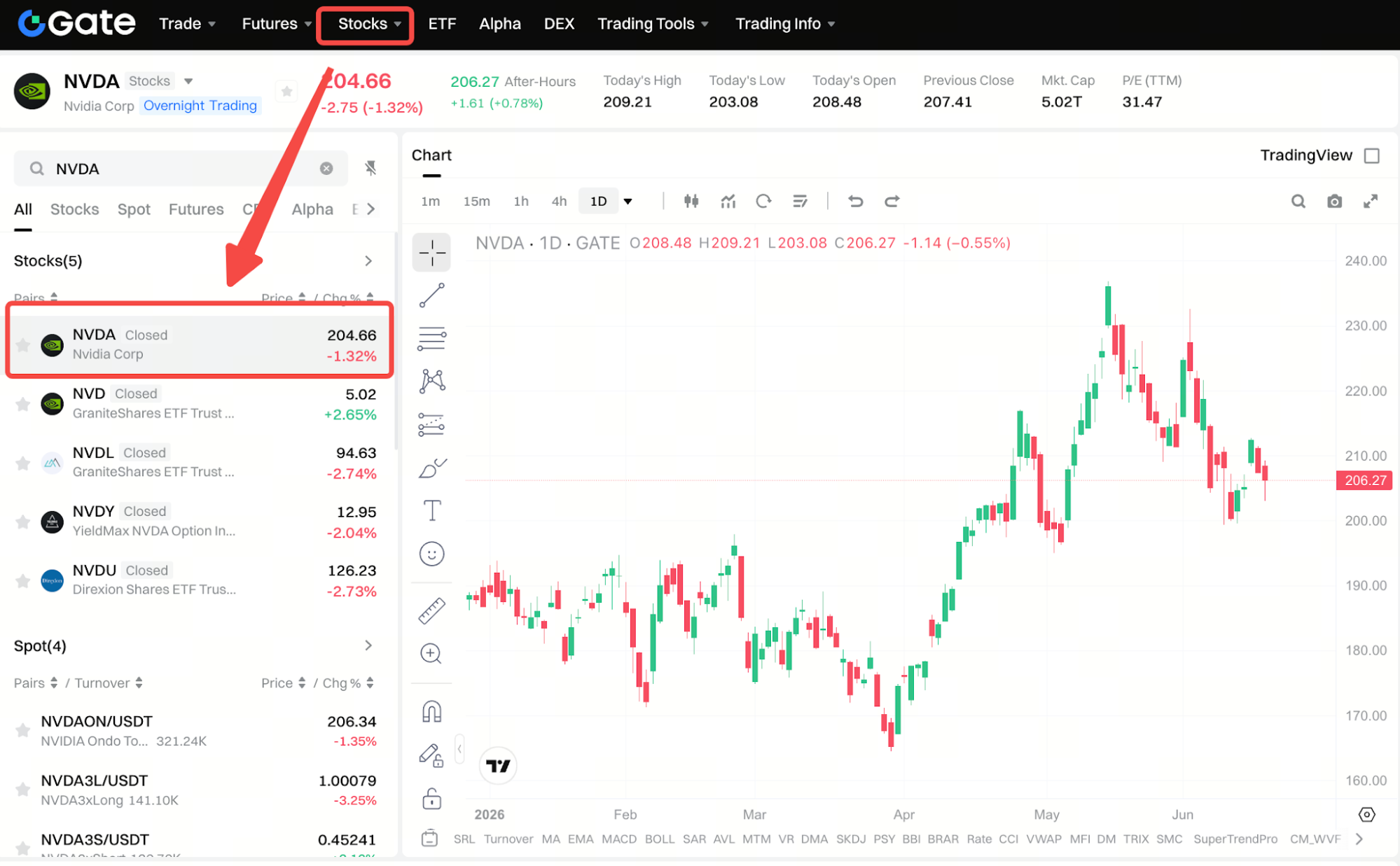
How to find NVIDIA stock?

Before entering the trading page, confirm the asset name, ticker, market status, and trading rules. Since stock products and market conditions change, always rely on real-time page information.

Here’s a quick checklist before placing an order:

Step What You Do What to Check
Enter Gate Stocks Open the Stock section Confirm you’re in the stock market
Search NVDA Find NVIDIA Verify the ticker
View Details Page Read product info Confirm market status
Check Balance See your USDT funds Confirm tradable amount
Open Order Page Prepare to trade Review fees and quantity

Step 3: How to Place an Order for NVIDIA Stock

After locating NVIDIA stock, go to the NVDA trading page, enter the amount or number of shares you want, and review the order details before confirming.
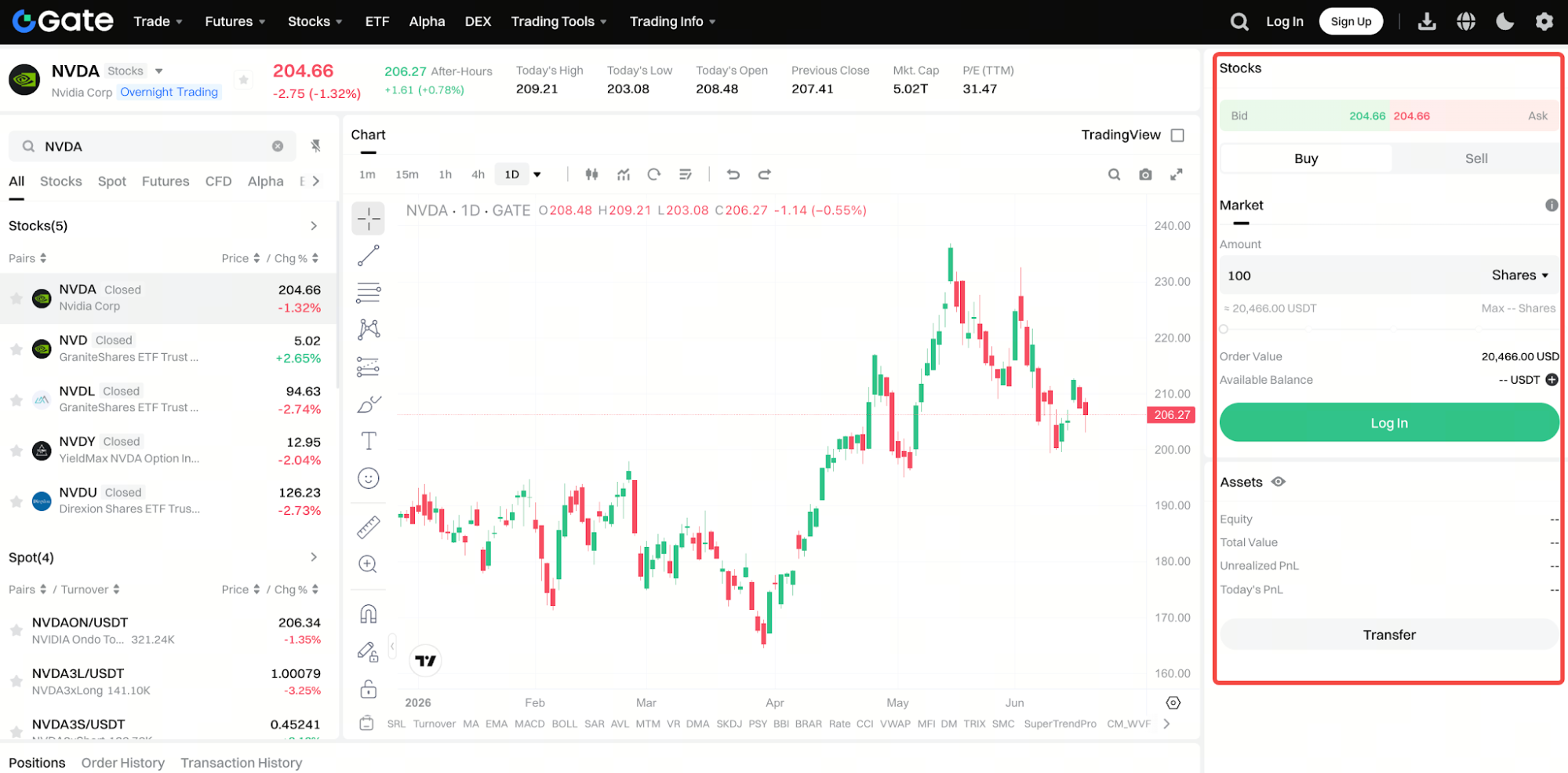
How to place an order to buy NVIDIA stock?

If market orders are available, your order will execute at the current market price. If limit orders are supported, you can set your own price, but execution time depends on market conditions.

Before submitting, confirm:

  • NVIDIA ticker (NVDA)
  • Order type
  • Amount or number of shares
  • Estimated transaction costs
  • Market status and liquidity
  • Any relevant alerts

Once filled, you can view your holdings in the stock account and manage all your assets in one place.

What Are the Trading Fees for NVIDIA Stock?

The stock trading fee displayed on Gate Stock can be as low as 0.023%. Always check the live page for the exact rate.

Beyond the trading fee, watch out for spreads, execution prices, and other costs. Since product rules and market conditions can shift, the live order page is your best reference.

Fee Type What It Means Note
Trading Fee Fee for executing the stock trade Check the live rate
Spread Difference between bid and ask Watch market liquidity
Execution Cost Change in actual fill price Review order confirmation
Other Fees Varies by product See official documentation

So before buying NVIDIA stock, carefully review the fee details on the order page.

What Risks Should You Know Before Buying NVIDIA Stock?

NVIDIA is a growth tech stock. Its price can be influenced by AI industry trends, data center demand, chip market cycles, earnings reports, and overall market sentiment.

NVIDIA’s business spans GPUs, data centers, AI computing platforms, autonomous driving, and robotics. Industry competition, customer demand shifts, and global supply chain factors can all affect the company’s performance and stock price.

Beyond market risk, consider liquidity risk, platform rule risk, and asset allocation risk. Growth tech stocks can be volatile, so allocate based on your own risk tolerance.

FAQ

How Is Buying NVIDIA on Gate Different From Using a Traditional Broker?

Gate Stock uses USDT for settlement and a unified account system, while traditional brokers typically rely on USD and bank accounts.

What’s the Minimum Purchase for NVIDIA Stock?

Check the Gate Stock live page for the current minimum purchase requirement.

What Is NVIDIA’s Stock Ticker?

NVIDIA trades under the ticker NVDA on the NASDAQ.

Does NVIDIA Stock Pay Dividends on Gate?

NVIDIA has a cash dividend policy. Eligible holdings may receive corresponding benefits per platform rules. Always refer to company announcements and live rules for details.

Can I Sell NVIDIA Stock Anytime?

When the market is open and product rules allow, you can sell your NVIDIA shares under real-time market conditions.

Author: Carlton
Disclaimer
* The information is not intended to be and does not constitute financial advice or any other recommendation of any sort offered or endorsed by Gate.
* This article may not be reproduced, transmitted or copied without referencing Gate. Contravention is an infringement of Copyright Act and may be subject to legal action.

Related Articles

How Does PAXG Work? In-Depth Overview of the Physical Gold Tokenization Mechanism
Beginner

How Does PAXG Work? In-Depth Overview of the Physical Gold Tokenization Mechanism

PAXG (Pax Gold) is a tokenized asset backed by physical gold, issued by the fintech company Paxos and traded on the Ethereum blockchain as an ERC-20 token. The core concept is to tokenize physical gold on-chain, with each PAXG token representing ownership of a certain amount of gold. This structure enables investors to hold and trade gold in the form of a digital asset.
2026-03-24 19:12:51
How is the price of PAXG determined? Pegging mechanism, trading depth, and influencing factors
Beginner

How is the price of PAXG determined? Pegging mechanism, trading depth, and influencing factors

PAXG (Pax Gold) is a tokenized asset backed by physical gold reserves, launched by fintech firm Paxos and issued as an ERC-20 token on the Ethereum blockchain. The core concept is to digitally represent real-world gold assets, allowing investors to hold and trade gold via the blockchain network. Because each PAXG token corresponds to a specific quantity of physical gold, its price is theoretically expected to closely track the global gold market.
2026-03-24 19:11:40
Gate Research: 2024 Cryptocurrency Market  Review and 2025 Trend Forecast
Advanced

Gate Research: 2024 Cryptocurrency Market Review and 2025 Trend Forecast

This report provides a comprehensive analysis of the past year's market performance and future development trends from four key perspectives: market overview, popular ecosystems, trending sectors, and future trend predictions. In 2024, the total cryptocurrency market capitalization reached an all-time high, with Bitcoin surpassing $100,000 for the first time. On-chain Real World Assets (RWA) and the artificial intelligence sector experienced rapid growth, becoming major drivers of market expansion. Additionally, the global regulatory landscape has gradually become clearer, laying a solid foundation for market development in 2025.
2026-03-24 11:56:16
What Are the Risks of TSLA? Understanding Tesla’s Competitive Landscape and Investment Challenges
Intermediate

What Are the Risks of TSLA? Understanding Tesla’s Competitive Landscape and Investment Challenges

The main investment risks of TSLA come from intensifying industry competition, pricing pressure, swings in profitability, and changes in market valuation. As one of the global leaders in the new energy vehicle industry, Tesla has strong brand and technology advantages, but it still faces mounting competition from both traditional automakers and emerging EV brands. When evaluating TSLA, investors should pay close attention to Tesla’s market share, margin trends, technological progress, and the broader market environment in order to form a more complete view of its long-term investment value and risk.
2026-04-21 06:59:56
GoldFinger Use Cases in DeFi: How Gold Assets Enter the On-chain Financial System
Beginner

GoldFinger Use Cases in DeFi: How Gold Assets Enter the On-chain Financial System

Through asset tokenization and a Proof of Reserve mechanism, GoldFinger brings gold into the DeFi ecosystem, allowing it to take part in on-chain financial activity as collateral, a liquidity tool, and a component of yield strategies. Once tokenized, gold assets such as ART can function as collateral, liquidity instruments, and building blocks in yield strategies across lending markets, decentralized exchanges, and structured returns, turning a traditional store of value into composable on-chain financial infrastructure.
2026-04-15 03:47:31
How Does GoldFinger Work? Gold Asset Tokenization, Proof of Reserve, and on-chain Circulation Explained
Beginner

How Does GoldFinger Work? Gold Asset Tokenization, Proof of Reserve, and on-chain Circulation Explained

GoldFinger operates through a process that includes asset custody, Proof of Reserve, token minting, and on-chain circulation. By placing physical gold within a compliant custody framework and mapping it on-chain through ART tokens, GoldFinger turns gold into a digital, programmable asset. At the same time, its Proof of Reserve mechanism ensures that on-chain tokens correspond to the underlying assets, supporting trading, collateralization, and redemption in DeFi scenarios.
2026-04-15 03:01:54