SanDisk Corporation is a NAND Flash and solid-state storage (SSD) U.S. stock listed on Nasdaq under the ticker SNDK. On Gate Stocks, the focus isn't on the traditional brokerage account opening process—it's about using USDT funds to search for SNDK, submit orders, confirm fees, and review positions.
The article SanDisk (SNDK) breaks down SNDK's fundamentals from three angles: business structure, industry chain position, and cyclical variables. For trading, head directly to the Gate Stocks page to verify the name, ticker, market, order type, available balance, fee rules, and trading status. Company fundamentals and trading workflow are separate domains—don't blend them into one decision.
The safest approach: first confirm your account and USDT are ready for stock orders, then search for SanDisk Corporation using the ticker SNDK, pick your order type, and review the trade history. After the spin-off, both WDC and SNDK exist independently—always check by ticker to avoid selecting the wrong asset or mixing up positions.
What Do You Need to Prepare Before Buying SNDK on Gate?
Before trading SNDK on Gate Stocks, confirm your account status, identity verification, stock trading permissions, available USDT, product availability, and regional eligibility. Different accounts and regions may have different page rules, so always rely on what the Gate Stocks page actually shows.
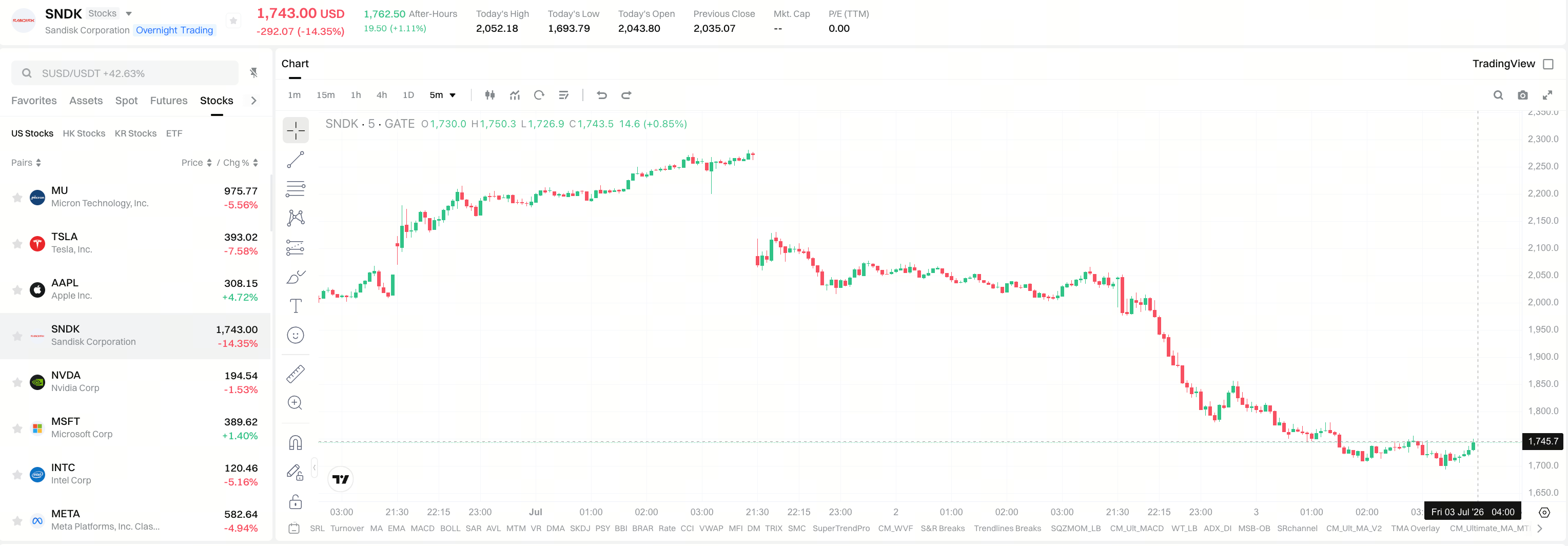
The preparation phase is designed to rule out issues like being unable to trade, funds not being available, ticker confusion, or fee misunderstandings—avoiding scenarios where you "can see the market but can't place an order" or find a balance mismatch.
| Preparation Item |
What to Check |
Common Impact |
| Account Permissions |
Whether Stocks / U.S. stock trading features are enabled |
Determines if you can submit orders |
| USDT Funds |
Whether available USDT has been moved to the stock account |
Affects order amount and tradable quantity |
| Product Availability |
Whether the SNDK page shows a tradable status |
Affects if an order can be submitted |
| Asset Identification |
Whether the name, ticker SNDK, and market info are consistent |
Affects whether you select the right stock |
| Fee Rules |
Trading fees, minimum units, settlement method |
Affects actual execution and position records |
This preparation checklist separates "can you see the page" from "can you place an order." SNDK is SanDisk Corporation—not the same ticker as WDC. Establish that distinction from the start.
Step 1: How to Prepare USDT and a Stock Trading Account?
Trading U.S. stocks on Gate Stocks typically requires verifying your account status, completing identity verification, confirming stock trading permissions, and having USDT ready for the stock account. The available USDT balance may differ from your regular spot account balance—make sure the funds are in a state that allows stock orders before trading.
Fund preparation involves deposits, transfers, available balance, and frozen amounts. If your USDT hasn't been confirmed or is tied up in other orders, the quantity you can buy may be less than your total balance. Account permissions and regional eligibility also affect whether you can trade SNDK—if the page shows it's unavailable, complete the necessary settings first.
Step 2: How to Search for SanDisk / SNDK on Gate Stocks?
After entering the Gate Stocks page, type SNDK in the search box. The page should display SanDisk Corporation or the corresponding stock name. Verifying the ticker and company name is your first line of defense, especially after the spin-off—SNDK and WDC coexist, and their names and businesses are easy to mix up.
If names are similar or there's a historical spin-off, searching by stock ticker is usually more reliable. Don't confuse SNDK with WDC; if the page shows only an abbreviation or short name, cross-check with the ticker, full company name, and trading market. SanDisk Spin-off and WDC / SNDK Relationship explains the business boundaries after the split: WDC focuses on HDD hard drives, SNDK on NAND Flash and SSDs.
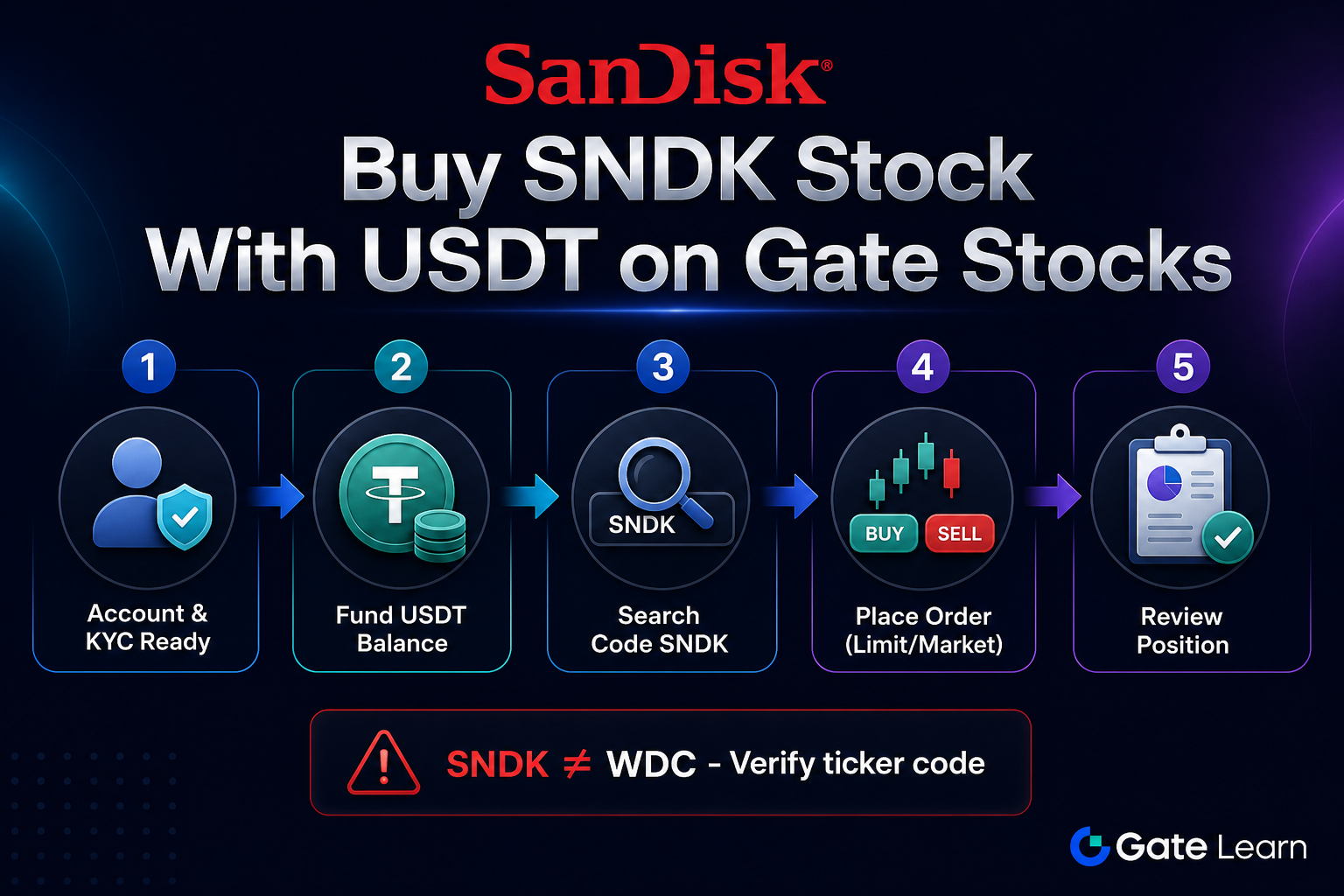 Figure 1. Gate Stocks workflow for trading SNDK: prepare account, transfer USDT, search for SNDK, place order, and review positions.
During the search phase, also confirm the trading status and hours. If the page shows "trading suspended" or "view only," you won't be able to submit orders at that time.
Step 3: How to Place an Order to Buy/Trade SNDK?
Once on the SNDK trading page, confirm the order direction, order type, quantity or amount, estimated execution amount, trading fee, and available account balance in sequence. Before submitting, double-check the stock name and ticker to avoid carrying an asset identification error into your trade history.
Common order types include limit orders and market orders. Limit orders let you set your own price conditions; market orders execute at the best available market price. Neither type is inherently better—they differ in execution logic, fill speed, and price control.
| Order Type |
Key Points to Check |
What Can Happen |
| Limit Order |
Price, quantity, validity status |
May not fill if the price condition isn't met |
| Market Order |
Available balance, market liquidity |
Execution price may differ from your estimate |
| Partial Fill |
Filled quantity, remaining order |
Positions and available balance update simultaneously |
Before final submission, use the confirmation box, fee prompt, and order direction as your last checkpoints. After execution, review the average fill price, quantity, and fees on the Orders and Positions page—and make sure the ticker is SNDK, not WDC.
What Fees and Order Rules Should You Confirm When Trading SNDK?
The stock trading page typically shows the trading fee, spread, order execution price, minimum trading unit, trading hours, and relevant prompts. Different products and regions may have different rules, so always refer to what's displayed on the page.
Beyond fees, watch for order execution costs. Market orders can incur slippage due to market liquidity, while limit orders may sit unfilled for a long time if your price isn't hit. Look at fee rules, execution methods, and order status together.
| Check Item |
Meaning |
Why It Matters |
| Trading Fee |
Fee charged when the order executes |
Affects the amount shown on the confirmation page |
| Spread |
Difference between the bid and ask price |
Affects your actual execution cost |
| Minimum Unit |
Smallest trading quantity the page allows |
Affects whether your order can be submitted |
| Trading Hours |
Time window when the asset is tradable |
Affects whether your order can be filled |
If the order page doesn't match your estimate, recheck the quantity, price, fees, and trading status. There may be settlement differences between the USDT funds metric and the asset price—always go by what the page shows.
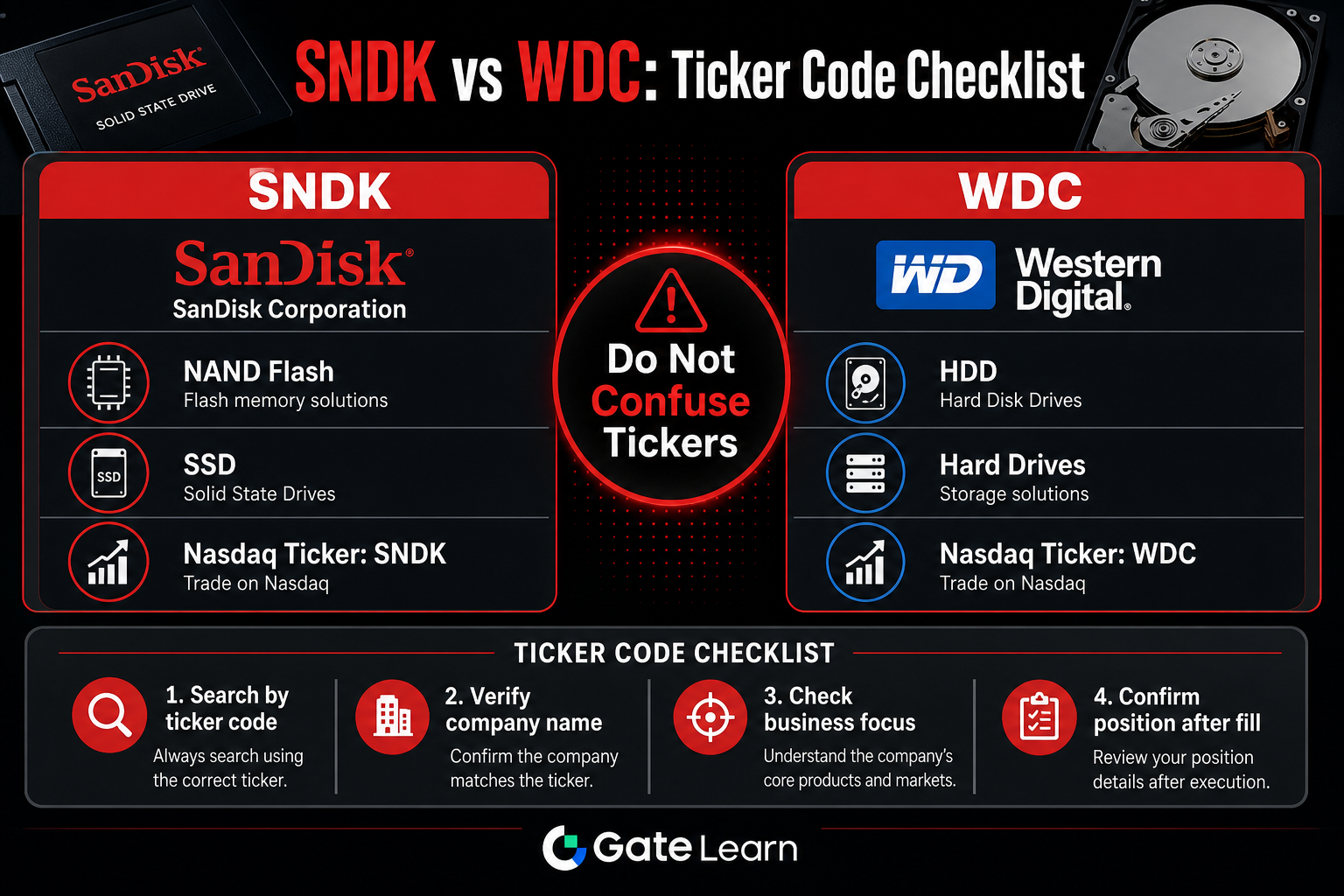 Figure 2. SNDK vs WDC ticker verification checklist: After the spin-off, these are separate listed entities—search and position review must use the stock tickers to distinguish them.
What Risks Should You Understand Before Buying SNDK?
Trading process risks and company fundamental risks are different beasts. Trading process risks include ticker misselection, order type misunderstandings, unclear fee rules, trading hour restrictions, and liquidity changes. Company fundamental risks come from NAND price cycles, SSD demand swings, capital expenditure pace, process node competition, and customer concentration.
SNDK stock has direct exposure to the NAND Flash industry cycle, which is structurally different from WDC's HDD cycle drivers. SNDK vs WDC vs Micron explains the differences among SNDK, WDC, and Micron as storage-related U.S. stocks from three angles: technology, cycle exposure, and financial metrics. Before trading, review company variables like gross margin, inventory turnover, capital expenditure, and capacity utilization using the SNDK Key Metrics and Risk Checklist, then verify your available balance, estimated execution amount, and fees against the page rules.
Common operational mistakes include confusing SNDK with WDC, mixing up available balance with purchasable quantity, ignoring trading hours, and not reviewing the position ticker after execution. At the company level, watch for NAND price volatility, capital expenditure pace, and process node competition. U.S. stock trading also involves exchange rate and platform settlement rules. Evaluate advantages, risks, and limitations separately—this is not a buy or sell recommendation.
Conclusion
Trading SNDK with USDT on Gate Stocks is essentially a standardized process: prepare your account and USDT, search for the ticker SNDK, verify the stock detail page, choose an order type, confirm fee rules, and review your position after execution. Since the SanDisk spin-off, SNDK and WDC are separate stock tickers. The trading page handles operational questions; the company's business and risk checklist handle asset understanding. SNDK is tied to the NAND Flash and SSD cycle—when researching the asset, use SNDK's own disclosed data and avoid mixing it with WDC's historical combined metrics.
FAQ
What company is SNDK on Gate Stocks?
SNDK is SanDisk Corporation, a NAND Flash and SSD company spun off from Western Digital in 2025 and listed independently on Nasdaq. SanDisk is both a consumer storage brand and the post-spin-off listed entity.
How is trading SNDK on Gate Stocks different from using a traditional broker?
Gate Stocks uses the platform account and USDT funds metric to present the trading process, while traditional brokers typically rely on local securities accounts and fiat currencies. For specific product rules, fees, and rights, always refer to the page instructions.
What's the difference between SNDK and WDC search results?
SNDK is SanDisk Corporation, focused on NAND Flash and SSDs; WDC is Western Digital, focused on HDD hard drives. They trade independently after the spin-off—don't mix up the tickers.
How do I confirm the minimum purchase requirement?
Check the minimum quantity, minimum amount, and allowed submission units in the order box prompts on the SNDK trading page. These can vary by stock, account status, and page rules.
Why hasn't my order been filled immediately?
Possible reasons include the trigger price not being reached, insufficient liquidity, or being outside tradable hours. Whether you can sell, cancel, or wait depends on the page order status and trading rules.
What industry does SNDK belong to?
SNDK is in the NAND Flash and SSD segment of the data storage industry. Key cyclical variables include NAND prices, wafer capacity utilization, enterprise and client SSD shipments, and storage industry capital expenditure pace.
How do I confirm dividend or corporate action rules?
Stock-related dividends, splits, mergers, or other corporate actions are governed by the Gate Stocks page instructions and platform notifications—not just by experience with traditional brokers.