What You Need to Prepare Before Buying Tesla Stock on Gate
Before using USDT to buy Tesla stock, users must have a Gate account, stock trading permissions, and sufficient USDT balance. Depending on account status, product rules, and regional requirements, identity verification and relevant eligibility procedures may be necessary.
Prior to trading, you should also confirm that Gate's stock service is available in your region and know that Tesla stock trades under the ticker TSLA. Since access rules may vary by region, always refer to the official Gate page for the most accurate information.
If you are new to these products, you may also want to learn how Gate's stock service operates and how real stock trading works.
| Requirement |
Purpose |
Items to Check |
| Gate Account |
Access stock services |
Confirm account status |
| Identity Verification |
Obtain trading permissions |
Complete KYC |
| USDT Balance |
Used for stock settlement |
Confirm available funds |
| Product Availability |
Confirm TSLA support |
View real-time page |
| Regional Eligibility |
Meet access requirements |
Confirm local rules |
Step 1: How to Deposit USDT on Gate
Gate Stocks supports settlement in USDT, so you need to ensure your account has sufficient USDT before purchasing Tesla stock.
Users can obtain USDT via on-chain deposits, spot trading, or account transfers. After depositing, funds typically require network confirmations before they can be used for stock trading.
When making an on-chain deposit, verify the correct network and deposit address, and carefully check the asset type to avoid errors that could result in fund loss.
Once your funds are ready, navigate to the Gate Stocks section to find Tesla stock.
Step 2: How to Find Tesla Stock
The Gate Stocks section supports searching by stock ticker and company name. After entering the stocks page, use the ticker TSLA to find Tesla stock.
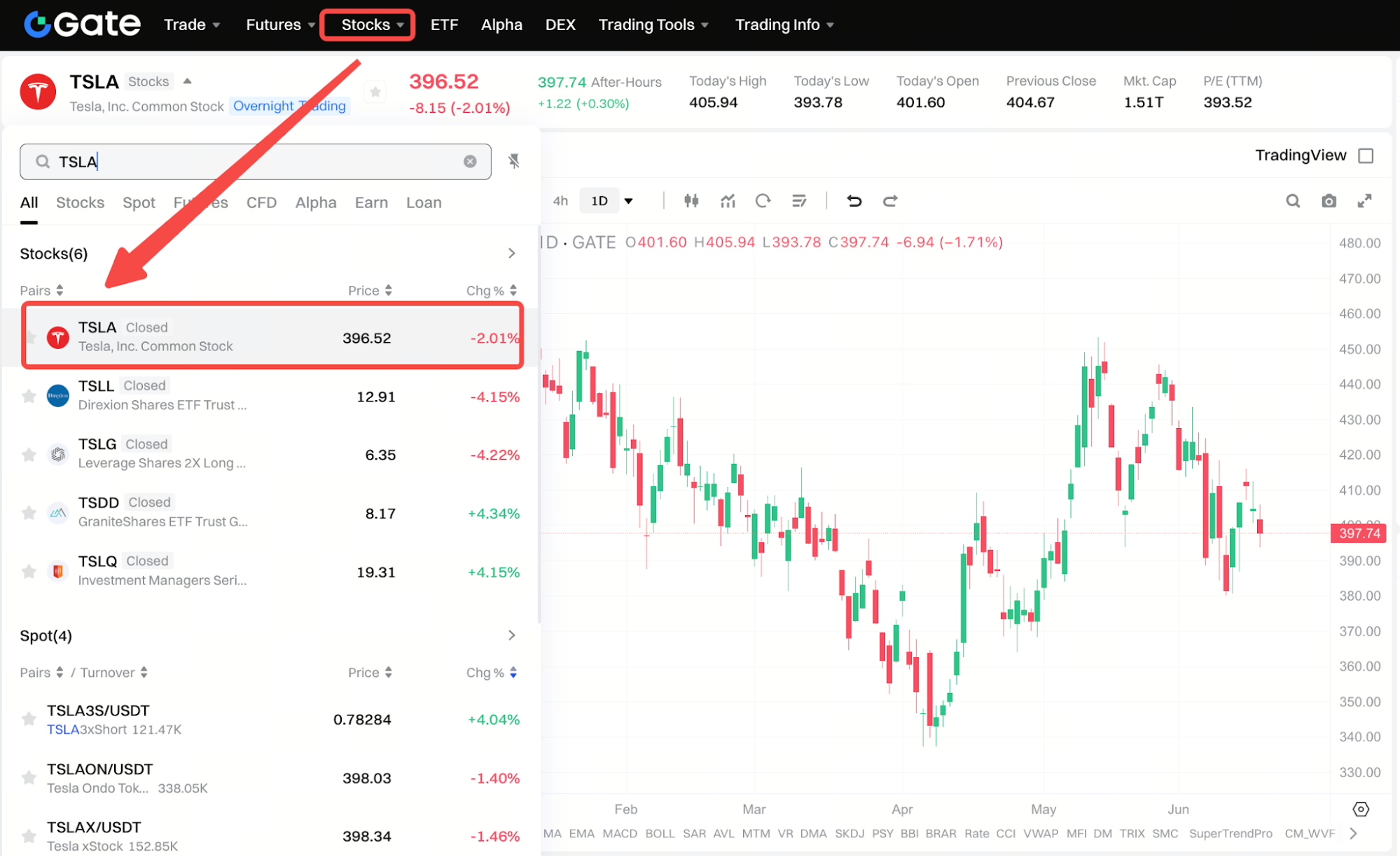
Before entering the trading page, confirm the asset name, stock ticker, market status, and relevant trading rules. Since stock products and market conditions may change, real-time page information should be your final reference.
Before placing an order, follow this checklist:
| Step |
User Action |
Items to Check |
| Enter Gate Stocks |
Open the stocks section |
Confirm entry into stock market |
| Search TSLA |
Find Tesla Inc. |
Verify the stock ticker |
| View Details Page |
Read product information |
Confirm market status |
| Check Balance |
View USDT funds |
Confirm tradable amount |
| Open Order Page |
Prepare to trade |
Review fees and quantity |
Step 3: How to Place an Order to Buy Tesla Stock
After finding Tesla stock, you can go to the TSLA trading page, enter the purchase amount or number of shares, and review the order details before confirming.
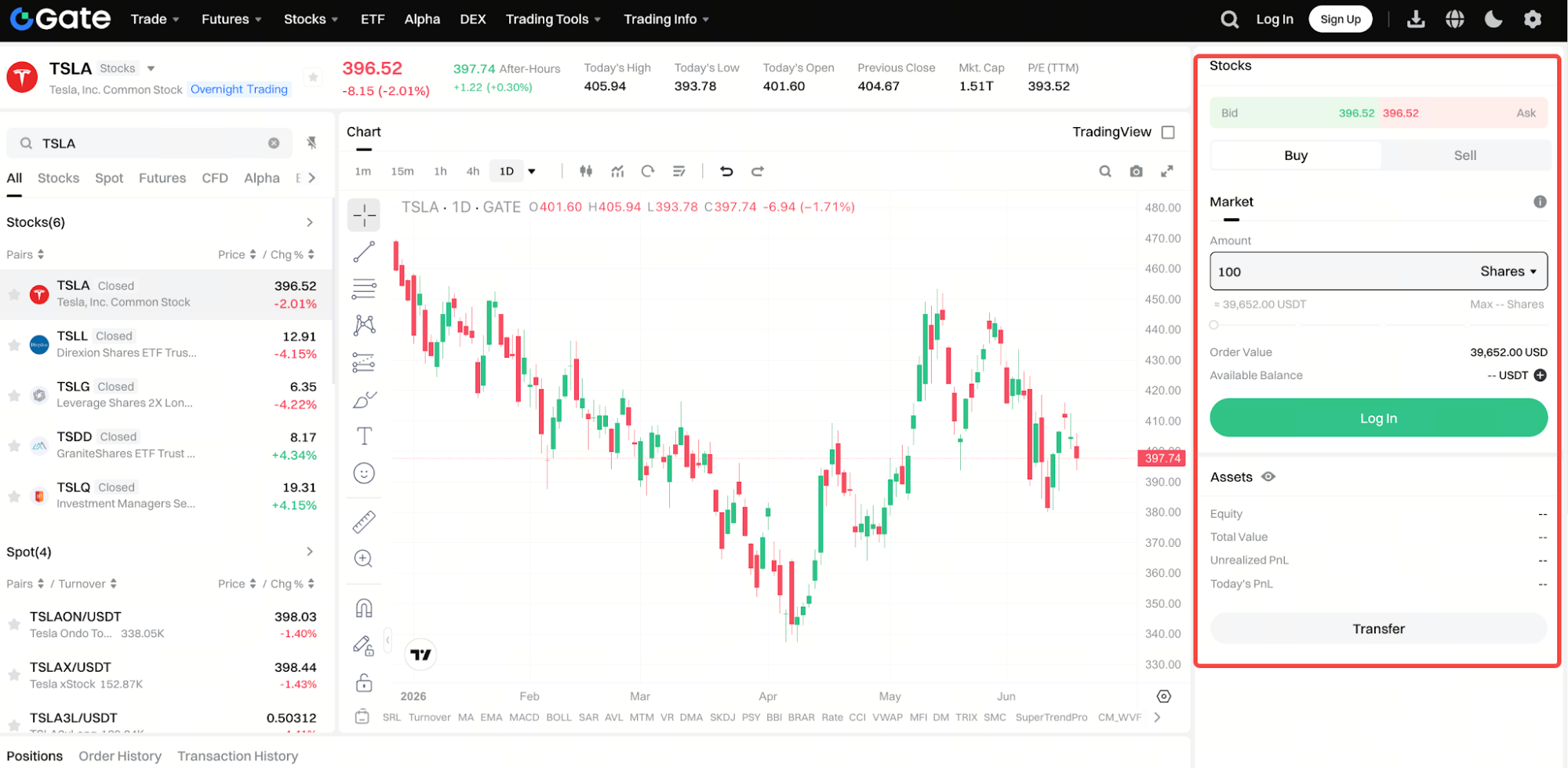
If a market order is supported, the order will typically execute at the current market price. If a limit order is supported, you can set your own buy price, though execution time will depend on market conditions.
Before submitting the order, key points to verify:
- Tesla stock ticker (TSLA);
- Order type;
- Purchase amount or number of shares;
- Estimated trading cost;
- Market status and liquidity;
- Relevant disclaimers.
After the order is filled, you can view your holdings in the stock account and manage your assets in a unified manner.
What Are the Trading Fees for Tesla Stock?
The stock trading fee displayed on the Gate Stocks page can be as low as 0.023%. The exact fee should be confirmed based on real-time page information.
In addition to trading fees, investors should also consider spreads, order execution prices, and other associated costs. Since product rules and market conditions may change, the information shown on the real-time order page should serve as the final reference.
| Fee Type |
Definition |
Notes |
| Trading Fee |
Fee incurred from stock execution |
Check real-time rate |
| Spread |
Difference between buy and sell prices |
Monitor market liquidity |
| Execution Cost |
Change in actual execution price |
Review order confirmation page |
| Other Fees |
Determined by product rules |
Refer to official documentation |
Therefore, before buying Tesla stock, carefully review the fee information on the order page.
What Risks Should You Know Before Buying Tesla Stock?
Tesla stock is a high-volatility growth stock, so its price may be influenced by factors such as the company's performance, vehicle delivery data, progress in artificial intelligence, interest rate changes, and market sentiment.
Tesla's business spans multiple areas, including new energy vehicles, energy storage systems, autonomous driving technology, humanoid robots, and AI infrastructure. Developments in these business lines, earnings reports, and changes in the macroeconomic environment can all affect the stock price.
Beyond market risk, investors should also consider liquidity risk, platform rule risk, and asset allocation risk. Since growth stocks are highly volatile, allocate funds based on your own risk tolerance.
FAQ
What is the difference between buying Tesla stock on Gate and buying it through a traditional broker?
Gate Stocks supports USDT settlement and uses a unified account system, whereas traditional brokers typically rely on USD and traditional banking systems.
What is the minimum purchase amount for Tesla stock?
The minimum purchase requirement for Tesla stock should be confirmed based on the real-time rules displayed on the Gate Stocks page.
What is Tesla's stock ticker?
Tesla's stock ticker is TSLA, and it is listed on the NASDAQ exchange.
Does buying Tesla stock on Gate pay dividends?
As of June 2026, Tesla has not implemented a cash dividend plan. Therefore, holding TSLA primarily generates returns through changes in the stock price.
Can Tesla stock be sold at any time?
When the market is open and product rules allow, users can sell their Tesla holdings according to real-time market conditions.