A crypto ETF is a regulated fund listed on a securities exchange that treats crypto as a financial asset for investment purposes, giving investors price exposure to underlying digital assets under securities or financial-product rules. Listing depends on whether local law places those assets in a securities or financial-product category and whether custody, disclosure, and investor-protection rules are in place. Is crypto a financial asset? explains why a financial-product frame is often a precondition for ETF access.
For investors, traders, and other market participants comparing regulated crypto products, the key issue is not just whether an ETF exists, but what type of access a market has actually approved. ETFs do not change how assets exist on-chain; they package price exposure for securities accounts. “Approval” also means different things: some markets allow spot bitcoin ETFs to trade; some only futures-style products; some build a legal frame without approving a named fund. This article helps you compare spot and futures ETFs, review which jurisdictions have approved which structures, understand why some countries still lack spot products, and verify product labels, custody, compliance, and risk before investing.
What Is a Crypto ETF in the Context of Digital Assets?
A cryptocurrency exchange-traded fund lists on a stock exchange, trades as fund shares, and gives investors exposure to crypto assets whose underlying holdings exist on blockchain technology or other distributed ledger technology systems. Investors buy shares through a securities account for exposure to bitcoin, ether, or related underlyings without managing private keys used to authorize transactions on those networks.
Core elements include the fund manager, custody arrangements, pricing benchmarks, and disclosure documents. Funds typically report holdings, fees, and risks; custodians hold spot assets or manage derivatives books. Secondary-market prices trade around net asset value.
What Consumer and Investor Protection Conditions Do Regulators Review?
Reviews usually ask four questions: whether the underlying is an eligible fund asset; whether custody and transaction records on a distributed ledger are verifiable; whether disclosure explains tracking method and fees; and whether secondary-market trading includes adequate investor protections.
In the United States, the SEC focuses on qualified custody, creation/redemption transparency, and market-manipulation risk for spot crypto ETFs; futures products follow commodities-pool operator rules and often use CME bitcoin or ether futures. When a token or offering is treated as a security, federal securities laws require registration with the SEC where applicable under securities laws. In May 2022, the exchange commission said it was doubling its Crypto Assets Unit to support oversight and consumer and investor protection. Hong Kong’s SFC, Australia’s ASIC, and Canadian securities regulators require licensed managers and ongoing disclosure. Regulatory challenges arise from the rapid development of digital assets in the financial sector, and the lack of uniform regulations globally creates uncertainty. Across markets, approval is product-specific—not a blanket “crypto legalization,” and differing regulatory regimes and significant gaps across jurisdictions create uncertainty in the crypto market.
Which Countries or Regions Have Approved Spot Crypto ETFs?
Based on public regulatory disclosures, regulated spot crypto ETFs or equivalent listings (mainly bitcoin and ether) appear in markets such as, as part of the broader crypto market even though it remains a small fraction of other financial assets globally:
| Jurisdiction |
Supervisor |
Approved product types |
Typical features |
| United States |
SEC |
Spot bitcoin ETFs, spot ether ETFs |
Multiple funds on NYSE/Nasdaq; spot held by qualified custodians |
| Hong Kong |
SFC |
Spot bitcoin ETFs, spot ether ETFs |
Local listing; licensed managers and custodians |
| Australia |
ASIC |
Spot bitcoin ETFs |
Fund units traded on markets such as ASX |
| Canada |
Provincial securities regulators |
Spot bitcoin ETFs |
Among earlier spot bitcoin ETF markets |
| Brazil |
CVM |
Bitcoin-related ETFs |
Regulated fund entry point in Latin America |
| Europe (selected venues) |
National supervisors |
Some bitcoin ETP/ETN |
Structures vary; not always identical to U.S. ETFs |
The table summarizes access forms, not every ticker, and valuation context matters: bitcoin’s market cap reached about USD 1 trillion in 2021, including roughly USD 1 trillion on March 28, 2021, while total crypto market capitalization peaked near $2.9 trillion in November 2021, shaping how investors think about market value. These assets generally are not issued by central banks, and central banks like most governments do not treat bitcoin as legal tender in the ordinary sense outside a few exceptions, which is one reason ETF wrappers matter for regulated access. European ETP/ETN products may differ on tax, redemption, and investor rights. Always read the prospectus, custody setup, and listing rules.
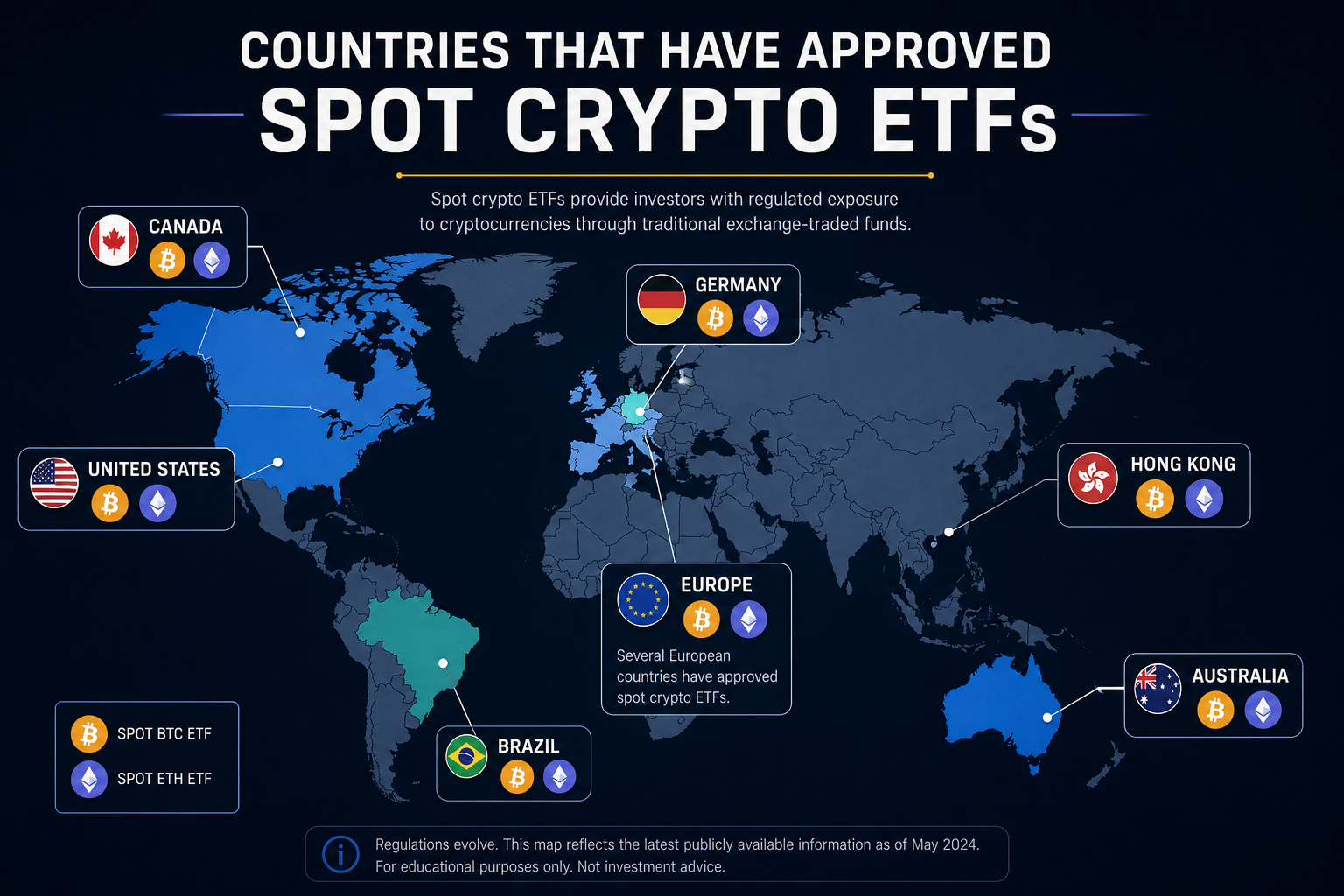 Figure 1. Major jurisdictions with approved spot crypto ETFs; product form and custody rules differ by market.
Where Do Futures Crypto ETFs Dominate?
Before or alongside spot approvals, futures crypto ETFs were an earlier regulated exposure tool. Spot ETF approvals developed partly because direct crypto asset transactions often happen on exchanges that run 24/7, unlike stock markets with limited trading hours. They do not hold spot bitcoin or ether directly; they hold futures listed on supervised derivatives venues and track prices indirectly.
| Dimension |
Spot crypto ETF |
Futures crypto ETF |
| Underlying exposure |
Direct spot digital assets |
Futures contract positions |
| Price tracking |
Usually closer to spot |
May reflect roll and basis |
| Regulatory path |
Securities law + qualified custody |
Commodities/derivatives rules + CPO/CTA compliance |
| Typical costs |
Management + custody fees |
Management fees + futures roll-related costs |
| Key risks |
Custody, liquidity, asset volatility |
Roll, basis, asset volatility |
Before U.S. spot bitcoin ETF approval, vehicles from issuers such as ProShares and Valkyrie offered futures exposure; Hong Kong and Singapore also used futures or other derivative structures, while direct trading remained dominated by centralized exchanges such as Coinbase and Binance. Decentralized exchanges such as dYdX also support peer-to-peer trading and show how smart contracts can automate trading functions in decentralized finance, which may lower fees by removing intermediaries. Futures ETFs provide compliant account exposure to bitcoin, ether, and other digital assets, but tracking precision and cost profiles differ from spot products, and direct market access differs from ETF trading because ETFs trade during exchange hours even though underlying crypto markets trade continuously.
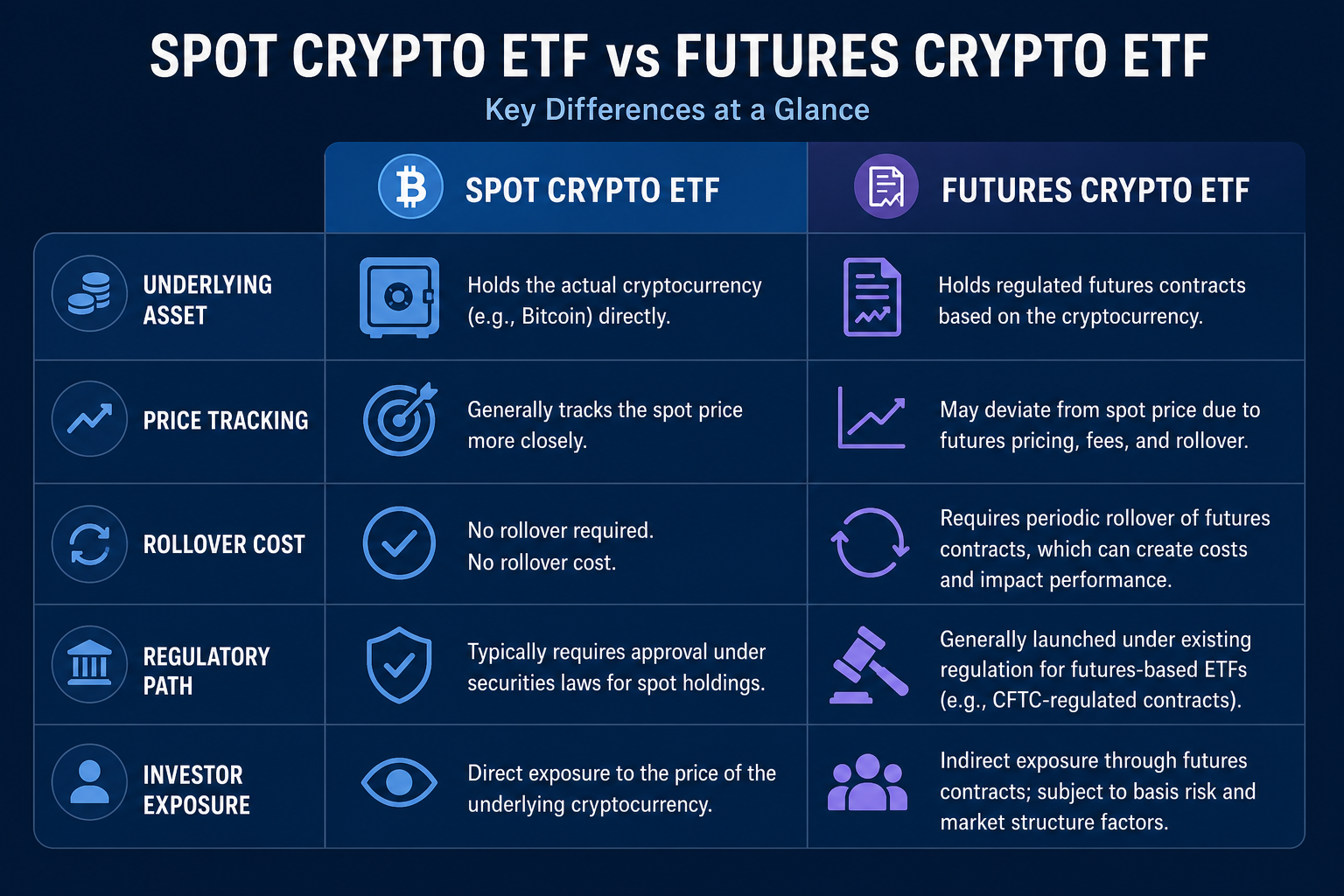 Figure 2. Structural differences between spot and futures crypto ETFs on underlying, tracking, roll costs, and regulatory path.
Why Do Markets Like Japan Still Lack Spot Crypto ETFs?
Some jurisdictions place digital assets under financial-product frames, though crypto assets are often treated differently from other asset classes and traditional asset classes when fund rules are drafted, yet still require separate product approval and fund-law implementation. In Japan, bringing crypto into FIEA supplies a category basis for spot crypto ETFs, but whether funds may hold crypto and whether exchanges may list them still depends on investment-trust rules, FSA product review, and exchange listing standards.
Legal reclassification and ETF product approval are therefore two layers. The first asks whether digital assets fit within existing asset classes or stand apart from other assets for fund eligibility purposes; the second asks whether a named fund may issue and list. “Building an ETF legal pathway” is not the same as “spot ETFs are already purchasable.”
Countries recognizing crypto as financial assets explains how Japan, the EU, and the United States write classification rules—and how that links to ETF access. Financial product vs payment method explains why a payment-method frame usually cannot support ETF product structures directly.
Countries recognizing crypto as financial assets explains how Japan, the EU, and the United States write classification rules—and how that links to ETF access. Financial product vs payment method explains why a payment-method frame usually cannot support ETF product structures directly.
Use public documents—not ticker buzzwords like “bitcoin” or “ether”—as the checklist:
| Check item |
What to confirm |
| Product type |
Spot ETF, futures ETF, ETP/ETN, or closed-end trust |
| Listing venue & supervisor |
Exchange, manager, and custodian oversight |
| Underlying mechanism |
Spot holdings vs futures, swaps, or notes |
| Fee stack |
Management, custody, trading, and roll-related costs |
| Disclosure |
Prospectus, annual reports, holdings reports |
| Tax treatment |
Dividends/capital gains in the investor’s residence |
| Rights |
Creation/redemption, voting, or other rights |
A crypto ETF is regulated account exposure, not automatic on-chain ownership. Direct ownership also means managing a crypto wallet, with hot wallets and hot storage connected to the internet for convenience, while cold storage keeps private keys offline for stronger security. Paper wallets are another offline option, storing private keys as printed QR codes, but the trade-offs still center on security and access. Custody, liquidity, tracking error, and policy change remain risks separate from coin-price moves, and direct transfers are typically irreversible, so investors should only invest money they can afford to lose.
Summary
Crypto ETF approval is a product-level, jurisdiction-level outcome—not a global “crypto legalization” switch. The United States, Hong Kong, Australia, Canada, and Brazil host regulated spot or futures crypto ETFs with different structures, custody, and investor rights. Spot ETFs generally hold underlyings; futures ETFs use derivatives and differ on tracking and costs. Markets such as Japan may reclassify assets under financial-instruments law while still requiring separate fund and exchange approvals. Verify supervisor, underlying mechanism, disclosures, and fees together.
FAQ
Which countries have approved spot bitcoin ETFs?
The U.S. SEC has approved multiple spot bitcoin ETFs for U.S. exchange listing; Hong Kong’s SFC has approved spot bitcoin ETFs for local listing. Australia, Canada, and Brazil also offer regulated spot bitcoin fund products. Structures, custodians, and fees differ—follow local disclosures.
What is the difference between spot and futures bitcoin ETFs?
Spot bitcoin ETFs typically hold bitcoin with a qualified custodian and track closer to the spot market. Futures ETFs hold supervised bitcoin futures and may be affected by roll and basis. Paths, costs, and tracking error differ structurally.
Does a crypto ETF, under federal securities laws, equal holding bitcoin directly?
No. Investors hold fund shares in a securities account; managers and custodians hold assets or derivatives per fund documents. Investors usually do not control on-chain keys; rights, redemption, and tax follow the prospectus and local law.
Can you trade crypto ETFs in Hong Kong?
Hong Kong has approved spot bitcoin and ether ETFs for local listing. Managers and custodians must meet SFC licensing and disclosure rules. Trade via compliant securities accounts and read each fund’s documents and fees.
Why do some countries still lack spot crypto ETFs?
Listing needs eligible underlyings plus custody, disclosure, market-abuse controls, and exchange rules, and some regulators worry crypto assets may not fit existing securities laws or fund frameworks as neatly as traditional financial assets. Some jurisdictions reclassify assets in law while fund approval, trust-law implementation, and listing procedures remain incomplete, and differing regulatory regimes across jurisdictions can slow approval even when a legal framework exists—creating a gap between framework and product.
Are there crypto ETFs in Europe?
Europe offers regulated forms including ETP, ETN, and some exchange-listed bitcoin-related funds. Tax, rights, and structure may differ from U.S. spot ETFs. Check the issuing supervisor, prospectus, and underlying holding method.