Based on public developments over the past two years, Cronos has shifted its strategy from “infrastructure availability” to “token-driven ecosystem expansion.” On one hand, Cronos EVM, Cronos zkEVM, and Cronos POS are being leveraged collaboratively to broaden application scenarios. On the other, staking entry points, institutional products, cross-chain liquidity, and developer incentives are being used to increase the real demand for CRO both on-chain and off-chain.
According to the latest public information, CRO’s staking support on Korea’s leading exchange Upbit, investment product collaboration with 21Shares, and roadmap initiatives around tokenization and AI applications all reinforce CRO’s demand-side narrative.
Core Functions and Use Cases of the CRO Token
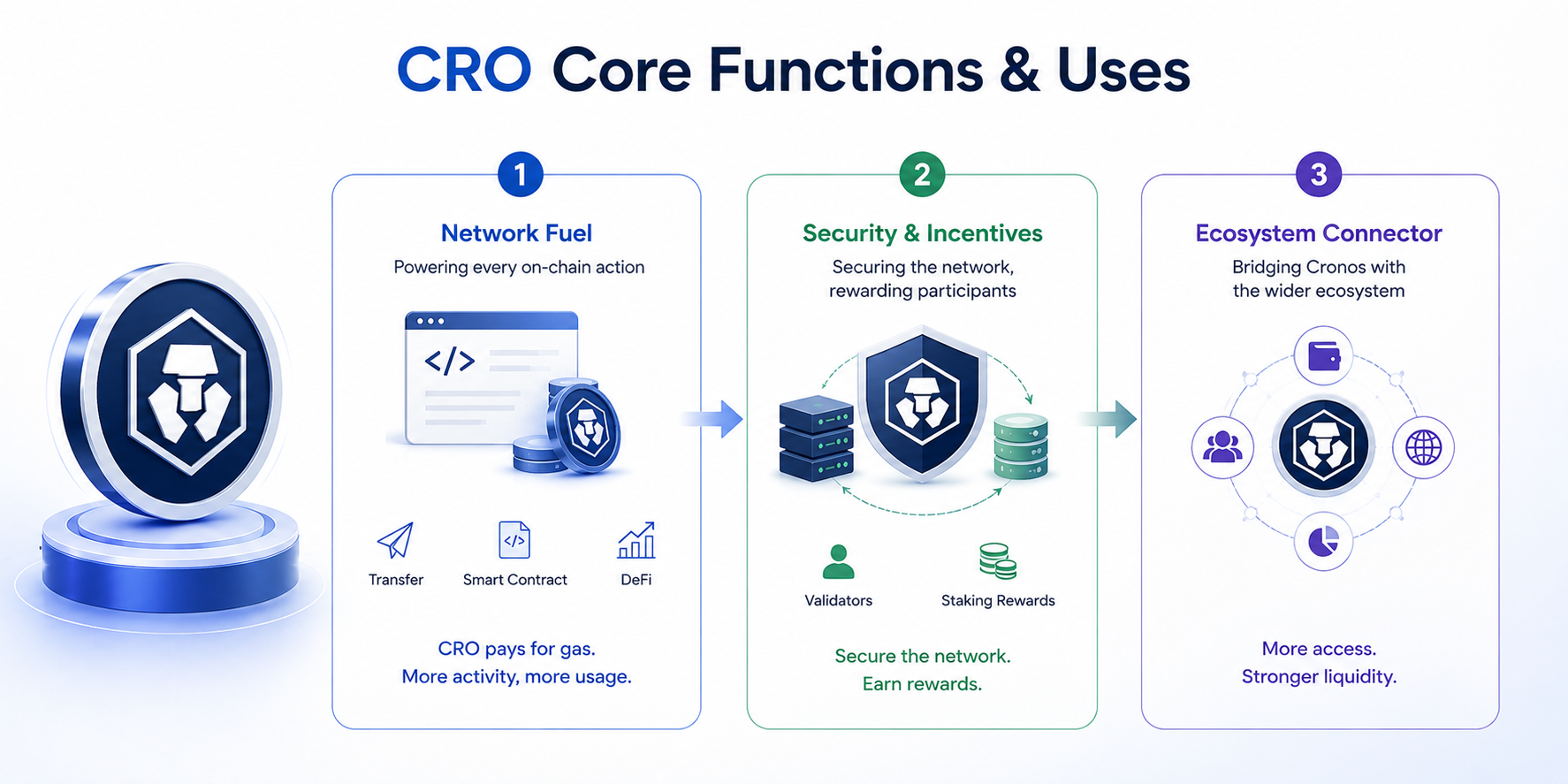
The first-layer function of CRO is to serve as network fuel. In environments such as Cronos EVM, users must pay Gas in CRO to initiate transfers, call Smart Contracts, and execute DeFi trades. As on-chain activity grows, CRO’s baseline usage frequency increases—making this one of the most stable sources of demand for public chain tokens.
The second-layer function is as a security and incentive connector. In the Cronos ecosystem, verifiers and node operators rely on economic incentives to maintain stable operation. Trading fees and related incentive mechanisms provide ongoing motivation for network participants to sustain the system. For users, staking offers a logic of return for long-term holders and directly links “holding tokens” to “maintaining the network.”
The third-layer function is as an ecosystem synergy medium. CRO is not only an on-chain technical variable but also acts as a bridge in collaborations between Cronos and external platforms.
Token Issuance and Distribution Mechanism
The token issuance and distribution mechanism determines the “funding source” and “timing” for ecosystem expansion. For CRO, the market’s long-term focus is on core issues such as: how total supply and circulation pace change, how ecosystem reserves are used, and whether incentives can be converted into real users and trading activity rather than just short-term liquidity bubbles.
According to public discussions and roadmap signals, the Cronos community has recently focused its tokenomics on two main lines:
- First, improving demand-side quality by binding CRO usage to real scenarios such as payments, lending, cross-chain, and institutional products.
- Second, optimizing supply-side cadence by using governance and planning to avoid “short-term release shocks,” with an emphasis on sustainable medium- and long-term allocation.
The key to this kind of mechanism design is not whether incentives exist, but whether the allocation of incentives is efficient. If tokens mainly flow toward short-term arbitrage, ecosystem data will show high volatility and low retention. If more tokens are directed to developer infrastructure, user growth, and high-retention scenarios, long-term value capture is usually stronger.
Therefore, when evaluating CRO’s distribution mechanisms, it is recommended to focus on three indicators: new address count and activity, trading fee and protocol revenue changes, and user retention after incentives end.
The Role of CRO in Ecosystem Incentives and Governance
At the ecosystem incentive level, CRO’s role can be summarized as “user acquisition + retention + expanding applications.”
- For users, staking returns, on-chain activity rewards, and protocol collaboration incentives reduce the barrier to first-time participation.
- For developers, ecosystem funds, collaborative resources, and liquidity support increase willingness to deploy projects.
- For protocols, token incentives can accelerate cold starts, helping trading depth and usage frequency reach sustainable thresholds.
Recent Cronos ecosystem initiatives show this incentive logic is extending toward “more mature capital market interfaces.” For example, ETPs and partnership information related to 21Shares signify that CRO’s reach is expanding from native crypto markets to regulated investment channels. For ecosystem growth, this brings two incremental drivers: a broader investor base and a more stable medium- to long-term capital structure.
On the governance side, CRO aligns “holder interests” with “long-term network development.” Governance is not merely a voting process but a mechanism for deciding key parameters and resource allocation—including incentive direction, ecosystem budget, and technical upgrade priorities.
A high-quality governance system typically has three features: decision-making transparency, incentive alignment, and verifiable execution. If governance consistently channels resources into high-yield tracks, CRO becomes more than a trading instrument and gradually forms part of the ecosystem’s productive relationships.
Market Value and Long-Term Potential of the CRO Token
CRO’s market value can be understood as comprising “fundamental value + expected value.”
Fundamental value comes from on-chain activities such as trade count, Gas consumption, TVL, stablecoin and lending volume, and developer numbers. Expected value derives from the market’s view of future growth paths, including institutional access, cross-chain expansion, payment use cases, and new demand from AI and tokenization.
Over the medium and long term, CRO’s potential depends on three “can it” factors:
- Can it continue to generate real on-chain demand? If trades and usage rely primarily on short-term incentives, value elasticity will be limited.
- Can it form cross-cycle capital entry points? Exchange listings, institutional products, and payment network collaborations will impact the long-term valuation ceiling.
- Can it maintain differentiation in multi-chain competition? Cronos’s edge lies in EVM compatibility + Cosmos interoperability + platform synergy. The key is converting these combined advantages into sustained data performance.
Based on recent public information, Cronos has indeed shown positive signals at the “demand entry” level: Upbit staking has expanded regional user participation, institutional product collaboration has improved traditional capital accessibility, and the roadmap continues to strengthen asset tokenization and cross-chain capabilities.
However, in the end, the market will look beyond narratives and focus on verifiable data: Are active addresses increasing? Is protocol revenue improving? Do ecosystem projects show retention and compounding?
Risk and Return Analysis for Investing in CRO
Sources of Return: Beyond Just Price Appreciation
Returns from investing in CRO typically come from three categories:
- Capital gains from price fluctuations;
- Holding returns from mechanisms such as staking;
- Revaluation driven by ecosystem expansion (such as new capital inflows, application growth, and institutional product advances).
When on-chain activity, partnership implementation, and capital structure all improve at the same time, CRO may experience a “resonance of utility value and market expectations,” often forming the foundation for strong market cycles.
Key Risks: Volatility, Delivery, and Competition
- High volatility risk: As a crypto asset, CRO is sensitive to macro liquidity, risk appetite, and regulatory expectations, leading to considerable short-term price swings.
- Narrative delivery risk: Roadmaps and partnership announcements are forward-looking signals, but if they fail to translate into real trading volume, user growth, or revenue, valuations may correct.
- Competitive substitution risk: L1 and L2 sectors face intense homogenous competition. If developers and liquidity shift to other networks, CRO’s demand growth could slow.
- Regulatory and compliance risk: Regulatory changes in various regions affecting exchanges, staking services, tokenized products, and cross-chain businesses will directly impact liquidity and market participation.
- Technical and ecosystem spillover risk: Issues with bridges, third-party protocols, contract vulnerabilities, or oracle anomalies—even if not on the main chain’s core layer—may affect asset security and market confidence via ecosystem linkages.
Practical Perspective: How to Evaluate More Rationally
For most investors, it is more effective to build a “fundamental tracking framework” than to focus only on short-term price movements:
- On-chain: active addresses, transaction count, Gas usage, TVL, stablecoin scale;
- Ecosystem: retention of leading protocols, ongoing developer deployment, net cross-chain inflows;
- Capital: changes in staking ratio, circulation structure, progress of institutional products;
- Governance: direction of key proposals, execution efficiency, quality of community consensus.
If these indicators show structural improvement, CRO’s medium- and long-term outlook becomes more robust. Conversely, even if there is short-term appreciation, sustainability may be lacking.
Conclusion
The core of CRO’s tokenomics is not isolated incentives, but connecting payment demand, network security, governance mechanisms, ecosystem expansion, and external capital entry into a self-sustaining system. For Cronos, real growth is not about short-term traffic spikes, but about fostering more genuine transactions, real applications, and authentic users to remain on-chain long-term.
Recent public updates indicate that Cronos is continuously strengthening CRO’s demand base through expansion of staking channels, institutional collaborations, cross-chain integration, and application-layer upgrades. These developments create conditions for ecosystem growth, but whether this translates into long-term value still depends on data delivery and execution quality.
For investors, CRO offers upside potential from public chain growth, but comes with high volatility and execution uncertainty. Replacing sentiment-driven approaches with fundamental tracking and managing risk rather than making single bets is generally a more stable way to participate in such assets.







