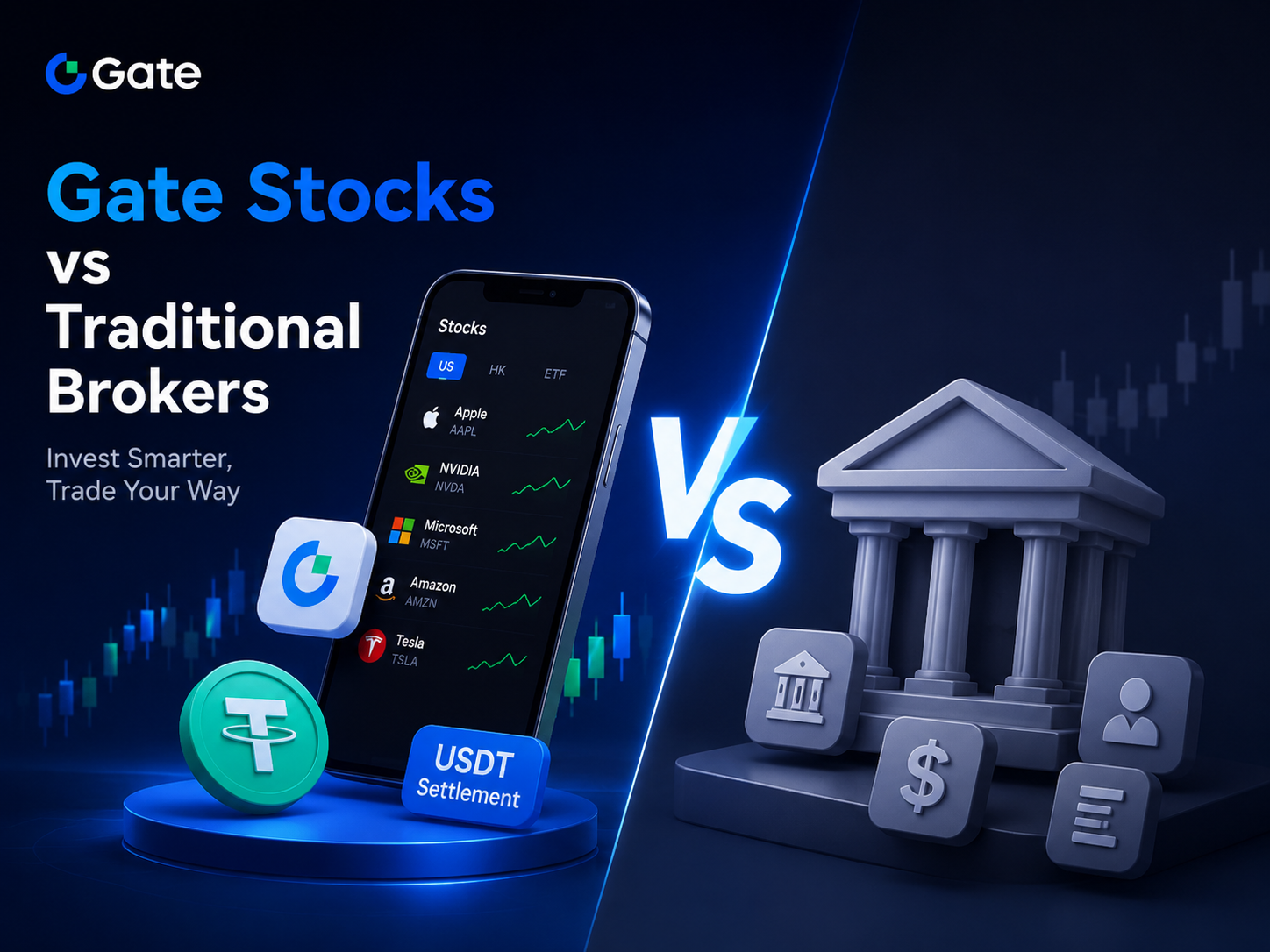
Although both Gate Stocks and traditional brokers allow you to invest in real U.S. stocks, they differ significantly in fund systems, account structures, and asset management models. Understanding these differences helps investors choose the approach that best suits their needs.
What Are the Core Differences between Buying U.S. Stocks on Gate and through Traditional Brokers?
Gate Stocks and traditional brokers both provide access to the U.S. stock market, but they operate with fundamentally different fund systems and account structures.
Traditional brokers typically rely on bank accounts and the USD system, requiring investors to deposit fiat currency, exchange funds, and trade through a securities account. Gate Stocks, in contrast, uses USDT for settlement within a unified account model, allowing stock and digital assets to be managed together.
As a result, the economic rights associated with the stocks are essentially the same — the main differences lie in how funds are managed and assets are allocated.
What's the Difference Between Buying U.S. Stocks with USDT vs. USD?
Both USDT and USD can be used to fund stock purchases, but the settlement systems differ.
Traditional brokers generally require USD, so investors may need to go through currency exchange and bank transfers. Gate Stocks supports USDT settlement, eliminating the need to convert to USD separately.
For long-term stablecoin holders, this reduces the steps needed to move funds between markets and improves overall capital efficiency. However, the stock prices and market regulations remain identical.
Are the U.S. Stocks Purchased on Gate Real Stocks?
Gate Stocks facilitates real stock trading, so eligible positions carry real economic rights.
This means corporate actions like cash dividends, stock dividends, stock splits, and reverse splits are processed automatically per platform rules and reflected in your account. Compared to tokenized stocks or price-mapping products, Gate Stocks offers an experience closer to traditional stock ownership.
In short, Gate Stocks is not an on-chain mapped asset — it is a genuine stock service covering global markets.
Do U.S. Stocks Bought on Gate Pay Dividends?
Gate Stocks handles economic rights for real stocks, so eligible positions are entitled to cash dividends from listed companies.
In addition to cash dividends, corporate actions like stock dividends, stock splits, and reverse splits are automatically processed. For long-term investors, returns come not only from price appreciation but also from accumulated cash income.
Therefore, total stock investment returns typically consist of capital gains plus shareholder returns.
Do U.S. Stocks on Gate Come with Voting Rights?
Gate Stocks represents real stock ownership, but governance rights like voting are handled according to the applicable rules and the underlying securities infrastructure.
For most individual investors, long-term returns come primarily from corporate growth, cash dividends, and share buybacks — so economic rights tend to be more valued than voting rights.
That's why long-term investors typically focus more on corporate profitability and shareholder return policies.
How Do Gate Stocks Differ from U.S. Stock CFDs?
Gate Stocks and U.S. stock CFDs both offer exposure to the U.S. stock market, but they are fundamentally different products.
Gate Stocks involves real stock trading with real economic rights; U.S. stock CFDs are derivatives whose returns come from price movements. The return structure and holding experience are therefore very different.
For long-term investors, real stocks and CFDs serve different purposes.
| Comparison Item |
Gate Stocks |
U.S. Stock CFD |
| Holds real stocks |
Yes |
No |
| Cash dividends |
Supported |
Adjusted per product rules |
| Shareholder status |
Yes |
No |
| Voting rights |
Handled per rules |
None |
| Stock dividends |
Supported |
Not supported |
| Long-term holding experience |
Better suited |
More trading-oriented |
| Return sources |
Price appreciation + shareholder returns |
Price fluctuations |
Do I Need to Exchange to USD before Buying U.S. Stocks on Gate?
Gate Stocks settles in USDT, so there's no need to convert to USD in advance.
Traditional brokers, by contrast, operate on a USD settlement system, requiring investors to exchange currency and move fiat funds. For users active in both digital and stock markets, reducing currency exchange steps improves capital efficiency.
Thus, the main difference lies in the fund system, not the stocks themselves.
How Do the Fee Structures of Gate Stocks and Traditional Brokers Compare?
Gate Stocks and traditional brokers may both charge trading fees, but their cost structures differ.
Beyond trading commissions, investors should consider spreads, currency exchange costs, and fund transfer costs. Traditional brokers operate within the banking system, while Gate Stocks uses a unified account system for asset management.
So the differences go beyond fees — they extend to the entire fund management process and cross-market asset allocation efficiency.
How Do I View and Manage Holdings after Buying U.S. Stocks on Gate?
Gate Stocks supports unified account management, allowing you to view and manage stock and digital assets on a single platform.
After a trade, you can check holding quantities, trade history, profit/loss, and account changes. The management experience is similar to a traditional brokerage account but eliminates the need to switch between multiple platforms.
For investors with both digital and stock assets, this unified model improves account management efficiency.
Why Can Gate Manage U.S. Stocks, Hong Kong Stocks, and Digital Assets All in One Place?
Gate Stocks uses a unified account system, enabling multi-asset management.
Through one platform, you can manage digital assets, U.S. stocks, Hong Kong stocks, and ETFs — no need to toggle between multiple accounts. This approach reduces the complexity of managing funds across separate systems.
For investors focused on global asset allocation, a unified account system offers a more convenient management experience.
Who Is Best Suited to Use Gate Stocks?
Gate Stocks is ideal for long-term stablecoin holders who are interested in both digital assets and global stock markets.
For users who want to manage multiple asset types on one platform, the unified account system boosts capital efficiency and reduces the friction of switching between platforms.
For those who primarily use bank accounts and fiat currency, traditional brokers still offer mature services and a well-established user base.
Will Gate Stocks Replace Traditional Brokers?
Gate Stocks and traditional brokers are not substitutes — they serve different user needs and fund systems.
Traditional brokers provide a mature securities service infrastructure, while Gate Stocks offers a new model that integrates digital assets with global stock markets. Both allow real stock investment, but they differ in fund management and usage scenarios.
Therefore, the key for investors is not to decide which is inherently better, but to choose based on their own funding sources, asset allocation needs, and habits.
Summary
Gate Stocks and traditional brokers both enable access to real U.S. stocks, but they differ significantly in fund systems, account structures, and asset management. Traditional brokers rely on fiat currency and the banking system; Gate Stocks uses USDT settlement and a unified account model.
For investors who hold digital assets long-term and are also interested in global stocks, the unified account system improves cross-market capital efficiency. For users who depend on traditional fiat systems, traditional brokers remain a mature and robust ecosystem. The two models are not replacements — they serve different investor types in different scenarios.