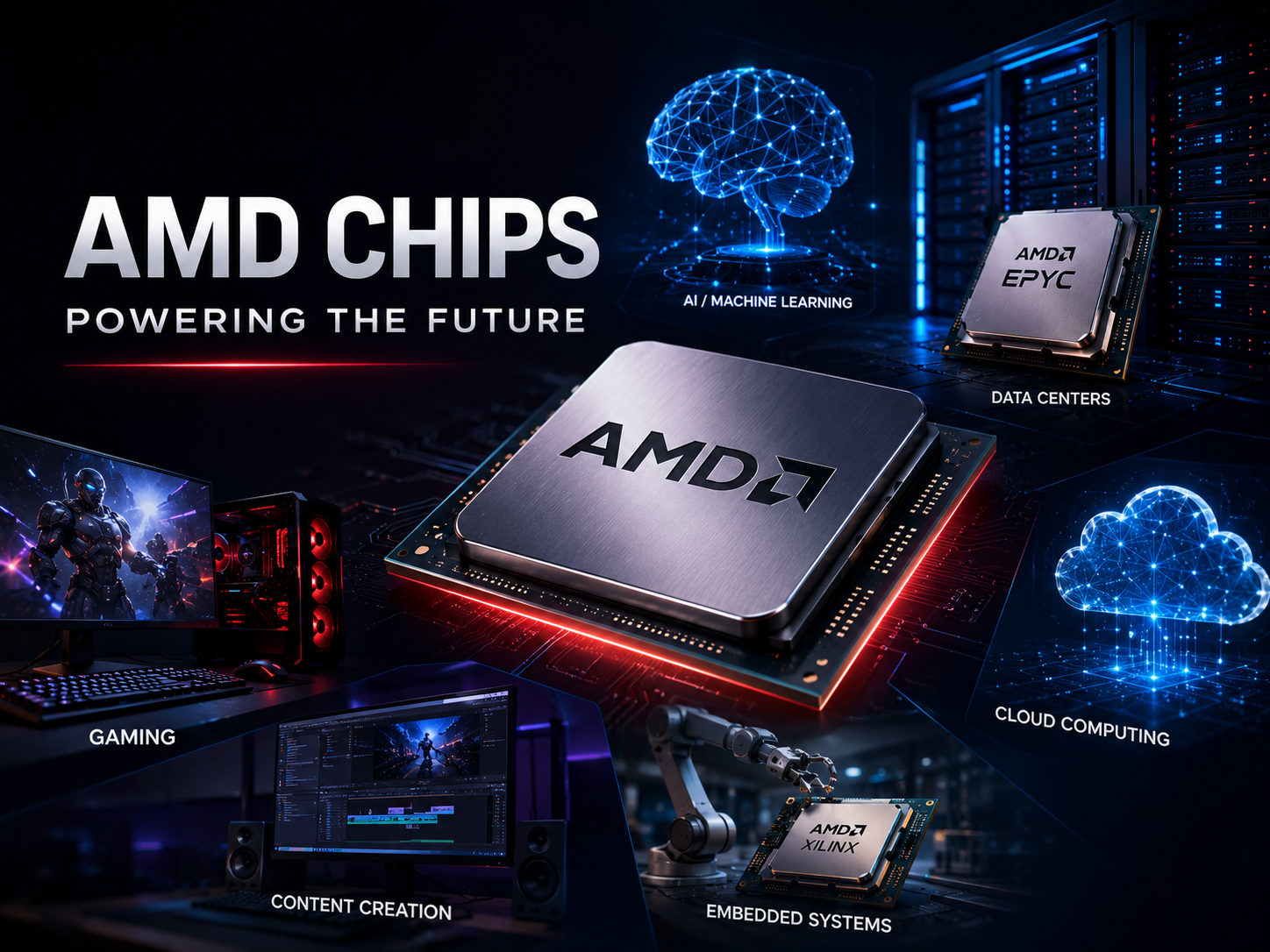
The key reason AMD continues to expand its range of use cases is that the company has both CPU and GPU technology systems. AMD can provide processors for personal computers, while also delivering high performance computing power for AI data centers and cloud computing platforms.
AMD’s positioning also differs between the consumer and enterprise markets. Ryzen and Radeon are more geared toward individual users, while the EPYC and Instinct series mainly serve cloud computing, AI infrastructure, and large enterprise markets.
What Are AMD’s Core Chip Products?
AMD’s product system is mainly made up of CPUs, GPUs, AI accelerators, and embedded chips. Different product lines are designed for different computing needs.
AMD’s most important current products include:
| Product Line |
Main Use |
| Ryzen |
Consumer CPUs |
| Radeon |
Gaming and graphics GPUs |
| EPYC |
Data center CPUs |
| Instinct |
AI accelerators |
| Xilinx FPGA |
Embedded and edge computing |
The Ryzen series is mainly used in personal computers and creator devices. Radeon GPUs are mainly used for game rendering, visual computing, and graphics processing.
EPYC and Instinct products are becoming increasingly important. As demand grows for AI model training and cloud computing, the data center business has become a key focus for AMD.
How AMD CPUs Are Used in the Consumer Market
AMD Ryzen processors have become an important CPU product in the consumer PC market. The Ryzen series mainly covers gaming PCs, office devices, creator workstations, and high performance laptops.
One of AMD Ryzen’s core strengths is its strong multi core performance. Multithreaded capability directly affects video rendering, content creation, and the efficiency of running large software applications.
AMD Ryzen is mainly used in the following scenarios:
-
Gaming PCs
-
Content creation
-
Video editing
-
High performance laptops
In the gaming market, AMD Ryzen mainly competes with the Intel Core series. AMD usually emphasizes multi core performance and value for money, while Intel places more emphasis on certain high frequency single core performance.
The importance of AMD CPUs in the consumer market comes not only from hardware performance, but also from a complete platform ecosystem. AMD has built a product system in which motherboards, graphics cards, and processors develop in coordination.
How AMD GPUs Are Used in Gaming
AMD Radeon GPUs are mainly used for game graphics rendering and visual computing. GPU chips can process large numbers of graphics tasks at the same time, which makes them suitable for large games and high resolution rendering scenarios.
AMD Radeon GPUs are now used in:
One of AMD GPU’s key advantages in gaming is its strong graphics computing capability and open ecosystem. AMD has also long supported graphics interface standards such as DirectX and Vulkan.
AMD Radeon GPUs are also used in some game console platforms. The graphics chips and CPUs in several mainstream game consoles are supplied by AMD.
Competition between AMD GPUs and NVIDIA GPUs mainly centers on graphics performance, ray tracing, and AI accelerated graphics.
How AMD Chips Support AI and Machine Learning
AI and machine learning require large amounts of parallel computing power, so GPUs and AI accelerators have become important parts of AI infrastructure.
The AMD Instinct series is mainly used for:
| AI Application Area |
Main Scenario |
| AI Training |
Large model training |
| AI Inference |
Real time AI computing |
| HPC |
High performance computing |
| Data Analysis |
Large scale data processing |
AMD Instinct GPUs can be used to train large language models and machine learning systems. AI training usually requires substantial GPU based parallel computing resources, which is why the data center market has become a major focus for AMD.
AMD is also continuing to develop the ROCm software ecosystem. ROCm is an open source GPU computing platform launched by AMD, mainly used to support AI and high performance computing tasks.
AMD’s main challenge in the AI market comes from NVIDIA’s CUDA ecosystem. CUDA has already built a strong developer base, while AMD is still expanding its own AI software ecosystem.
How AMD Is Used in Cloud Computing and Servers
AMD EPYC server chips have entered the cloud computing and enterprise server markets. EPYC products mainly emphasize multi core performance, energy efficiency, and enterprise grade scalability.
AMD EPYC chips are now used in:
The importance of AMD’s data center business continues to rise. As demand grows for AI model training and cloud computing, the server market has become a major competitive area in the global chip industry.
AMD EPYC’s advantages in certain scenarios mainly come from high core counts and strong parallel processing capability. Large data centers usually pay close attention to power consumption and compute density, so AMD’s multi core architecture has a certain competitive edge.
AMD has long competed with Intel’s Xeon series in the server market, but changing demand for AI infrastructure has also created more enterprise market opportunities for AMD.
AMD Chips’ Role in Edge Computing
Edge computing mainly emphasizes low latency, localized computing, and real time data processing. AMD chips have already entered industrial equipment, communications systems, and embedded computing markets.
A key part of AMD’s edge computing business comes from the Xilinx FPGA product system. FPGA chips can flexibly adjust their computing structure according to different needs, making them suitable for industrial and communications scenarios.
The main uses of AMD chips in edge computing include:
The edge computing market is becoming increasingly important. As AI models gradually move into end devices, demand for local computing power is also beginning to grow.
AMD’s competitive focus in edge computing mainly centers on high performance, low power computing and flexible hardware architecture.
Strengths and Limitations of AMD’s Application Ecosystem
One of AMD’s core strengths is that it has both CPU and GPU technology systems. AMD can cover multiple markets, including consumer PCs, AI data centers, and enterprise servers.
The main strengths of AMD’s application ecosystem include:
| Strength Area |
Main Feature |
| Multi product coverage |
CPU plus GPU plus AI |
| Multi core performance |
Strong parallel computing capability |
| Open ecosystem |
Supports open source platforms |
| Data center strategy |
Continued expansion in enterprise markets |
AMD also has some limitations. In the AI software ecosystem, AMD still lags behind NVIDIA, especially in development tools and AI framework support.
AMD’s enterprise ecosystem also has a shorter history than Intel’s. Some large enterprises still rely more heavily on the server ecosystem that Intel has built over many years.
AMD’s competitiveness in the AI market will continue to be shaped by its software ecosystem and its ability to work with data center partners.
Is AMD Expanding Its Enterprise Application Market?
AMD is continuing to expand its enterprise market presence. Data centers, AI infrastructure, and cloud computing platforms have become important business directions for AMD today.
AMD’s enterprise market expansion mainly focuses on three areas:
-
Data center CPUs
-
AI accelerators
-
Edge computing platforms
AMD Instinct AI GPUs have already entered some large AI clusters and supercomputer markets. As demand for large AI model training grows, the enterprise GPU market is also expanding rapidly.
AMD is also entering industrial and communications markets through FPGA and embedded businesses. The addition of Xilinx has further expanded AMD’s product structure in enterprise computing.
AMD’s current goal is no longer limited to the consumer chip market. It is building a complete ecosystem covering AI, data centers, and enterprise computing.
Conclusion
AMD chips now cover many areas, including consumer PCs, gaming graphics, AI training, cloud computing, and edge computing. The Ryzen, Radeon, EPYC, and Instinct series form AMD’s current core product system.
Growth in AI and data center demand is also pushing AMD to expand its enterprise market strategy. AMD is no longer just a traditional PC chipmaker, but is gradually entering the high performance computing and AI infrastructure markets.
Competition between AMD, Intel, and NVIDIA is also driving the global chip industry into a new computing era.
FAQs
What Are AMD Chips Mainly Used For?
AMD chips are mainly used in gaming PCs, AI data centers, cloud computing platforms, enterprise servers, edge computing devices, and high performance workstations.
Who Is AMD Ryzen Mainly Suitable For?
AMD Ryzen is mainly suitable for gamers, content creators, office users, and high performance PC users who need multithreaded computing capability.
Can AMD GPUs Be Used for AI Training?
AMD Instinct GPUs can be used for AI model training and high performance computing tasks, and they support the ROCm open source AI computing platform.
Why Is AMD Entering the Data Center Market?
Data centers and AI training require large amounts of high performance computing resources, so AMD is expanding its enterprise market presence through the EPYC and Instinct series.
What Is AMD’s Role in Edge Computing?
AMD’s edge computing business mainly covers industrial equipment, communications systems, and embedded platforms, with a focus on FPGA and low latency local computing.
How Are AMD and NVIDIA Different in the AI Market?
AMD places more emphasis on open ecosystems and the ROCm platform, while NVIDIA mainly relies on the CUDA software ecosystem and a more mature AI development system.