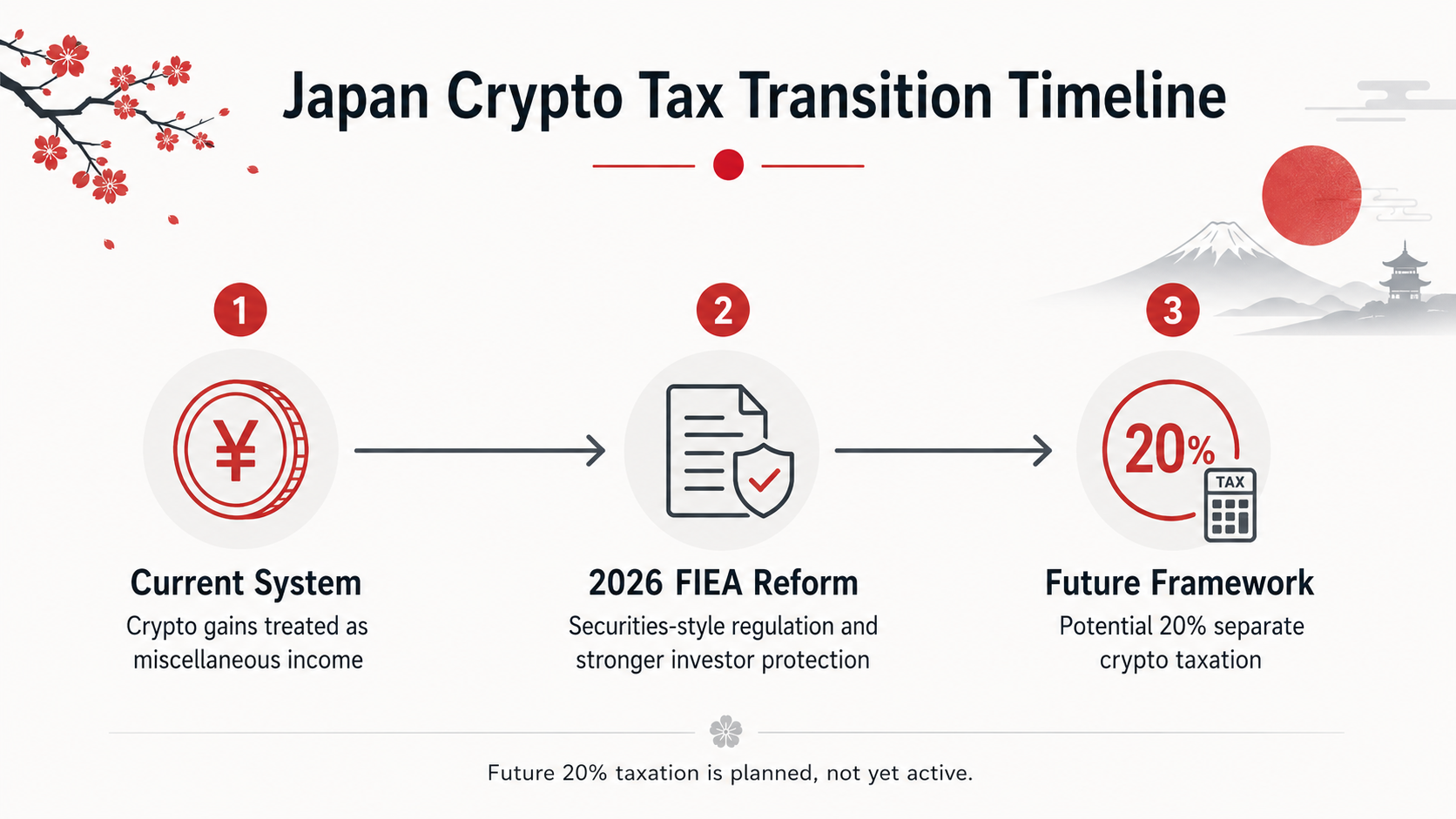
Crypto taxes in Japan are currently calculated by treating most individual cryptocurrency gains as miscellaneous income (zasshotoku), which is added to other taxable income and taxed under progressive income-tax rates. Selling crypto for yen, exchanging one token for another, or using cryptocurrency for payments can create taxable events. For high-income taxpayers, the combined national and local tax burden can approach approximately 55%.
Japan’s 2026 Financial Instruments and Exchange Act (FIEA) reform introduces a major regulatory change by bringing qualifying crypto assets closer to Japan’s traditional financial-market framework. However, the future 20% separate taxation system is not active yet and requires additional implementation steps.
TL;DR
-
Japan currently taxes most individual crypto gains as miscellaneous income rather than under a separate crypto tax rate.
-
Taxable events may include selling crypto, crypto-to-crypto swaps, and paying for goods with digital assets.
-
Current crypto taxation uses progressive income-tax brackets, with the highest combined burden approaching approximately 55%.
-
Japan’s 2026 FIEA reform introduces stronger disclosure, market-conduct, and exchange-supervision rules.
-
A future 20% separate taxation system with loss carryforward rules is planned but is not available yet.
What Are the Current Crypto Tax Rules in Japan?
Japan currently taxes most individual cryptocurrency profits as miscellaneous income, meaning crypto gains are combined with other taxable income when calculating income tax.
The Japan National Tax Agency (NTA) states that crypto asset income is generally classified as miscellaneous income unless specific circumstances support another classification, such as business income treatment.
Unlike listed securities, which generally use a separate taxation system, cryptocurrency profits currently follow Japan’s general progressive income-tax structure.
Understanding this distinction is important because a crypto gain does not receive a fixed tax percentage. The final tax burden depends on the taxpayer’s total income, deductions, and applicable local taxes.
Readers comparing Japan’s regulatory transition with broader crypto classification changes can also review how crypto assets are being recognized as financial assets in Japan through Japan’s crypto financial asset reclassification.
Which Crypto Transactions Are Taxable in Japan?
Crypto transactions become taxable when a taxpayer realizes income through disposal or receives crypto-related income.
| Transaction Type |
Current Tax Treatment |
| Selling Bitcoin or crypto for Japanese yen |
Gain or loss is calculated using disposal value and acquisition cost |
| Swapping BTC for ETH or another token |
The exchanged crypto is treated as disposed of at its yen value |
| Buying goods with crypto |
The crypto used for payment may create taxable income |
| Mining rewards |
Received value may be treated as income |
| Staking rewards |
Received value may create taxable income |
| Holding crypto without selling |
Unrealized gains are generally not taxed |
A common misconception is that taxes only apply when crypto is converted into fiat currency. In Japan, a token swap can also trigger taxation because the original asset has effectively been exchanged for another asset.
What Are Japan’s Current Crypto Tax Rates?
Japan does not currently have one fixed cryptocurrency tax rate. Crypto income is generally added to other taxable income and assessed using progressive income-tax brackets.
| Taxable Income |
National Income Tax Rate |
| ¥1.95 million or below |
5% |
| ¥1.95 million to ¥3.3 million |
10% |
| ¥3.3 million to ¥6.95 million |
20% |
| ¥6.95 million to ¥9 million |
23% |
| ¥9 million to ¥18 million |
33% |
| ¥18 million to ¥40 million |
40% |
| Above ¥40 million |
45% |
Japan also applies local inhabitant tax and a reconstruction surtax. Because crypto gains are combined with other taxable income, higher-income taxpayers may face a combined burden approaching approximately 55%.
The actual amount depends on income level, deductions, expenses, and personal circumstances. The Japan National Tax Agency provides current income-tax guidance and crypto calculation information for taxpayers.
How Does Crypto Income Affect Tax Calculation in Japan?
Crypto gains can increase a taxpayer’s marginal tax rate because they are added to existing taxable income.
For example, if a taxpayer already has taxable income that places part of their earnings into a higher tax bracket, an additional crypto gain may cause some income to be taxed at a higher marginal rate.
Japan’s progressive system does not mean the entire crypto gain is automatically taxed at the highest rate. Instead, different portions of income fall into different brackets.
This makes transaction records especially important for active traders who complete many swaps, sales, or reward transactions during the year.
Can Crypto Losses Be Used to Reduce Taxes in Japan?
Under the current system, crypto losses generally cannot be used to offset salary income or carried forward into future years.
| Feature |
Current Rules |
| Offset crypto losses against salary |
Generally unavailable |
| Carry losses forward |
Generally unavailable |
| Separate crypto taxation |
Not active |
| Record keeping requirement |
Required |
The future tax framework is expected to change this by introducing a three-year loss carryforward system for qualifying crypto transactions.
Understanding how losses are treated is also important when comparing Japan’s future system with broader concepts such as crypto loss carryforward rules.
Japan’s 2026 FIEA amendment changes crypto regulation by introducing stronger financial-market rules for qualifying crypto assets and related businesses.
The reform does not immediately replace current tax rules, but it creates the regulatory foundation for future taxation changes.
| Reform Area |
Expected Impact |
| Disclosure requirements |
More information about qualifying crypto assets and issuers |
| Insider trading restrictions |
Limits trading using material non-public information |
| Exchange supervision |
Stronger compliance and governance obligations |
| Investor protection |
More securities-style safeguards |
The Financial Services Agency’s reform framework moves crypto closer to Japan’s regulated financial-market structure. This explains why regulatory classification matters beyond taxation alone.
The distinction between the Payment Services Act and the FIEA is important because crypto regulation is shifting from a payment-focused model toward a broader investment-asset framework.
Will Japan Introduce a 20% Separate Crypto Tax System?
Japan plans to introduce a 20% separate taxation framework for qualifying crypto assets, but the system is not active yet.
| Category |
Current System |
Future System |
| Tax method |
Miscellaneous income |
Separate taxation |
| Tax rate |
Progressive rates |
20% planned |
| Loss treatment |
Generally unavailable |
Three-year carryforward planned |
| Effective status |
Active |
Requires implementation |
The proposed 20% rate consists of:
-
15% national tax
-
5% local tax
The Ministry of Finance’s FY2026 tax reform outline links the new taxation framework to the implementation of updated crypto regulations.
The expected timeline depends on when the relevant FIEA provisions officially take effect. If implementation occurs during 2027, separate taxation could begin from January 1, 2028.
Until official rules are published, Japanese taxpayers should continue using the existing taxation framework.
Japan’s FIEA reform may create a regulatory pathway for domestic crypto investment products, but it does not automatically approve Bitcoin or Ethereum ETFs.
Future crypto investment products would still require:
The reform creates a possible framework for institutional products, but specific ETF launches depend on additional regulatory decisions.
What Should Crypto Users in Japan Do Before the New Rules Begin?
Crypto users in Japan should continue maintaining complete transaction records under the current tax system.
Important records include:
The most important distinction during the transition period is understanding the difference between a law being passed and a tax rule becoming effective.
Japan’s FIEA reform represents a major regulatory shift, but current crypto tax obligations remain until the new framework officially begins.
Summary
Crypto taxes in Japan currently operate under a progressive income-tax system. Most individual crypto gains are treated as miscellaneous income, and taxable events can include selling crypto, exchanging tokens, or using digital assets for payments.
Japan’s 2026 FIEA reform strengthens crypto regulation through improved disclosures, insider-trading restrictions, and stronger exchange oversight.
The planned 20% separate taxation system could significantly change how qualifying crypto transactions are taxed, but it is not active yet. Taxpayers should continue following current Japan National Tax Agency guidance until implementation rules are finalized.
This article is for educational purposes only and does not constitute tax, legal, or investment advice.
FAQs
How do I calculate crypto tax in Japan?
Crypto tax calculation generally requires determining the yen value of each taxable transaction and subtracting the acquisition cost of the disposed asset. Because Japan taxes most crypto gains as miscellaneous income, the final amount depends on total taxable income.
Is crypto-to-crypto trading taxable in Japan?
Yes. Swapping one cryptocurrency for another, such as Bitcoin for Ethereum, can create a taxable event because the disposed asset must generally be valued in Japanese yen.
Do I pay tax on Bitcoin if I only hold it in Japan?
Generally, no. Holding crypto without selling or disposing of it does not usually create a taxable event under the current system.
Is Japan’s 20% crypto tax rate already available?
No. Japan’s 20% separate taxation framework is planned but is not currently active. Existing progressive taxation rules continue to apply.
Can crypto losses reduce my salary tax in Japan?
Generally, no. Current rules do not normally allow crypto losses to offset employment income or carry forward to future years.