O Nifty 50 não é apenas um benchmark essencial para investidores domésticos na Índia, mas também é amplamente usado por ETFs globais, fundos de índice e investidores institucionais. Seu mecanismo de cálculo afeta diretamente a eficiência do rastreamento de fundos de índice, a representatividade do mercado e a lógica de alocação global de capital, tornando-o uma peça central da infraestrutura do mercado de capitais indiano.
O que é o Índice Nifty 50?
Criado pela National Stock Exchange of India (NSE), o Nifty 50 é um índice acionário central que reúne 50 empresas blue-chip de grande capitalização do mercado indiano. Ele é amplamente utilizado para refletir o desempenho geral do mercado de capitais indiano e serve como referência fundamental para ETFs, fundos de índice e produtos derivativos.
Diferente de índices tradicionais, o Nifty 50 não apenas acompanha os movimentos de preço das ações — ele adota o método de ponderação por capitalização de mercado de free-float. Isso significa que a influência de uma empresa no índice é determinada principalmente pelo volume de suas ações efetivamente disponíveis para negociação no mercado.
Como o índice abrange setores como finanças, tecnologia, energia, bens de consumo e manufatura, o Nifty 50 também é visto como uma janela importante para a estrutura econômica da Índia e as tendências de desenvolvimento industrial.
O que é Capitalização de Mercado de Free-Float?
A capitalização de mercado de free-float é um conceito central no mecanismo de cálculo do Nifty 50. Refere-se à parcela do valor total de mercado de uma empresa que está realmente disponível para negociação.
Por exemplo, mesmo que uma empresa tenha alto valor de mercado, se grande parte de suas ações estiver nas mãos de fundadores, governo ou investidores estratégicos de longo prazo, a proporção de ações negociáveis será menor. No cálculo do Nifty 50, considera-se apenas o valor das ações livremente negociáveis.
O cálculo da capitalização de mercado de free-float é feito da seguinte forma:
$\text{Free Float Market Cap} = \text{Share Price} \times \text{Outstanding Shares} \times \text{Free Float Factor}$
A principal razão para usar esse mecanismo é refletir com mais precisão o montante de capital que pode realmente participar das negociações, além de reduzir a influência excessiva dos acionistas controladores sobre os pesos do índice.
Qual é a Fórmula de Cálculo do Nifty 50?
O valor do índice Nifty 50 é calculado a partir da soma das capitalizações de free-float de todas as ações que o compõem. O índice parte de um valor base fixo e é continuamente atualizado conforme o mercado se movimenta.
Sua lógica central de cálculo é:
$\text{Nifty 50 Index Value} = \frac{\sum (\text{Free Float Market Cap of 50 Companies})}{\text{Base Market Capital}} \times \text{Base Index Value}$
Quando os preços das ações componentes sobem, a capitalização de free-float aumenta, elevando o índice; quando caem, o índice recua.
Devido à ponderação por capitalização de mercado, variações nos preços de grandes empresas costumam ter maior impacto sobre o índice. Por exemplo, oscilações nas ações da Reliance Industries ou do HDFC Bank afetam o índice de forma mais significativa do que as de empresas de peso médio.
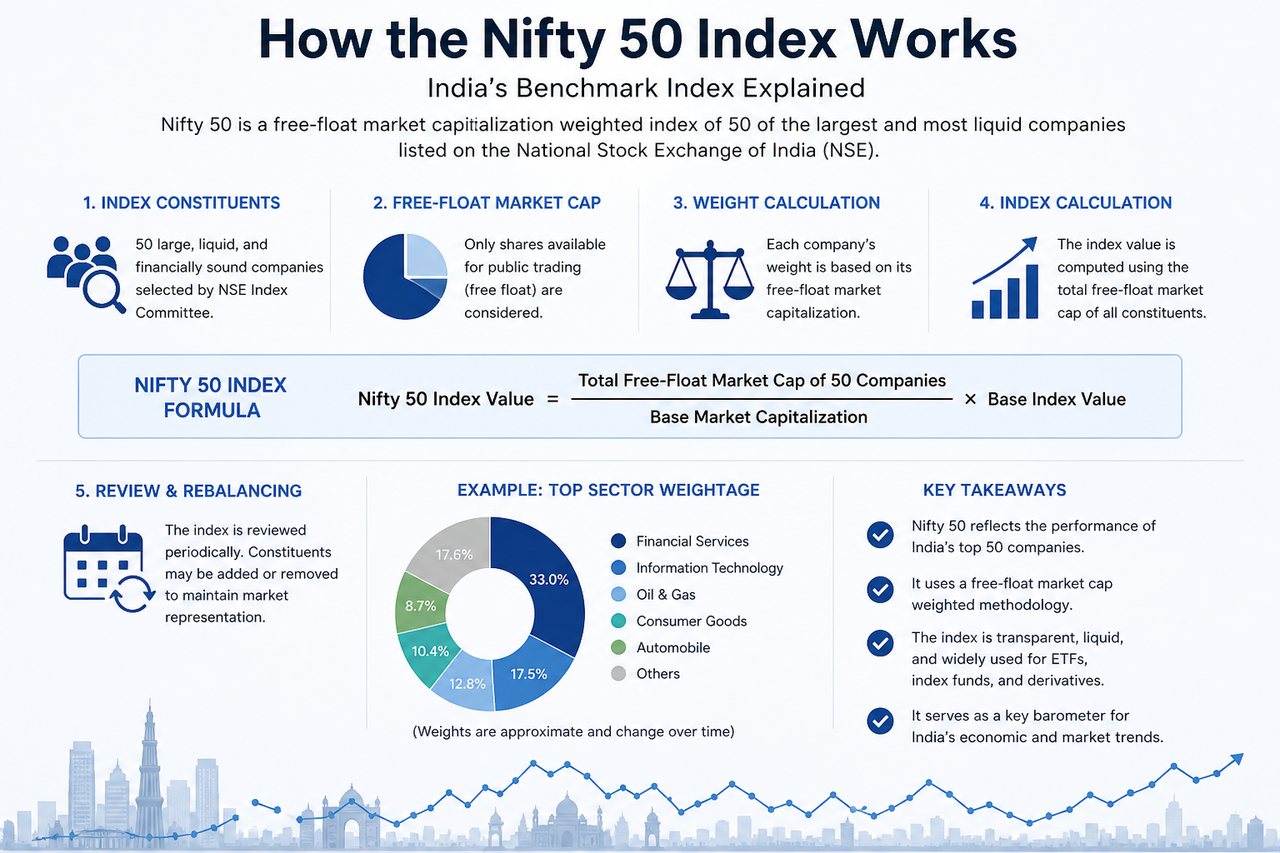
Como os Pesos dos Componentes são Alocados?
No Nifty 50, nem todas as empresas têm a mesma relevância. Quanto maior o peso de uma empresa, maior a influência de suas variações de preço sobre o índice.
Os pesos são determinados principalmente pela capitalização de free-float, de modo que grandes instituições financeiras e empresas de tecnologia costumam ter participações mais altas. HDFC Bank, Reliance Industries e Infosys, por exemplo, estão historicamente entre as ações de maior peso.
O cálculo do peso é:
$\text{Company Weight} = \frac{\text{Company Free Float Market Cap}}{\text{Total Free Float Market Cap of Index}}$
Isso significa que, mesmo que algumas ações menores subam com força, o impacto geral no índice pode não ser tão evidente. Já as empresas de grande capitalização com pesos mais altos conseguem influenciar a direção do índice com mais facilidade.
Como os Componentes do Nifty 50 são Ajustados?
Para manter a representatividade do mercado, o Nifty 50 passa por ajustes periódicos de composição e rebalanceamento. O Comitê do Índice reavalia a elegibilidade das empresas com base em critérios como:
- Capitalização de free-float
- Liquidez das ações
- Valor preenchido médio diário
- Representação setorial
- Tempo de listagem e conformidade regulatória
Se uma empresa apresenta queda prolongada no valor de mercado ou baixa atividade de negociação, pode ser removida do índice; por outro lado, empresas de grande capitalização emergentes podem ser incluídas.
Esse mecanismo dinâmico ajuda o Nifty 50 a refletir continuamente as mudanças na estrutura econômica indiana. Com o avanço da economia digital e do setor de tecnologia, por exemplo, a influência de empresas de TI e internet no índice também cresceu.
O que Acontece Durante o Rebalanceamento?
No rebalanceamento, ETFs, fundos de índice e instituições quantitativas geralmente precisam ajustar suas carteiras em conjunto para manter o rastreamento preciso do Nifty 50.
Se uma empresa é adicionada ao índice, fundos passivos normalmente precisam comprar suas ações; se removida, pode sofrer pressão vendedora desses fundos. Por isso, os ajustes do índice podem ter um impacto relevante nos preços de curto prazo das ações envolvidas.
Além disso, o rebalanceamento altera a estrutura de pesos setoriais. Uma queda no peso do setor financeiro ou um aumento no peso do setor de tecnologia, por exemplo, pode influenciar as tendências futuras do índice e a estrutura de risco do mercado.
Qual a Diferença Entre o Nifty 50 e os Índices Ponderados por Preço?
Índices tradicionais como o Dow Jones Industrial Average (DJIA) usam ponderação por preço: ações com maior preço exercem mais influência.
Já o Nifty 50 usa ponderação por capitalização de free-float: o foco está no tamanho de mercado das empresas, não apenas no nível de preço.
| Aspecto de Comparação |
Ponderado por Cap. de Mercado Free-Float |
Ponderado por Preço |
| Base Central |
Capitalização de mercado da empresa |
Preço da ação |
| Impacto de Grandes Empresas |
Maior |
Não necessariamente |
| Representatividade de Mercado |
Mais forte |
Relativamente limitada |
| Índices Comuns |
Nifty 50, S&P 500 |
DJIA |
Esse formato torna o Nifty 50 mais indicado como referência de longo prazo e facilita sua replicação por ETFs e fundos de índice.
Resumo
A lógica central de cálculo do Nifty 50 se baseia na ponderação por capitalização de free-float. Suas variações dependem não apenas dos preços das ações, mas também da proporção de ações negociáveis, dos pesos das empresas e da estrutura setorial.
Por meio de ajustes regulares de composição e rebalanceamento, o Nifty 50 mantém sua representatividade das grandes empresas listadas na Índia e segue como referência essencial para ETFs, fundos de índice e o mercado de derivativos.
Perguntas Frequentes
Como o Nifty 50 é calculado?
O Nifty 50 usa ponderação por capitalização de free-float: o índice é calculado com base na soma das capitalizações de free-float das 50 ações componentes.
O que é Capitalização de Mercado de Free-Float?
É o valor de mercado das ações que podem ser efetivamente negociadas, excluindo as ações detidas pelo governo, fundadores ou holders estratégicos de longo prazo.
Por que grandes empresas têm mais impacto no Nifty 50?
Porque o índice usa ponderação por capitalização de mercado — variações nos preços de empresas com maior peso afetam o índice de forma mais expressiva.
O Nifty 50 é ajustado regularmente?
Sim. O Comitê do Índice revisa periodicamente a composição com base em capitalização, liquidez e representação setorial.
Qual a diferença entre o cálculo do Nifty 50 e o do Dow Jones?
O Nifty 50 usa ponderação por capitalização de free-float; o Dow Jones Industrial Average usa ponderação por preço.
Por que os ETFs valorizam o método de cálculo do Nifty 50?
Um mecanismo de cálculo transparente e estável reduz o erro de rastreamento e aumenta a eficiência de replicação dos fundos de índice.