Over the past decade, most blockchain networks have been built on traditional consensus mechanisms. Bitcoin uses Proof-of-Work, or PoW to ensure security, while Ethereum has shifted to Proof-of-Stake, or PoS, to improve efficiency. Yet whether it is PoW or PoS, neither model easily serves the new demands of the AI and verifiable computation era.
Nockchain is positioned at its core as a verifiable computation network based on ZK Proof-of-Work, or ZKPoW. It attempts to replace the hash operations performed by traditional miners with Zero-Knowledge Proof generation, bringing network security and real computational demand into the same system.
How Does ZK Proof-of-Work Operate?
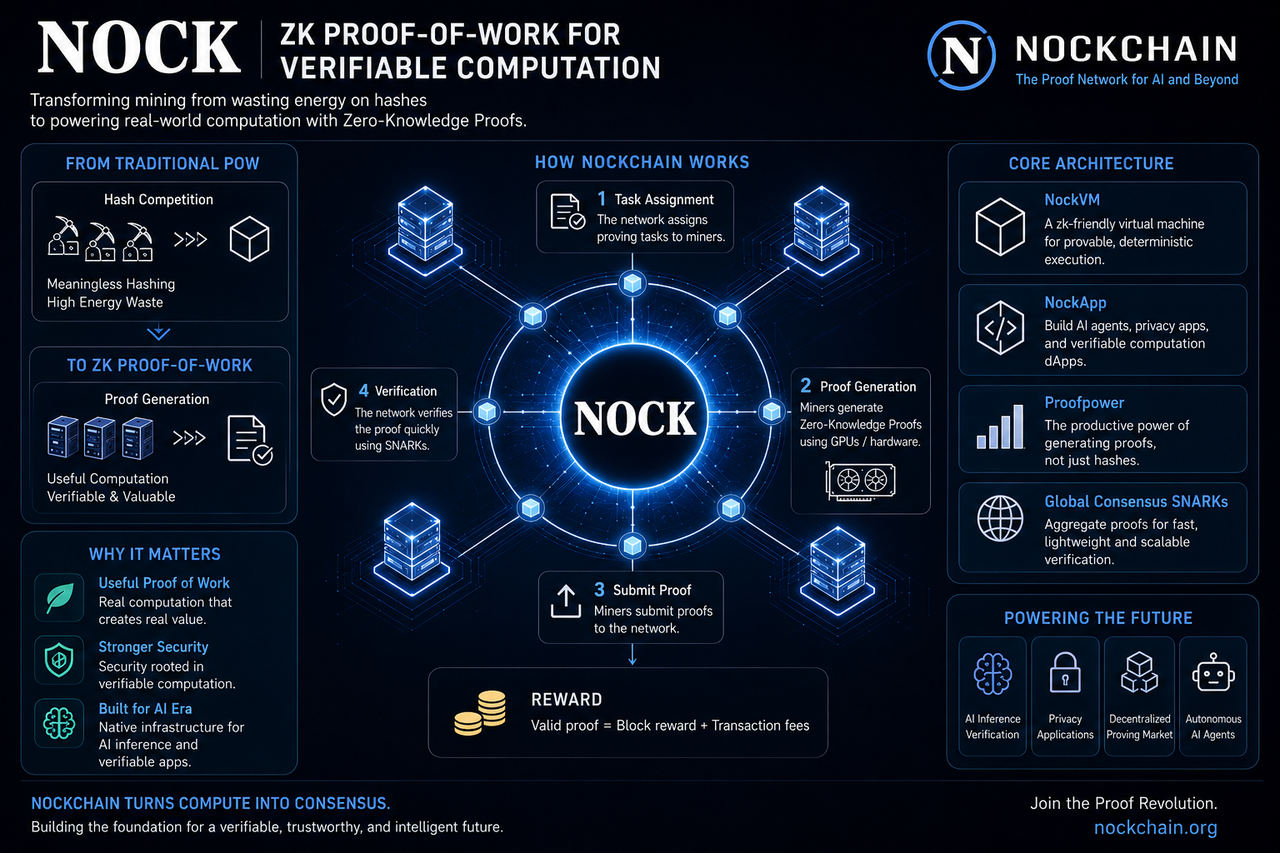
Traditional PoW networks work by having miners continuously perform hash calculations until they find a result that meets the network’s difficulty requirement. In Nockchain, the work miners perform is replaced by Zero-Knowledge Proof generation.
The network assigns proving tasks to miners, who generate the corresponding proofs using GPUs or proving hardware. Once a proof is successfully verified, the miner can receive block rewards and network revenue.
This means miners no longer compete through hashpower, but through proof generation capability. Network security comes from verifiable proofs, while computing power itself is used for real computation. As a result, Nockchain is seen as an important representative of “Proof of Useful Work.”
What Is Proofpower?
In the Bitcoin network, hashpower is the measure of a miner’s competitiveness. In Nockchain, that measure is Proofpower.
Proofpower can be understood as a miner’s ability to generate valid Zero-Knowledge Proofs. GPU performance, proving speed, proof compression capability, and hardware optimization all affect a miner’s Proofpower.
How Does NockVM Work?
NockVM is Nockchain’s core virtual machine and a key part of the network’s operating infrastructure.
Unlike a traditional smart contract VM, NockVM is not designed simply to increase TPS. Its goal is to optimize “provability.” Smart contract execution on traditional blockchains is often complex, and proof generation costs can be high. NockVM, by contrast, is better suited to zk-friendly computation.
Its operating logic emphasizes deterministic execution, lightweight proving, and verifiable execution, making it easier to generate Zero-Knowledge Proofs for application execution results. This is one of the key reasons Nockchain can support verifiable AI and the proving economy.
How Does NockApp Operate?
NockApp is the application model that runs on Nockchain.
Developers can build AI Agents, privacy applications, decentralized proving services, and verifiable AI applications on Nockchain. The biggest difference from traditional DApps is that a NockApp’s execution results can be verified by Zero-Knowledge Proofs.
For example, after an AI Agent completes an inference task, it can generate a proof showing that the inference process genuinely occurred and was not tampered with. This model is important for future AI networks, because AI inference verification is becoming a major industry need.
What Are Global Consensus SNARKs?
To reduce verification costs, Nockchain introduces the Global Consensus SNARKs architecture.
Traditional blockchains usually require all nodes to repeat computations, while SNARK-based verification allows a proof to be generated once and then quickly verified by the network. This design can reduce the burden of on-chain computation and improve network scalability.
As a result, Nockchain is better suited to complex computation scenarios, especially fields that require extensive verification capabilities, such as AI inference, privacy computation, and proving markets.
How Is Nockchain Different from Traditional PoW?
Nockchain and Bitcoin both follow the logic of PoW, but they belong to different generations of blockchain models.
Bitcoin’s core goal is to secure the network through hash competition, while Nockchain’s core goal is to build a verifiable computation network through proof generation.
In Bitcoin, miners perform meaningless hash operations. In Nockchain, miners perform proving computation with real-world use. This means blockchain computing power can begin to truly serve new demands in AI, ZK, and Verifiable Computation.
What Challenges Does Nockchain Face?
Although Nockchain’s architecture is innovative, it still faces several practical challenges.
At present, Zero-Knowledge Proof generation remains costly and places high demands on GPUs and proving hardware. At the same time, the AI proving market is still in an early stage, and the scale of real demand has yet to be proven.
In addition, Nockchain still needs to further build its developer ecosystem, proving economy, and application-layer demand. Only when these pieces form a complete loop can the ZKPoW model truly achieve long-term growth.
Conclusion
Nockchain is attempting to redefine how blockchain networks operate.
Through ZK Proof-of-Work, or ZKPoW, Nockchain upgrades the meaningless hash operations used in traditional PoW into Zero-Knowledge Proof generation with real-world utility. Miners no longer merely consume energy. Instead, they directly participate in building verifiable computation and proving infrastructure.
FAQs
What Is ZKPoW?
ZKPoW, or Zero-Knowledge Proof-of-Work, is a new type of PoW mechanism that replaces hash competition with proof generation, allowing computing power to be used for real computational tasks.
What Is Proofpower in Nockchain?
Proofpower refers to a miner’s ability to generate valid Zero-Knowledge Proofs. It is the equivalent of hashpower in traditional PoW networks.
What Role Does NockVM Play?
NockVM is Nockchain’s core virtual machine, designed with a focus on improving proving efficiency and verifiable execution capability.
Nockchain focuses on verifiable computation and proving infrastructure. It can be used to verify AI inference and AI Agent execution, which is why it is regarded as AI-native blockchain infrastructure.







