In the past, most DeFi yield models relied on liquidity mining and token incentives. When market liquidity declined or token prices fell, these yields often became difficult to sustain over the long term. As a result, more protocols have begun exploring “real yield” models, where returns come from the market itself rather than from additional token issuance by the protocol. Against this backdrop, yield bearing stablecoins and structured yield protocols have gradually become an important direction for the next wave of DeFi infrastructure.
YieldVault uses Delta neutral hedging strategies, perpetual contract funding rates, and on-chain position management to provide users with stable yield while seeking to control the risks of market volatility.
What Is YieldVault?
As the yield strategy module of Solstice, YieldVault is responsible for deploying user deposited assets into on-chain yield strategies.
Users typically enter the protocol through USX or other stable assets, after which the protocol allocates funds to YieldVault. The module then executes market neutral strategies to capture funding rate income and other structured sources of yield.
Unlike traditional DeFi yield pools, YieldVault is not centered on “high APY.” Its core focus is whether the source of yield is sustainable and whether the protocol can manage risk effectively.
What Is a Delta Neutral Strategy?
Delta neutral is a common financial hedging strategy designed to reduce directional market risk while capturing returns from market structure.
In crypto markets, YieldVault typically holds both a spot asset and a corresponding short position in perpetual contracts. For example, the protocol may buy spot BTC while opening a BTC short position in the perpetual market.
Because the spot and short positions move in opposite directions, when the price of BTC rises, the spot position gains value while the short position loses value. When BTC falls, the reverse happens. As a result, the protocol’s overall price risk is relatively reduced.
YieldVault’s core yield does not come from the price movement of BTC itself, but from funding rates in the perpetual contract market.
This model is clearly different from a traditional “long only” approach. The protocol is more focused on returns from market structure than on capital gains from rising asset prices.
How Are Perpetual Contract Funding Rates Generated?
Funding rates are the balancing mechanism of perpetual contract markets.
Because perpetual contracts have no expiry date, exchanges usually use funding rates to regulate long and short demand. When demand for long positions is too high, long traders need to pay fees to short traders. When demand for shorts is higher, payment flows in the opposite direction.
In most bull market environments, demand for long positions is often stronger, so funding rates are usually positive. This means the party holding a short position can continuously earn funding rate income.
YieldVault uses this market structure to capture funding rates by establishing short positions.
Because the yield comes from market trading activity rather than additional token issuance by the protocol, this model is also viewed as part of a “real yield” structure.
What Is the Full Operating Process of YieldVault?
After users deposit USDC or other stable assets into Solstice, the protocol mints USX or eUSX according to its rules.
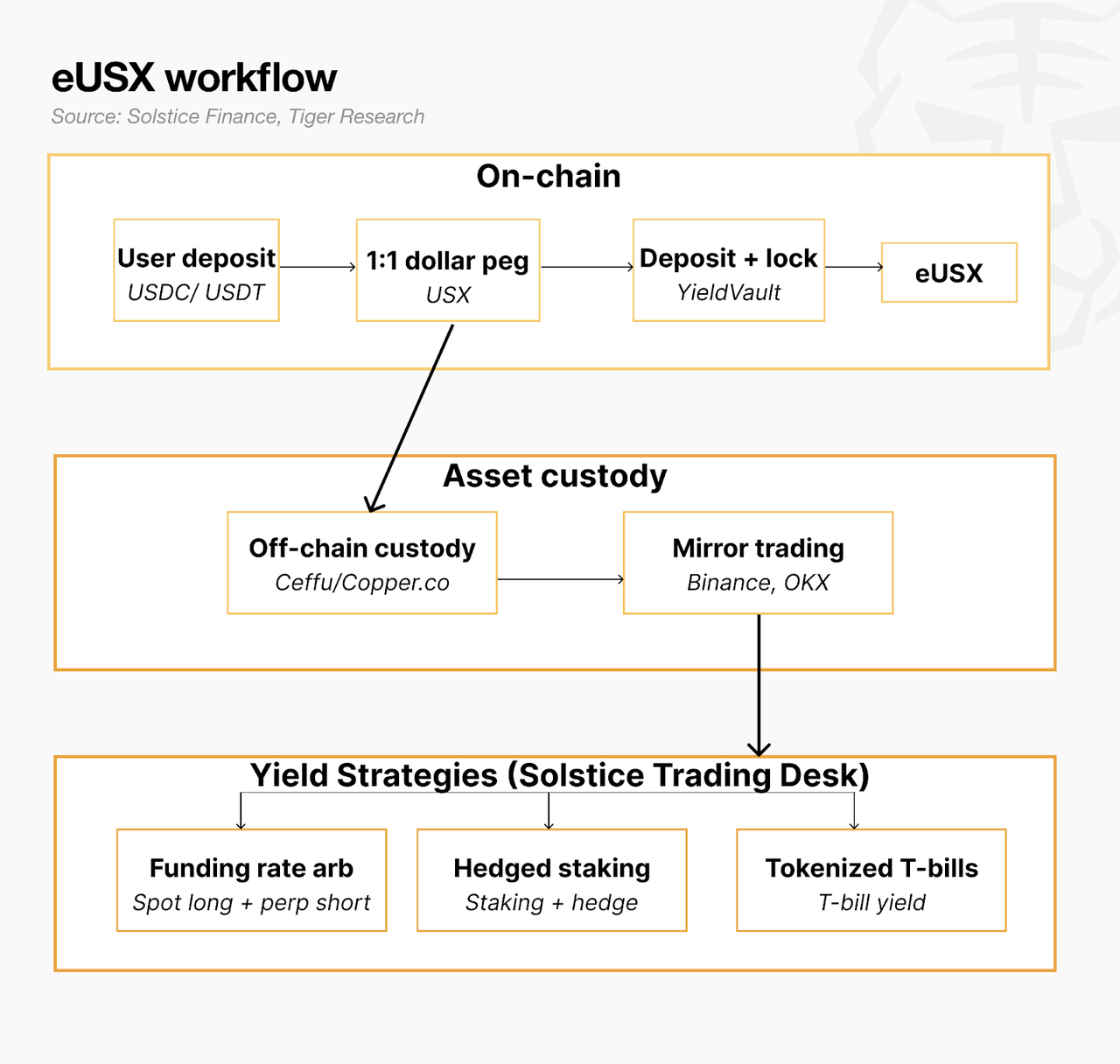
YieldVault then deploys part of the funds into perpetual and spot markets. Based on its risk parameters, the protocol establishes both spot positions and short hedging positions.
While the strategy is running, the protocol continuously monitors market funding rates, position risk, and market volatility, then dynamically adjusts position size.
If market funding rates remain positive, the protocol continues to earn yield. That yield then enters the yield pool and is reflected in the growth of eUSX’s asset value.
Throughout the process, users typically do not need to trade actively. Instead, they gain yield exposure by holding eUSX.
Why Is YieldVault Closer to an Institutional Grade Yield Strategy?
Traditional DeFi yield protocols usually rely on simple liquidity mining, while YieldVault places greater emphasis on risk management and capital efficiency.
Its core logic has certain similarities to hedge funds or market neutral strategies in traditional finance, including:
-
Reducing directional risk through hedging
-
Capturing returns from market structure
-
Dynamically managing position risk
-
Emphasizing capital efficiency
In addition, YieldVault depends on real time position adjustments, capital management, and market liquidity control, making it closer to professional asset management logic.
As institutional capital gradually enters on-chain markets, this type of “institutional grade yield protocol” has also become an important direction in today’s DeFi landscape.
How Is YieldVault Different From Traditional Liquidity Mining?
The yield from traditional liquidity mining usually comes from newly issued tokens by the protocol.
This means the protocol needs to keep subsidizing users. Once the token price falls, the yield often becomes difficult to maintain.
YieldVault, by contrast, places more emphasis on yield generated by the market itself, such as funding rates, market arbitrage, or structured returns.
The core differences are:
| Comparison Dimension |
YieldVault |
Traditional Liquidity Mining |
| Yield Source |
Market structure returns |
Token incentives |
| Risk Type |
Hedging and market risk |
Token price risk |
| Yield Sustainability |
Depends on market structure |
Depends on protocol subsidies |
| Core Logic |
Asset management |
Liquidity subsidies |
| Market Positioning |
Institutional grade yield |
User growth tool |
As the DeFi market matures, more protocols are shifting from “high APY” toward “real yield” models.
What Risks Does YieldVault Face?
Although Delta neutral strategies can reduce part of the market risk, YieldVault still faces several potential risks.
The first is funding rate risk. If market funding rates fall for a long period or even turn negative, protocol yield may decline significantly.
The second is extreme market risk. In highly volatile markets, slippage, liquidation, or liquidity issues may arise between spot and perpetual positions.
The protocol also faces smart contract risk, oracle risk, and trading platform risk. If the underlying on-chain infrastructure experiences abnormal conditions, execution of the yield strategy may also be affected.
In addition, market neutral does not mean “risk free.” Even if the protocol reduces directional risk, it still needs to continuously manage position and liquidity risks.
Conclusion
As Solstice’s core yield module, YieldVault provides users with on-chain yield through Delta neutral strategies, perpetual contract funding rates, and on-chain position management.
Compared with traditional liquidity mining models that rely on token subsidies, YieldVault places greater emphasis on real yield, risk hedging, and capital management efficiency, making it closer to institutional grade asset management logic.
However, a market neutral strategy does not mean there is no risk at all. Funding rate changes, market volatility, smart contract risk, and liquidity issues remain important challenges that yield protocols must continue to face over the long term.
FAQs
Where Does YieldVault’s Yield Come From?
Its yield mainly comes from funding rates in perpetual contract markets, as well as certain returns from market structure.
What Is a Delta Neutral Strategy?
Delta neutral is a hedging strategy that reduces directional market risk by holding both spot and short positions at the same time.
How Is YieldVault Different From Liquidity Mining?
Traditional liquidity mining relies on token incentives, while YieldVault places more emphasis on real yield generated by market structure.
Is YieldVault Completely Risk Free?
No. The protocol still faces risks such as funding rate changes, market volatility, smart contract vulnerabilities, and liquidity risk.
Why Is Solana Suitable for YieldVault?
Solana offers high performance and low transaction costs, making it better suited to yield strategies that require frequent position management and hedging operations.