Understanding how SOXL leverage works is essential for assessing product risk, holding periods, and trading strategies. Many investors mistakenly assume that if the index gains 30% in a year, SOXL must gain roughly 90%. In reality, this overlooks the effects of daily compounding and dynamic rebalancing.
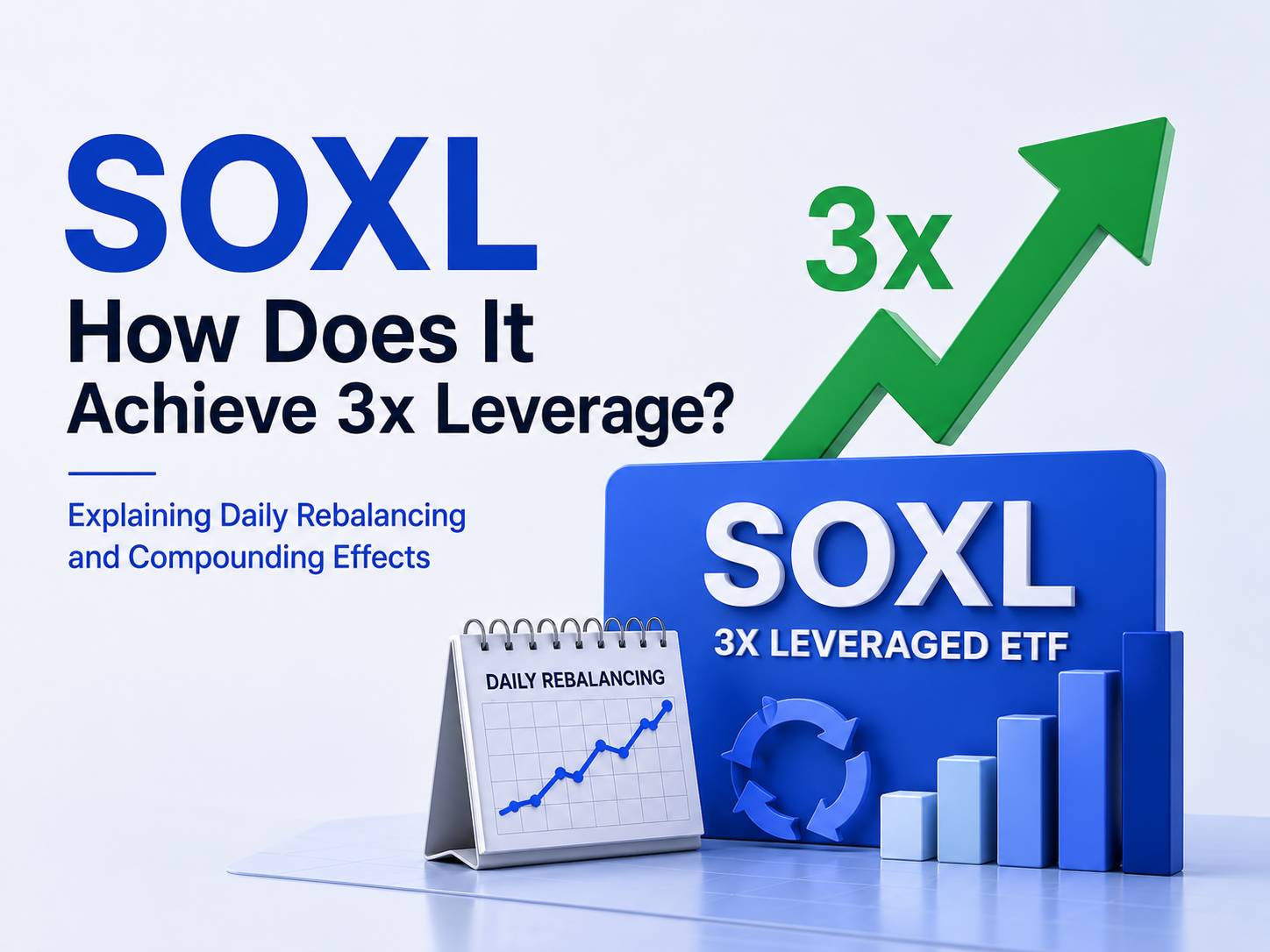
What Is the Leverage Mechanism of SOXL
SOXL is a leveraged ETF that aims to deliver approximately three times the daily return of the U.S. semiconductor industry index. To achieve this, the fund manager does not simply borrow money to buy three times the stocks. Instead, they use a combination of financial derivatives such as swap contracts and stock index futures to build risk exposure.
This approach allows for nearly three times market exposure without holding a large amount of spot stocks. The fund also keeps a portion of cash and short-term bonds to meet liquidity needs and manage margin requirements.
SOXL's leverage multiple is not a fixed long-term figure; it is reset to the target level after each trading day closes. Therefore, the prospectus emphasizes a Daily Investment Results target, not a long-term return target.
Investors should understand that SOXL is designed to amplify short-term market moves, not to replace a regular semiconductor ETF for long-term allocation.
| Comparison Dimension |
Regular ETF |
SOXL |
| Leverage Multiple |
1x |
~3x daily |
| Investment Instruments |
Stocks |
Stocks + Swaps + Futures + other derivatives |
| Daily Rebalancing |
No |
Yes |
| Return Target |
Long-term index tracking |
~3x daily return |
SOXL's leverage mechanism allows it to respond quickly to market changes, but it also means risks are magnified accordingly.
How daily rebalancing works
After each trading day, SOXL recalculates its portfolio's risk exposure and adjusts positions to maintain approximately three times leverage at the start of the next trading day.
If the index rises, SOXL's net asset value (NAV) increases. To keep three times leverage, the fund typically needs to increase risk exposure. If the index falls, NAV decreases, and risk exposure must be reduced. This dynamic adjustment is called daily rebalancing.
Daily rebalancing ensures SOXL consistently maintains its target leverage level while preventing the multiple from drifting away from the designed value due to market fluctuations.
This mechanism also means that SOXL starts each day with a new NAV to calculate returns. Therefore, long-term performance is not simply the index's cumulative change multiplied by three.
For example, if the semiconductor index rises 5% on day one and falls 5% on day two, the index is nearly back to its starting point. However, due to compounding after two rebalancing events, SOXL's cumulative return may show a significant deviation.
Why long-term returns may deviate from three times
Many investors believe that SOXL's long-term returns should always equal three times the index's cumulative return. This is one of the most common misconceptions about leveraged ETFs.
SOXL's returns are recalculated daily, and new returns accumulate based on the previous day's adjusted NAV. Therefore, multi-day returns involve compounding, not simple addition.
In a consistently rising market, daily compounding can produce returns that exceed three times the index's cumulative return. Conversely, in a highly volatile market, daily rebalancing amplifies losses and drawdowns, making long-term returns significantly lower than expected.
As a result, SOXL depends more on market trends than on the index's final percentage change.
This is also why regulatory documents repeatedly stress that SOXL is more suitable for short-term trading.
How volatility decay affects NAV
Volatility decay is one of the most important risks for leveraged ETFs and is often overlooked by long-term holders.
When the market fluctuates continuously, even if the index eventually returns to its starting point, SOXL's NAV may keep declining. This is because each daily gain or loss is based on the new NAV, not the original principal.
For instance, if the index drops 10% on day one and rises about 11.1% on day two, the index is back to where it started. But due to three times leverage and daily rebalancing over those two days, SOXL's NAV typically cannot recover to its initial level.
The more violent and prolonged the volatility, the more pronounced the impact of volatility decay.
Thus, SOXL bears not only directional risk but also path dependency risk from daily compounding.
Which market environments suit SOXL best
SOXL performs best in markets with clear trends and consistent directional movement.
When the semiconductor industry is driven by AI, data centers, advanced manufacturing, or the industry cycle, and the index rises steadily, daily compounding can enhance SOXL's returns.
In contrast, if the market is range-bound or oscillates frequently, volatility decay from daily rebalancing can erode NAV, leading to performance that falls well short of investor expectations.
Therefore, SOXL is better used as a short-term trend trading tool rather than a long-term holding.
When trading SOXL, investors typically consider corporate earnings, macroeconomic data, interest rate policy, and the semiconductor cycle to gauge market trends, rather than relying solely on index moves.
Summary
SOXL builds approximately three times risk exposure through financial derivatives and uses daily rebalancing to maintain target leverage, thereby amplifying the daily return of the semiconductor index.
At the same time, daily compounding and volatility decay mean SOXL's long-term returns may differ markedly from the index's cumulative performance. Understanding the leverage mechanism, rebalancing logic, and suitable market conditions is key to using SOXL effectively.
FAQ
Why can SOXL achieve three times leverage?
SOXL achieves roughly three times risk exposure through derivatives like swap contracts and stock index futures, not by holding three times the number of semiconductor stocks.
Why does SOXL rebalance daily?
SOXL rebalances daily to maintain its target leverage of about three times, allowing it to track the next trading day's three times return of the semiconductor index.
Why aren't SOXL's long-term returns necessarily three times the index?
SOXL uses daily compounding, and daily rebalancing makes cumulative returns path-dependent on market volatility. Thus, long-term performance may deviate from three times the index's cumulative return.
What is volatility decay?
Volatility decay is the phenomenon where, due to daily rebalancing and compounding, an ETF's NAV can keep declining even if the index returns to its starting point in a volatile market.
Is SOXL better for long-term or short-term holding?
SOXL is designed to deliver three times daily returns, making it more suitable for short-term trading in clear trends rather than long-term asset allocation.