Samsung Electro-Mechanics is a key player in South Korea's electronic components industry and one of the core suppliers within Samsung Group's electronics business chain. Its main products include multilayer ceramic capacitors (MLCCs), semiconductor packaging substrates, and high-end camera modules, which are widely used in smartphones, AI servers, electric vehicles, and industrial automation equipment.
As the global tech industry structure undergoes accelerated restructuring, the electronic components sector is transitioning from a traditional supporting role to an infrastructure-level track. In particular, the rapid advancement of artificial intelligence has fueled growing demand for high-density, high-stability electronic components in computing infrastructure, placing companies like Samsung Electro-Mechanics on a long-term growth trajectory.
From a capital market perspective, the South Korean stock market is anchored by its semiconductor and electronics manufacturing industries. Samsung Group holds a significant weighting in the index structure, and the performance of its supply chain companies is highly correlated with the global technology cycle. As a midstream core supplier, Samsung Electro-Mechanics' profitability is closely tied to the global electronics demand cycle, the AI investment cycle, and the consumer electronics upgrade cycle.
Samsung Electro-Mechanics and the South Korean Stock Market Structure
The Korea Exchange (KRX) is one of the most highly concentrated markets for global tech manufacturing assets, primarily comprising semiconductors, display panels, batteries, and consumer electronics. Within this structure, Samsung-affiliated companies have long held a core position, exerting significant influence on market index trends.
Samsung Electro-Mechanics occupies a unique position in the industrial chain, serving not only as a key supplier to Samsung Electronics but also providing products to global technology leaders like Apple and Tesla. This "multi-client, high-technical-barrier" structure gives it strong resilience and growth flexibility.
Additionally, a notable feature of the South Korean capital market is its strong cyclical volatility. Changes in the semiconductor industry's inventory cycle often amplify stock price fluctuations. Therefore, when allocating investments in Samsung Electro-Mechanics, investors typically need to factor in the global technology cycle.
Gate's Latest Korean Stock Trading Mechanism and Product Logic
According to Gate's latest announcement, it has officially launched Korean stock trading functionality, allowing users to directly trade stocks listed on the Korea Exchange (KRX) using USDT as a unified settlement asset.
The core mechanisms of this system include:
- Direct trading of KRX-listed stocks (KOSPI / KOSDAQ)
- Coverage of core assets such as Samsung Electronics, SK Hynix, Hyundai Motor, and NAVER
- A unified stock account system shared with U.S. and Hong Kong stocks
- USDT used as the trading and pricing base asset
- Trade execution, position management, P&L statistics, and fund record functions
The key innovation of this model is the integration of cross-market assets into a single account system, eliminating the need for a traditional cross-border brokerage account to participate in the South Korean stock market.
In the traditional setup, investing in South Korean stocks typically involves multiple steps—account opening, KRW exchange, cross-border remittance, and local broker operations. Gate's unified account structure significantly simplifies this process, dramatically improving trading efficiency and capital utilization.
Complete Steps to Buy Samsung Electro-Mechanics Stock on Gate
Within the current Gate stock trading system, the process for purchasing Samsung Electro-Mechanics stock is as follows:
Step 1: Account Registration and Identity Verification (KYC)
Users must register on Gate and complete identity verification in accordance with regulatory requirements to obtain stock trading permissions.
Step 2: Transfer Funds to the Stock Account
After verification, transfer USDT from your spot account to the stock account for Korean stock trading settlement.
Step 3: Enter the Korean Stock Trading Market
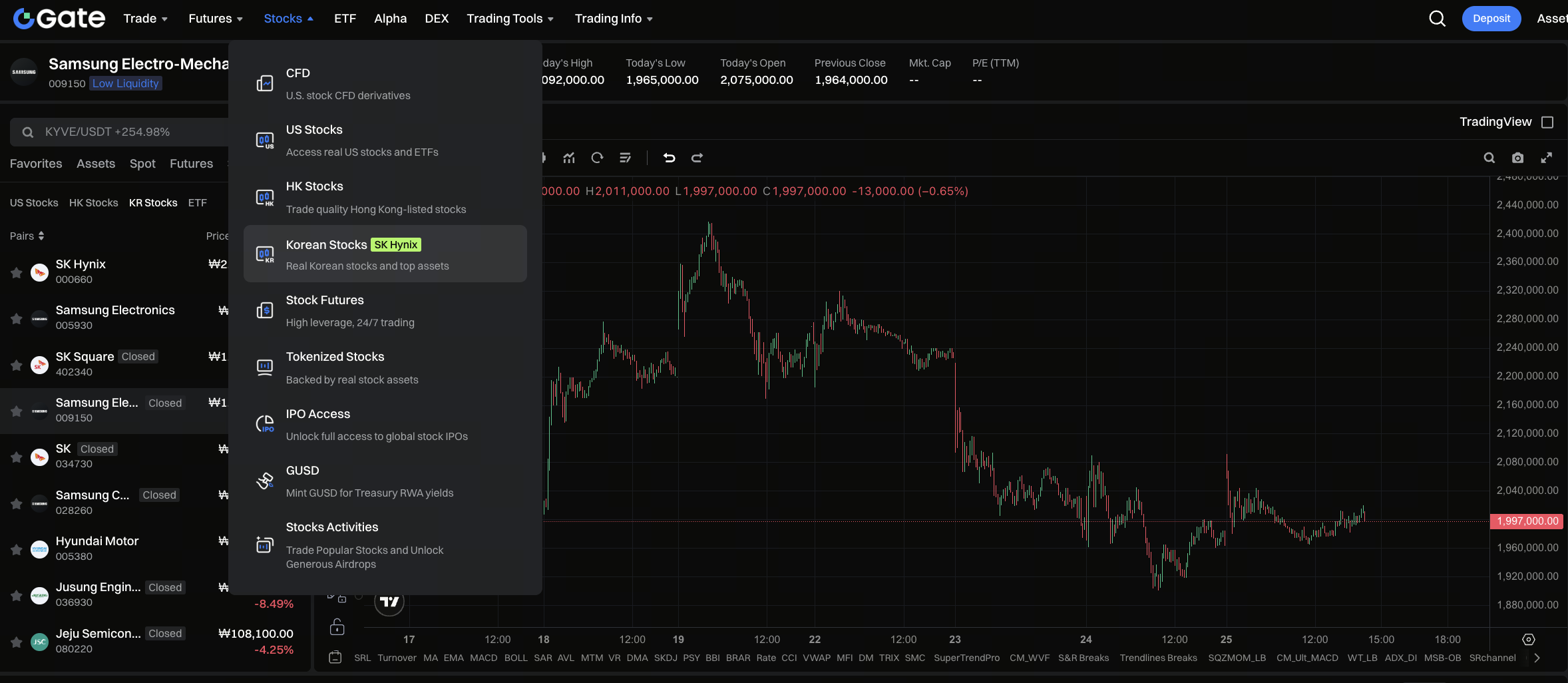
In the stock trading module, select the Korean market and search for Samsung Electro-Mechanics or its stock code (009150).
Step 4: Place an Order to Execute the Trade
Choose a market order or limit order to buy. The system generates position records upon matching and updates your assets in real time.
Step 5: Unified Account Asset Management
Position data is displayed alongside your U.S. and Hong Kong stock holdings, providing a cross-market portfolio management interface for easy overall asset allocation analysis.
Trading Rules, Fund Settlement, and Market Coverage
In Gate's stock system, Korean stock trading operates under a unified account structure with the following core rules:
- USDT is used as the pricing and settlement unit
- Korean stock trading shares a unified account system with U.S. and Hong Kong stocks
- Supports real-time trade execution and position updates
- Provides P&L statistics, asset distribution, and fund flow queries
- Covers the KRX main board and KOSDAQ core stock pool
From a trading structure perspective, this model merges the traditional securities account system with the digital asset system, making cross-market trading more continuous and integrated.
The unified account structure also allows investors to more intuitively compare asset performance across different markets, such as the return differences between U.S. tech stocks and South Korean semiconductor assets.
Industrial Logic and Growth Drivers of Samsung Electro-Mechanics
Samsung Electro-Mechanics' long-term growth is primarily driven by three key industrial trends:
First, AI Infrastructure Expansion: AI servers are driving increasing demand for high-density MLCCs and high-reliability packaging materials, fueling industrial chain expansion.
Second, Consumer Electronics Upgrade Cycle: The trend toward premium smartphones is boosting demand for camera modules and precision circuits.
Third, Electric Vehicle and Industrial Electronics Development: Rising vehicle electrification is driving sustained demand for high-reliability electronic components.
Furthermore, global supply chain restructuring is enhancing the strategic importance of high-end electronic components, further solidifying Samsung Electro-Mechanics' long-term demand base.
Investment Risks and Cross-Market Allocation Strategies
Although Samsung Electro-Mechanics has strong industrial competitiveness, investors should be aware of the following risk factors:
- Significant cyclical volatility in the semiconductor industry
- Uncertainty in global consumer electronics demand
- Potential additional volatility from exchange rates and USDT pricing
- Institutional and liquidity differences in cross-market trading
From an asset allocation perspective, South Korean tech assets are more suitable as a growth component within a portfolio rather than a concentrated single position. By diversifying across U.S., Hong Kong, and South Korean stock assets, investors can effectively reduce the risk tied to a single market cycle.
Conclusion: Global Stock Trading and Asset Allocation Trends
As the global financial system digitizes, stock markets are moving from regional fragmentation toward unified asset management systems. Through the Korean stock trading channel provided by Gate, investors can more efficiently participate in leading South Korean tech assets like Samsung Electro-Mechanics.
Driven by the long-term forces of AI, semiconductors, and smart manufacturing, the electronic components sector in which Samsung Electro-Mechanics operates still holds structural growth opportunities. The emergence of unified accounts and cross-market trading mechanisms further lowers the barrier to global asset allocation, enabling investors to manage multi-market portfolios on a single platform.
FAQs
Q1: Do I need a South Korean brokerage account to buy Samsung Electro-Mechanics stock on Gate?
No. According to Gate's latest announcement, users can directly trade KRX-listed stocks on the platform without opening a local South Korean brokerage account.
Q2: Can I use KRW to buy Samsung Electro-Mechanics stock?
No. The Gate stock trading system primarily uses USDT as the settlement and pricing unit.
Q3: Are Gate's Korean stocks spot stocks or derivatives?
Users can directly trade stocks listed on the Korea Exchange, representing a real stock market access system—not a pure derivative product.
Q4: Is trading Samsung Electro-Mechanics stock separate from U.S. stock trading?
No. Gate uses a unified stock account system, allowing U.S., Hong Kong, and South Korean stock assets to be managed within the same account.
Q5: Are Korean stock trades subject to trading time restrictions?
Trade execution follows the Korea Exchange's trading hours, but account management and asset viewing are available 24/7.
Q6: What are the main risks of investing in Samsung Electro-Mechanics?
These include semiconductor cycle fluctuations, changes in global consumer electronics demand, exchange rate volatility, and structural differences in cross-market trading.