For a long time, investing in U.S. stocks was closely associated with overseas accounts, cross-border transfers, and managing multiple accounts. However, as demand for cross-market asset allocation has grown, the available ways to access U.S. equities have become increasingly diverse. More investors are now paying attention to whether account opening is complicated, whether fund conversion is required, whether unified account management is supported, and how assets are managed after transactions are completed.
The biggest difference between various U.S. stock trading methods is not whether they provide access to the U.S. market—it lies in account structure, funding pathways, trading barriers, and long-term asset management efficiency. Understanding the logic behind each model helps investors choose a more suitable path for participating in U.S. equities.
What You Should Understand Before Buying U.S. Stocks
Before deciding how to buy U.S. stocks, it is important to recognize that participating in the U.S. market is not simply about opening an account. The market includes not only stocks but also ETFs and other asset categories. Different participation models offer different trading formats, account structures, and funding processes, making it more important to understand product rules than simply selecting a platform.
For most investors, several questions are worth considering in advance: Is a separate securities account required? Is USD funding necessary? Are cross-border transfers involved? Is fractional trading supported? Will dividends and corporate actions such as stock splits be processed? These factors influence not only market accessibility but also the long-term trading experience.
From an asset management perspective, more accounts and longer funding paths generally mean higher maintenance costs. In contrast, reducing account switching and fund conversion steps often creates a more sustainable cross-market investing experience. Before starting, investors should identify whether convenience, asset coverage, or unified account management matters most.
Participating in U.S. Stocks Through Traditional Overseas Brokers
Traditional overseas brokers have long been one of the most common ways to invest in U.S. equities. Under this model, users open an independent securities account, complete identity verification and funding procedures, and then gain access to U.S. stocks and ETFs.
Traditional brokers emphasize a complete securities account framework. In practice, account setup, fund transfer, and asset management often occur as separate processes, making the overall experience more similar to conventional securities investing.
The main advantage of this approach is broad market access and mature product infrastructure, making it suitable for long-term equity allocation. Investors with existing securities experience and familiarity with standalone trading accounts often continue to prefer this model.
However, managing multiple accounts, arranging cross-border funding, and completing currency conversion can increase complexity. As a result, traditional overseas brokers tend to suit investors seeking long-term securities exposure through established investment habits.
Accessing U.S. Equities Through Hong Kong Brokerage Channels
Participating in U.S. stock markets through Hong Kong brokers is another common cross-border investment approach. This path generally relies on securities account infrastructure combined with market access services.
Compared with overseas brokers, Hong Kong channels are often easier to understand due to account familiarity, language advantages, and regional market experience. Investors already accustomed to securities investing may appreciate managing multiple markets under one system.
However, account requirements, funding arrangements, and available trading products vary across platforms. Investors should pay close attention to account management rules and overall capital efficiency.
This approach is generally more suitable for users seeking to manage assets across multiple securities markets while maintaining a consistent investment workflow.
Participating in U.S. Stocks and ETFs Through Gate Using USDT
Gate Stocks is Gate’s stock trading service that allows users to directly participate in U.S. stocks and ETF markets using USDT, without opening a separate overseas brokerage account or converting into USD.
Compared with traditional approaches, Gate Stocks emphasizes a unified account experience. Once account preparation is complete, users can manage funding, stock trading, and asset allocation within one account structure without maintaining separate securities accounts.
In terms of trading capabilities, Gate Stocks supports participation in stocks and ETFs using USDT, while also supporting fractional investing for more flexible capital allocation. Cash dividends, stock dividends, stock splits, and reverse splits are processed according to product rules.
For users already familiar with digital assets, Gate Stocks provides a bridge between digital assets and U.S. equity markets. Investors can complete stock investing and cross-market allocation without constantly switching between multiple accounts.
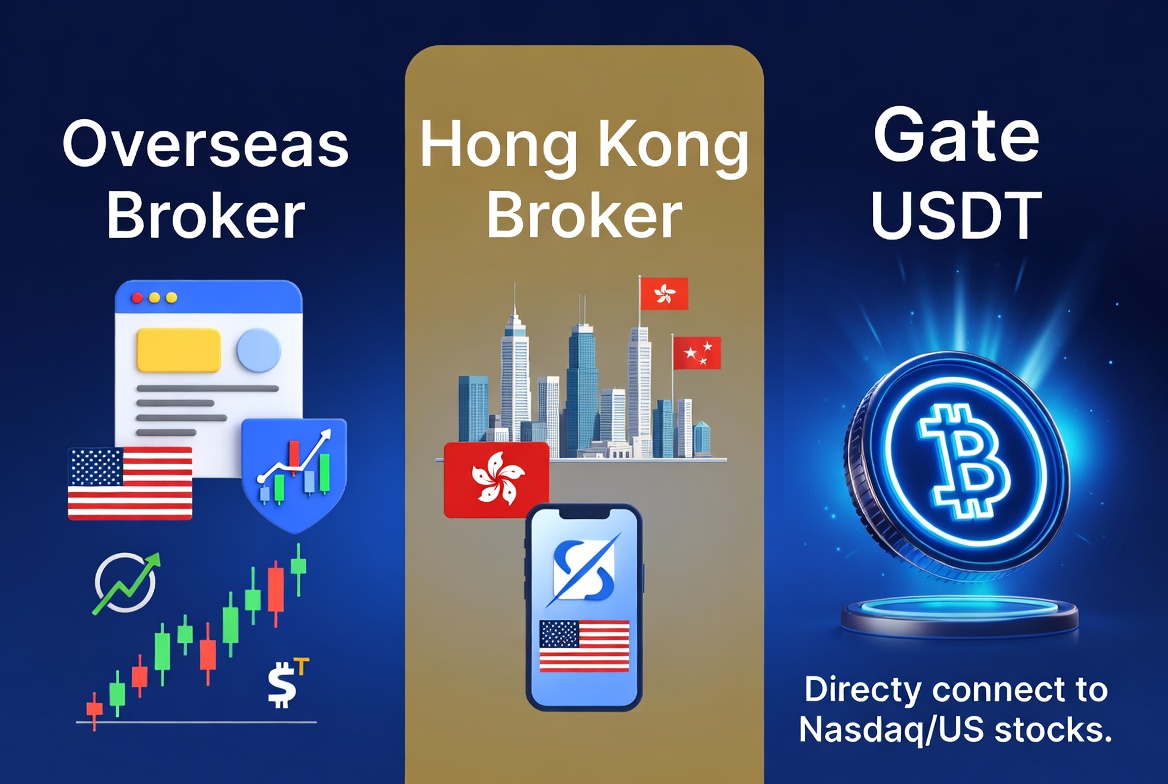
Comparing Account Setup and Funding Processes Across Three Approaches
The key difference among different ways to buy U.S. stocks begins with account structure and funding design. The more complicated the account opening process and the more steps involved in fund conversion, the higher the overall barrier to entry.
From a user experience perspective, traditional securities models emphasize independent account capabilities, while unified account models prioritize capital efficiency. Fewer accounts and shorter funding paths generally lead to smoother investment continuity.
For investors seeking greater trading efficiency, understanding the account logic behind each approach matters more than simply comparing platform names.
Comparing Trading Barriers and User Experience Across Three Methods
The difficulty of buying U.S. stocks is not defined solely by funding requirements—it also depends on how many steps are required to complete a transaction. Account setup, capital conversion, and execution all influence the overall experience.
Traditional overseas brokers focus on comprehensive securities functionality, Hong Kong brokers emphasize cross-market account management, while Gate Stocks focuses more on capital efficiency and unified account access. None of these models is inherently better—they serve different investor preferences.
In practice, investors usually care about funding speed, order convenience, support for small-position investing, and ease of portfolio monitoring. Shorter trading processes generally translate into smoother experiences.
When comparing options, investors should look beyond market access and also evaluate account maintenance costs, convenience, and long-term asset management.
Which Investment Needs Fit Different U.S. Stock Participation Methods
Investors focused on long-term securities allocation and complete account structures are generally better suited to traditional overseas brokers.
Those seeking to manage assets across multiple securities markets often place greater value on unified account experiences and operational efficiency.
For users already accustomed to digital asset accounts, participating in U.S. stocks through Gate Stocks using USDT and accessing ETFs may reduce conversion complexity and create a more continuous investment experience.
There is no universal answer to buying U.S. stocks. Account preferences, funding arrangements, trading frequency, and long-term portfolio goals are often more important than any single channel.
Three Steps to Start Trading Stock Assets Through Gate
After preparing your account, you can begin participating in U.S. stocks and ETFs through Gate Stocks without opening a separate brokerage account.
Step 1: Download the Gate App or complete account registration and identity verification. Account preparation can generally be completed within minutes.
Step 2: Transfer USDT into your stock account. Once funds arrive, they can be used directly for stock trading without USD conversion.
Step 3: Enter the stock section, search for the target stock or ETF ticker, select the quantity, and place an order to begin investing.
The entire process can be completed within Gate’s unified account environment without switching platforms or maintaining independent brokerage accounts.
Risks to Consider When Investing in U.S. Stocks
Investing in U.S. stocks is not only about gaining access to global asset allocation opportunities—it also requires understanding the risks associated with different market environments and participation models. Whether investing through traditional overseas brokers, Hong Kong brokerage channels, or participating in U.S. stocks and ETFs through Gate Stocks, investors should pay attention to factors such as market volatility, exchange rate fluctuations, account management, and product-specific rules.
First, U.S. stock prices are influenced by macroeconomic conditions, industry cycles, company performance, and market sentiment, which may lead to significant price fluctuations. Second, different participation methods involve different funding paths and account structures. More accounts and additional fund conversion steps generally increase overall management complexity. In cross-market investment scenarios, investors should also understand differences in product availability, trading rules, and how corporate actions are handled.
In addition, before participating in the U.S. stock market, investors should fully understand the risk characteristics of the investment products themselves, including whether they are suitable for long-term holding, whether liquidity conditions differ, and how dividends, stock splits, and asset processing are managed. Choosing an approach that aligns with personal trading habits and asset management needs can help create a more stable cross-market investment experience.
Conclusion
There is no single answer to how to buy U.S. stocks. Traditional overseas brokers, Hong Kong brokers, and participating through Gate Stocks using USDT each represent different account structures and funding pathways.
For investors, the more important considerations are account complexity, capital efficiency, trading experience, and long-term asset management capability.
As demand for cross-market asset allocation continues to grow, unified account structures and multi-asset coordination are becoming increasingly important. Choosing the right method for your own needs matters more than following any single path.
FAQ
Can mainland investors buy U.S. stocks?
Mainland investors can generally access U.S. stock markets through compliant platforms and account structures, although account opening, funding arrangements, and trading rules vary.
Do I need an overseas bank account to buy U.S. stocks?
Not necessarily. Supported funding methods vary depending on the platform.
Can I buy U.S. stocks directly with RMB?
Some methods require currency conversion, while others support participation through digital assets without directly exchanging into USD.
Can USDT be used to participate in U.S. stock trading?
Platforms supporting relevant rules allow users to participate in U.S. stocks and ETFs using USDT without completing USD conversion in advance.
Is fractional stock trading supported?
Some platforms support fractional investing, allowing participation in popular stocks without purchasing full shares.
What U.S. stock assets are available through Gate Stocks?
Gate Stocks supports participation in U.S. stocks and ETF markets while offering unified account management, USDT-based trading, and corporate action processing according to product rules.