Gold, silver, and crude oil have long been important parts of global traditional financial markets. Gold is commonly used as a safe haven asset and store of value, silver is influenced by both industrial demand and its precious metal characteristics, while crude oil serves as a key pricing benchmark for the global energy system. Traditional commodity markets mainly operate through futures exchanges, ETFs, and over the counter markets. With the development of blockchain technology and RWA assets, however, these traditional commodities are gradually entering the digital asset ecosystem.
The growth of the crypto asset market is no longer limited to native digital currency trading. More on-chain protocols are trying to map real world commodity assets onto blockchain networks, allowing users to participate in traditional markets through stablecoins, tokenized commodities, and on-chain derivatives.
Why Are Gold, Silver, and Crude Oil Entering the Crypto Asset Market?
One important reason gold, silver, and crude oil are entering the crypto market is the development of real world asset, or RWA, tokenization. Blockchain networks are attempting to map assets from traditional finance into tradable on-chain assets, improving global liquidity and settlement efficiency.
Gold and silver have strong store of value characteristics, which made them among the earlier commodity categories to enter on-chain finance. Some projects use tokenized gold and silver tokens to convert metal assets into digital tokens that can circulate on blockchain networks, allowing users to participate in the market without directly holding physical metals.
The on-chain representation of crude oil assets is more concentrated in derivatives and index protocols. Users can gain indirect exposure to the crude oil market through commodity CFDs or perpetual contracts, without taking physical delivery of crude oil.
What Are the Main Ways to Access Precious Metals and Energy Markets Through Crypto Assets?
Users can generally participate in on-chain precious metals and energy markets in four main ways, including tokenized commodities, on-chain derivatives, commodity index protocols, and ETF mapped assets related to commodities.
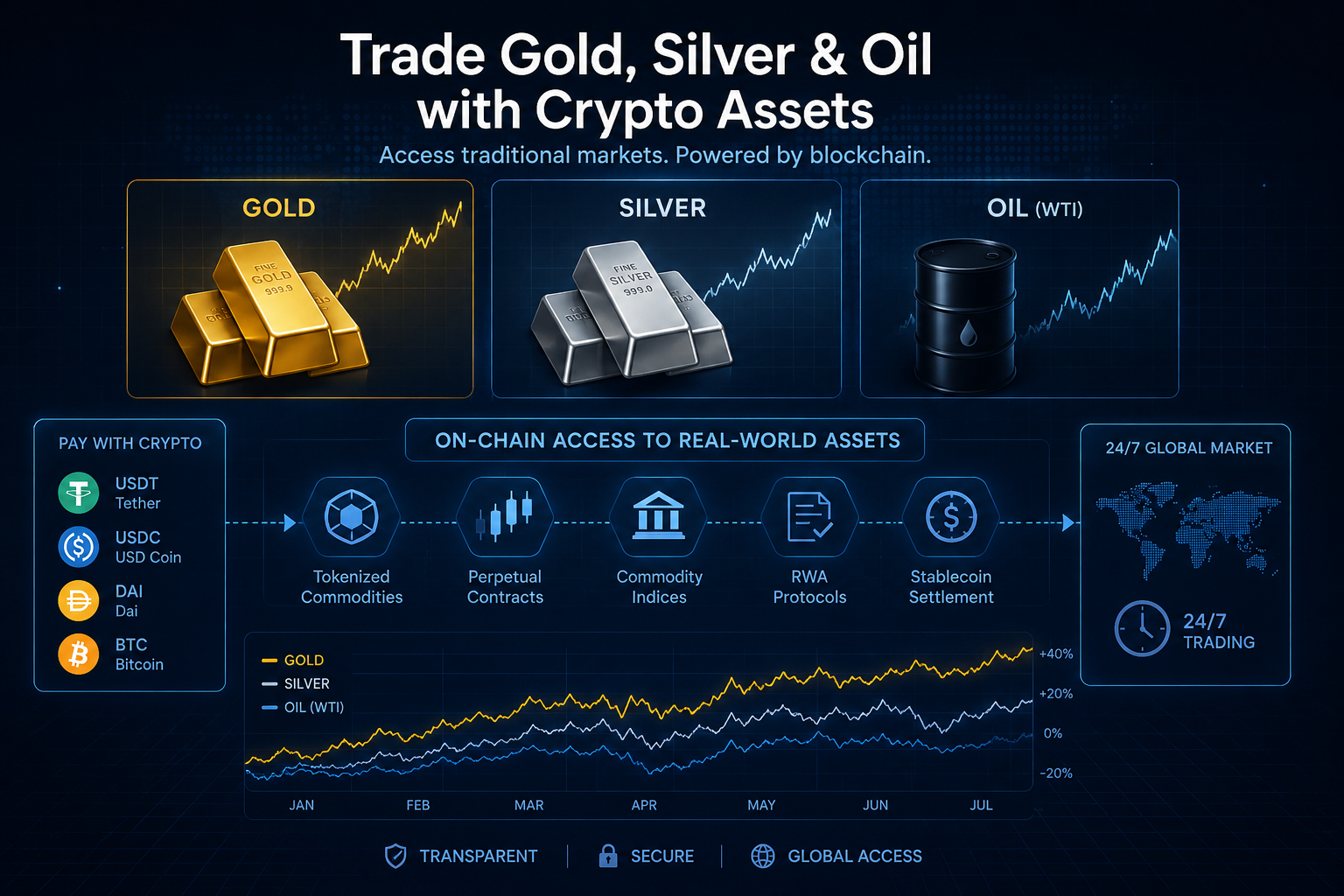
Tokenized gold and silver are the most common forms of on-chain commodities. Users can gain indirect exposure to gold or silver through on-chain tokens.
Crude oil assets are more often tracked through structures such as XTI perpetual contracts or contracts for difference. Users do not need to hold physical crude oil, but can still participate in price movements through leverage and margin mechanisms.
Some DeFi protocols also offer commodity index products, combining gold, energy, and macro assets to provide users with on-chain commodity exposure.
How Do the Market Logics of Gold, Silver, and Crude Oil Differ?
The core logic of gold is usually tied to safe haven demand, U.S. dollar liquidity, and the global interest rate environment. When market risk appetite falls, gold is often viewed as a defensive asset for capital.
Silver has the dual nature of both a precious metal and an industrial raw material. In addition to financial market demand, silver prices are also affected by industrial demand. The crude oil market, by contrast, depends more heavily on global economic activity and the structure of energy supply and demand.
Although gold and silver both belong to the precious metals category, they differ clearly in market structure and volatility characteristics. Within the crude oil market, there are also different benchmark systems.
How Do On-Chain Precious Metals and Energy Assets Maintain Price Pegs?
On-chain commodity assets usually rely on oracle systems to obtain traditional market prices. Oracles synchronize real time data from exchanges, futures markets, or spot markets to blockchain networks, providing price references for smart contracts.
Tokenized gold usually also incorporates physical reserve proof mechanisms. Arbitrage mechanisms in on-chain markets can also help commodity assets maintain price stability. When the on-chain price diverges significantly from the external market, market makers and arbitrage traders may narrow the gap through cross market trading.
However, during periods of sharp market volatility or insufficient liquidity, some on-chain commodity assets may still temporarily lose their peg.
After entering on-chain markets, precious metals and energy assets are being used in a wider range of DeFi and cross market financial scenarios. Gold tokens can be used as tokenized gold collateral for lending, and some protocols allow stablecoins to be generated against them. on-chain commodity derivatives can be used for macro trading and cross market arbitrage.
As RWA assets continue to expand, on-chain commodity assets may be further applied to stablecoin reserves, on-chain ETFs, and multi asset investment protocols in the future.
What Are the Risks of Trading Gold, Silver, and Crude Oil with Crypto Assets?
Commodity markets themselves are highly volatile. More specifically, gold is affected by changes in interest rates and the U.S. dollar, crude oil can experience sharp price swings due to geopolitical or supply chain events, and silver is also influenced by industrial demand.
on-chain trading adds further risks, including smart contract risk, oracle risk, and liquidity risk. If oracle prices become abnormal, a protocol is attacked, or liquidity is insufficient, on-chain commodity assets may experience pricing deviations.
When using leverage to trade crude oil or precious metals perpetual contracts, liquidation risk is also present. In addition, some tokenized commodities depend on centralized custodians, which introduces risks related to asset transparency and custodian credit.
How Do Tokenized Commodity Assets Differ from Traditional Commodity Investment?
Traditional commodity investment usually relies on futures exchanges, ETFs, or over the counter markets, and is limited by trading hours and regional market access. on-chain commodity assets, by contrast, can enable always open trading and global settlement.
The barrier to entry for on-chain commodity markets is usually lower. Users can participate directly in some commodity asset trading through stablecoins, without needing traditional financial accounts or complex futures delivery processes.
However, traditional commodity markets are usually more mature in terms of regulatory systems, liquidity depth, and institutional participation. While on-chain markets improve openness and composability, they also add protocol risk and technical risk.
For this reason, on-chain commodity assets are better understood as a digital extension of traditional commodity markets, rather than a complete replacement for the traditional commodity system.
Conclusion
Traditional commodities such as gold, silver, and crude oil are gradually converging with the blockchain finance ecosystem. Tokenized commodities, on-chain derivatives, and RWA protocols allow digital asset users to participate in traditional commodity price movements through crypto markets.
Gold usually serves as a safe haven asset, silver combines industrial and financial characteristics, and crude oil depends more on global economic conditions and the structure of energy supply and demand. The different logic behind each commodity also shapes the risks and mechanisms of on-chain trading products.
FAQs
Is a Gold Token the Same as Physical Gold?
Gold tokens usually rely on custodians that hold physical gold and issue on-chain assets according to a certain ratio, so their prices tend to move in line with gold. However, projects differ in reserve audits, redemption mechanisms, and regulatory structures, meaning they are not exactly the same as directly holding physical gold.
Why Is Crude Oil Usually More Volatile Than Gold?
Crude oil prices are closely tied to global economic activity, transportation systems, geopolitics, and inventory supply and demand, making them more vulnerable to sudden events. Gold reflects safe haven and store of value characteristics more strongly, so its overall volatility is usually lower than crude oil.
Do On-Chain Commodity Assets Support 24 Hour Trading?
Most on-chain commodity assets can be traded around the clock, but their prices usually still reference data from traditional financial markets. When traditional markets are closed, on-chain assets may experience lower liquidity or price deviations.
How Do Tokenized Commodities Maintain Their Price Pegs?
Tokenized commodities usually rely on physical reserves, price oracles, and arbitrage mechanisms to maintain price linkage with the underlying asset. Some projects also disclose reserve proofs and audit information on a regular basis.
What Additional Risks Come with Trading Crude Oil Through Crypto Assets?
Beyond crude oil’s own price volatility, on-chain trading may also involve leveraged liquidation, smart contract vulnerabilities, oracle failures, and insufficient liquidity. Under extreme market conditions, these risks may further amplify market volatility.