As the DeFi market gradually expands from spot trading into more sophisticated derivatives, perpetual futures have become one of the largest sectors by on-chain trading volume. Compared with traditional crypto spot markets, perpetual futures allow users to trade long or short with leverage and participate in market price movements without holding the actual assets.
TradeXYZ is an on-chain perpetual futures trading platform built on Hyperliquid HIP-3 Builder infrastructure. Its markets not only cover crypto assets such as BTC and ETH, but are also gradually expanding into stocks, commodities, and indices. Through an on-chain order book, funding rates, and an oracle system, TradeXYZ aims to build a global, always-on, multi-asset perpetual futures market.
What Components Make Up TradeXYZ’s Trading System?
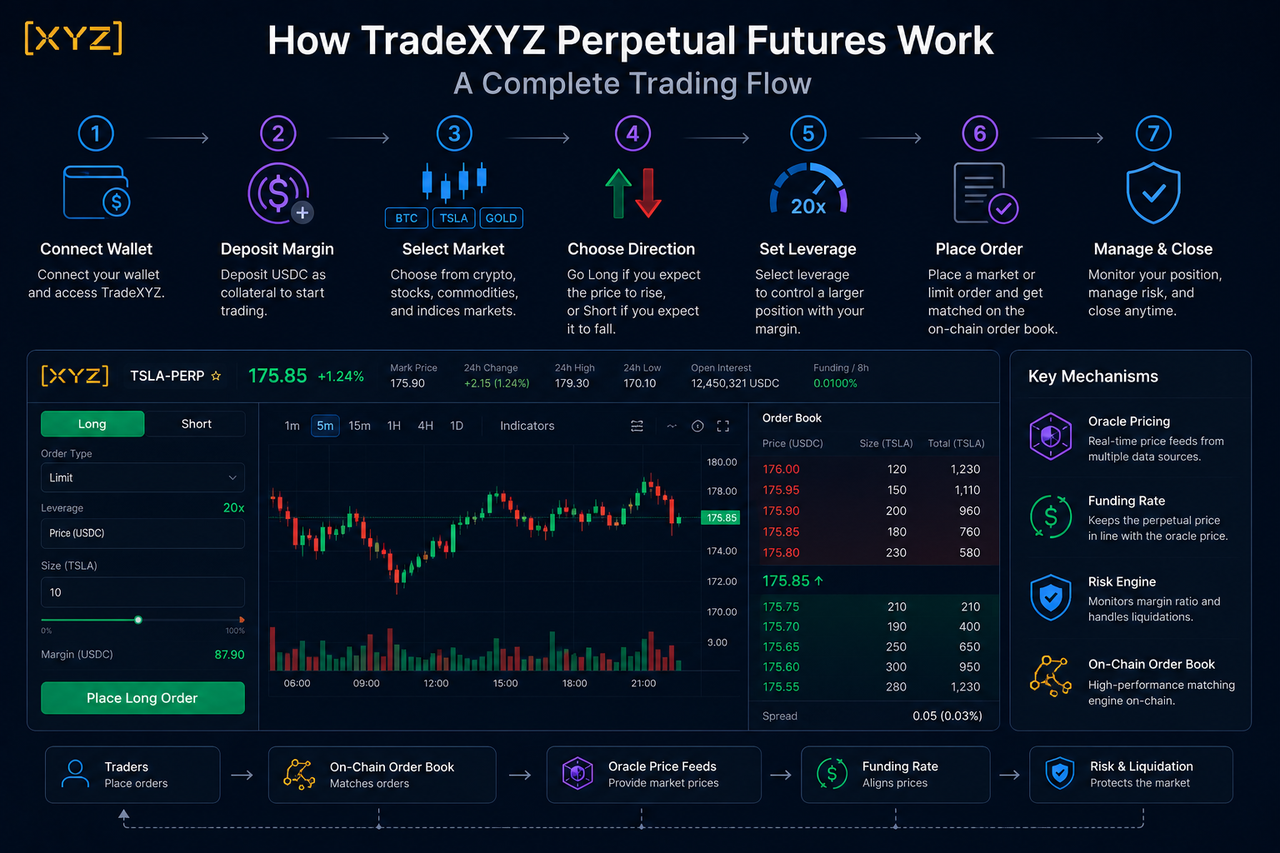
TradeXYZ’s perpetual futures market is mainly built around an order book, oracles, funding rates, and a risk control system.
The on-chain order book is responsible for matching buy and sell orders. Users can place limit orders or take existing orders directly, much as they would on a traditional trading platform. The oracle system continuously provides external reference prices for stocks, commodities, indices, and crypto assets, affecting mark prices, funding rates, and liquidation calculations.
In addition, the platform manages leveraged positions through its margin system and risk engine.
| Core Module |
Main Function |
| On-chain order book |
Matches buy and sell orders |
| Oracle system |
Provides external price references |
| Funding rate |
Balances market prices |
| Margin system |
Manages leveraged positions |
| Risk engine |
Controls liquidation risk |
Together, these components form the operating foundation of the on-chain perpetual futures market.
How Do Users Start Trading on TradeXYZ?
Users typically participate in TradeXYZ market trading directly through an on-chain wallet.
First, users connect their wallet and deposit USDC as margin. They can then choose from different markets, such as BTC, ETH, Tesla, Gold, or index markets.
After selecting a market, users decide whether to go long or short and set their leverage and position size. Once the order is filled, the system calculates the margin ratio, position risk, and unrealized profit and loss in real time.
Liquidity, volatility, and leverage limits usually vary across different markets.
| Market Type |
Example Assets |
| Crypto Assets |
BTC, ETH |
| Stock Market |
Tesla, SpaceX |
| Commodity Market |
Gold, Oil |
| Index Market |
S&P500 |
How Does the Leverage Mechanism Work?
Leverage allows users to control a larger position with a smaller amount of margin.
For example, if a user has 1,000 USDC and uses 10x leverage, they can theoretically trade a position worth 10,000 USDC.
This mechanism can improve capital efficiency, but it also magnifies downside risk. When the market moves against a position, the user’s margin ratio continues to decline. If the margin is no longer sufficient to cover losses, the system may trigger forced liquidation.
TradeXYZ typically adjusts leverage limits dynamically based on market volatility, asset liquidity, and position size to reduce systemic risk.
How Does TradeXYZ Calculate Liquidation Risk?
TradeXYZ uses a risk engine to continuously monitor user positions.
The most important indicators include margin ratio, mark price, leverage level, and market volatility. The platform typically does not use the latest traded price directly for liquidation. Instead, it uses the Mark Price to calculate risk.
This mechanism helps reduce the chance of abnormal liquidations caused by short-term market swings.
When a user’s margin ratio falls below the system requirement, the platform triggers forced liquidation to prevent the account from falling into a negative balance.
| Risk Indicator |
Function |
| Margin ratio |
Measures position safety |
| Mark Price |
Prevents liquidation based on abnormal prices |
| Leverage level |
Controls position risk |
| Market volatility |
Adjusts risk parameters |
Why Does TradeXYZ Use an Order Book Model?
TradeXYZ uses an on-chain order book rather than a traditional AMM liquidity pool model.
The order book model is closer to professional traditional trading platforms. It usually provides more transparent market depth, lower slippage, and more precise price discovery.
For complex markets such as stocks, commodities, and indices, the order book structure is generally better suited to high-frequency trading and professional derivatives markets.
However, this model also depends more heavily on continuous liquidity and market maker participation.
How Is TradeXYZ Different from Traditional Futures Markets?
Although perpetual futures and traditional futures are both derivatives, there are still clear differences between them.
Traditional futures usually have fixed expiration dates, which require regular contract rollovers and settlement. Perpetual futures, by contrast, operate continuously through funding rates.
In addition, on-chain perpetual futures markets usually support global 24/7 trading.
| Comparison |
Perpetual Futures |
Traditional Futures |
| Has an expiration date |
No |
Yes |
| Requires contract rollover |
No |
Yes |
| Uses funding rates |
Yes |
No |
| Supports 24/7 trading |
Yes |
Usually no |
| Main operating environment |
On-chain market |
Traditional exchange |
One of TradeXYZ’s core innovations is using on-chain infrastructure to turn traditional derivatives markets into always-on global markets.
Conclusion
Through its on-chain order book, oracle prices, funding rates, and risk control system, TradeXYZ has built a multi-asset perpetual futures market that supports stocks, commodities, indices, and crypto assets.
Users can use USDC margin to trade long or short in a global 24/7 market, apply leverage, and participate in on-chain price discovery.
As on-chain derivatives infrastructure continues to mature, perpetual futures are becoming one of the most important financial trading tools in DeFi. However, because of leverage, market volatility, funding rates, and other factors, perpetual futures remain a high-risk market. Users should fully understand how they work and the risks involved before participating.
FAQs
Do TradeXYZ Perpetual Futures Have an Expiration Date?
No. One of the main features of perpetual futures is that they do not have a fixed expiration date.
Do Users Need to Hold Real Stocks or Commodities?
No. Users trade on-chain perpetual futures built around asset prices, not the actual assets themselves.
Why Does the Funding Rate Change?
The funding rate changes dynamically based on the balance between long and short positions. It is used to keep the market price aligned with the reference price.
Why Does Leverage Increase Risk?
Leverage magnifies both gains and losses, so even a small price movement can lead to a large loss or even forced liquidation.
What Is the Role of the Mark Price?
The mark price is mainly used for risk control and liquidation calculations. It helps reduce the risk of erroneous liquidations caused by abnormal traded prices.
Why Does TradeXYZ Use an Order Book Model?
The order book model can provide more transparent market depth, lower slippage, and more efficient price discovery, making it better suited to professional derivatives markets.







