AI Agent and blockchain technology are converging to reshape how digital finance interactions work. Traditional DeFi applications require users to handle market analysis, asset allocation, protocol switching, and risk management themselves, but AI Agents now allow intelligent systems to automate many complex operations.
UnifAI Network is a key infrastructure in the Agentic Finance landscape. Its core mission is to give AI Agents real on-chain execution power. Through a unified tool layer, an Agent execution framework, and an open development environment, UnifAI enables AI not only to understand user intent but also to interact directly with blockchain protocols, powering automated financial services.
What Role Does an AI Agent Play in UnifAI?
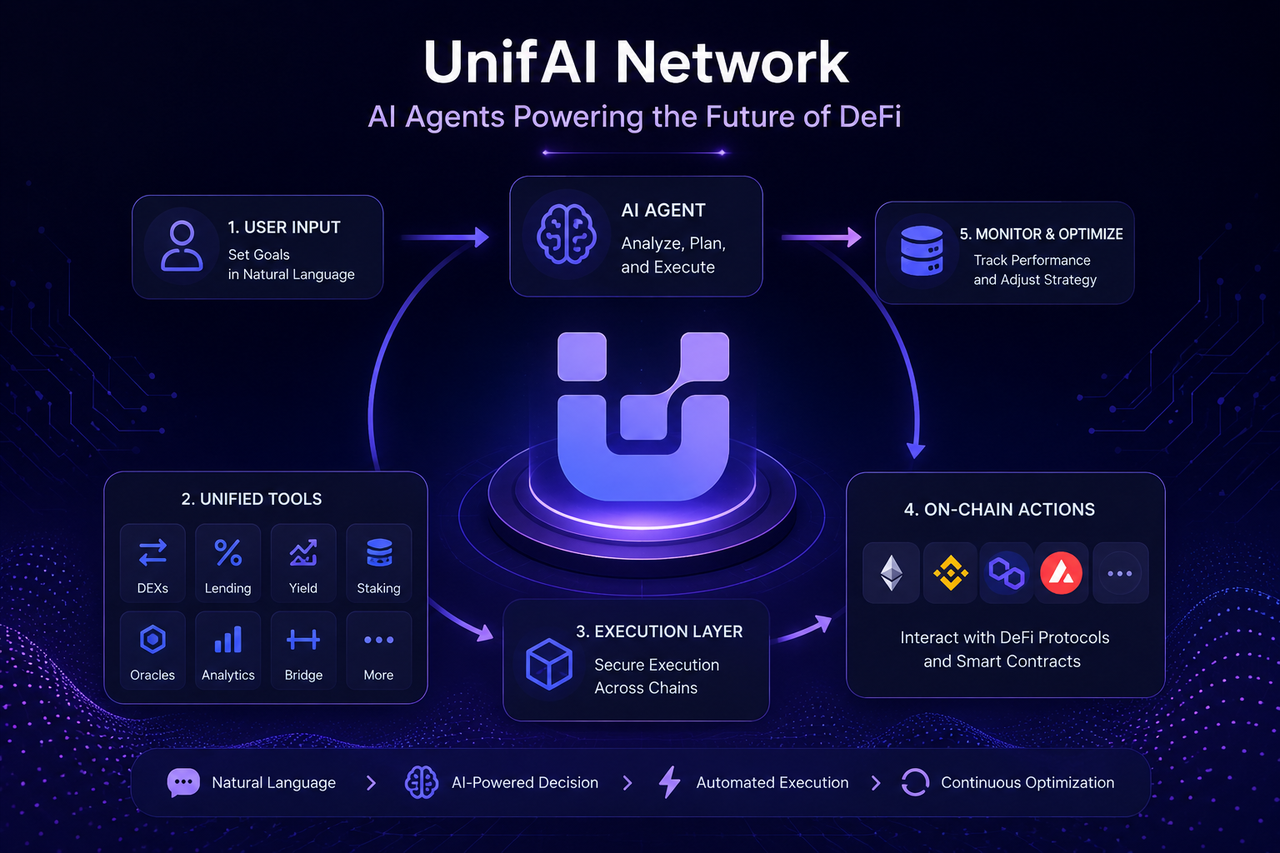
An AI Agent is the core execution unit of the UnifAI Network.
Traditional financial tools typically only offer data analysis or decision suggestions, whereas an AI Agent can understand, plan, decide, and execute — all in one. Instead of manually performing every step, users simply set a goal and let the Agent autonomously find the best way to achieve it.
For example, if a user wants to optimize stablecoin yields, the AI Agent can analyze multiple yield protocols and automatically handle capital allocation and ongoing management.
In UnifAI's architecture, the AI Agent acts more like a digital financial assistant than a conventional automated script.
Where Does UnifAI's Automated Execution Process Begin?
The entire process usually starts with user goal input.
The user submits a request to the AI Agent, such as:
-
Obtaining stable returns
-
Managing cross-chain assets
-
Automating trading strategies
-
Monitoring portfolio risk
After receiving the goal, the AI Agent converts the natural language request into executable tasks.
The focus at this stage isn't immediate trade execution — it's understanding user intent and building a task planning framework.
That's why goal parsing is the first step of the automated execution process.
Task planning is one of the biggest differentiators between an AI Agent and a traditional trading bot.
Traditional bots execute commands based on fixed rules, while an AI Agent dynamically determines an execution path based on current conditions.
For instance, when a user wants the highest possible yield, the AI Agent analyzes the current market environment, available protocols, risk levels, capital size, and liquidity. The Agent then generates an execution plan and decides which tools and protocols to call next.
This planning ability allows AI Agents to handle far more complex financial tasks.
Unified Tools is a critical middleware layer connecting the AI Agent to the blockchain ecosystem.
If the AI Agent is the decision-maker, Unified Tools is its toolbox.
Through Unified Tools, the AI Agent can access decentralized exchanges (DEXs), lending protocols, liquid staking protocols, yield aggregators, blockchain data services, and oracle systems. The unified interface reduces technical differences between protocols, enabling the Agent to quickly call external resources.
This is also a key foundation for UnifAI's cross-protocol automation.
How Does an AI Agent Interact with DeFi Protocols?
Once task planning is complete, the AI Agent selects the appropriate protocol to execute the operation.
For yield optimization, the execution process may include:
-
Fetching on-chain yield data
-
Comparing multiple protocols
-
Selecting a target protocol
-
Completing asset approval
-
Depositing funds
-
Continuously monitoring yield changes
Throughout this process, the user doesn't need to manually visit multiple platforms.
The AI Agent interacts with protocols through a unified interface and adjusts strategies as the environment changes.
This automated capability is a core feature of Agentic Finance.
How Is an Automated DeFi Strategy Completed?
Suppose a user wants to manage a stablecoin asset.
First, the AI Agent analyzes the currently available yield markets.
Then, through Unified Tools, the Agent fetches real-time data from multiple protocols and compares yield rates, liquidity, and risk levels.
After identifying the best solution, the Agent automatically deploys the asset to the target protocol.
If a higher-yield or lower-risk opportunity emerges later, the AI Agent can reallocate capital accordingly.
The entire process forms a continuous loop: goal setting → data analysis → task planning → protocol invocation → trade execution → continuous monitoring → dynamic optimization. This closed-loop execution model is the core operational logic of the UnifAI Network.
How Does UnifAI Handle Risk Management?
Risk management is an essential part of the AI Agent's automated execution process.
In traditional DeFi, users must monitor market and position changes themselves. In UnifAI, the AI Agent continuously tracks key metrics.
Monitoring includes:
When abnormal conditions arise, the AI Agent can take appropriate actions based on preset rules, such as adjusting positions or transferring funds.
This continuous monitoring enhances the sustainability of automated strategies.
What Is the Difference Between an AI Agent and a Traditional Trading Bot?
AI Agents and trading bots both execute tasks automatically, so they're often compared.
However, their underlying logic is fundamentally different.
| Comparison Dimension |
AI Agent |
Trading Bot |
| Decision-making |
Dynamic decision-making |
Fixed rules |
| Learning ability |
Supports reasoning and adaptation |
Not available |
| Task planning |
Autonomous planning |
Preset workflow |
| Tool invocation |
Multi-protocol coordination |
Single logic |
| Environmental adaptation |
Strong |
Limited |
| Application scope |
Comprehensive financial tasks |
Specific trading tasks |
Trading bots are best for executing well-defined rules, while AI Agents excel in complex, constantly changing environments.
That's a key reason UnifAI chose the Agent architecture.
Why Is UnifAI's Execution Model Suitable for Agentic Finance?
The core goal of Agentic Finance is to make AI an active participant in financial activities.
This model requires AI not only to analyze information but also to invoke tools, execute tasks, and continuously optimize based on results.
UnifAI's Agent runtime environment, unified tool layer, and open development framework give AI Agents full execution capabilities.
Thus, UnifAI is not just a DeFi application — it's an infrastructure network that powers Agentic Finance.
Summary
UnifAI Network builds a complete automated financial framework using AI Agents, Unified Tools, and execution infrastructure. Users only need to set a goal, and the AI Agent handles task planning, protocol invocation, on-chain execution, and risk monitoring — achieving full automation from decision-making to execution.
Unlike traditional DeFi, which relies heavily on user operations, UnifAI positions the AI Agent as the primary executor of financial activities. By connecting multiple DeFi protocols and on-chain services, UnifAI is moving Agentic Finance from conceptual exploration toward a practical, usable digital financial infrastructure.
FAQs
What does the AI Agent do in the UnifAI Network?
The AI Agent understands user goals, creates execution plans, calls on-chain tools, executes trades, and continuously monitors results. It is the core execution unit of the entire system.
What are Unified Tools?
Unified Tools is UnifAI's unified tool layer that connects DeFi protocols, data services, and blockchain infrastructure, allowing AI Agents to access external resources through standardized interfaces.
Does UnifAI's automated execution process require continuous user intervention?
No. After the user sets a goal, the AI Agent autonomously handles task planning and execution. User involvement is only needed for specific authorization or risk control scenarios.
Can UnifAI connect to multiple DeFi protocols?
Yes. UnifAI's unified tool layer supports AI Agents in invoking multiple protocols and services, enabling cross-protocol coordinated operations and automated asset management.