If you are asking whether XRP is a scam, start with evidence, not headlines. Use the same red-flag checklist you would apply to any cryptocurrency, then separate Ripple (the company) from XRP (the XRPL native asset). Escrow debates, validator influence, and the U.S. SEC case against Ripple Labs explain why the word “scam” spreads online. Those fights can be intense—but they still differ from schemes built on deception, hidden minting, or fabricated products.
What Is the Difference Between Ripple and XRP?
By the standards usually used to spot crypto fraud, XRP does not look like a classic scam. It is the native asset of a long-running public ledger with transparent issuance rules, open-source code, and a network that can keep running without Ripple’s day-to-day involvement. For retail traders and anyone assessing legitimacy under regulatory pressure, the useful question is not “is there controversy?” but “what kind of controversy is it?”
Ripple Labs is a U.S. fintech company focused on Ripple (XRP) cross-border payment infrastructure, including RippleNet and On-Demand Liquidity (ODL) used by banks and other financial institutions. XRP is the native asset of the XRP Ledger, launched in 2012. Transfers settle through a consensus process among independent validators rather than proof-of-work mining, typically with fast confirmation and low fees.
The two are connected, not identical. Ripple historically held a large XRP allocation and helped bootstrap early technology and ecosystem tooling, so headlines often blur fundraising, token sales, and ledger operations. XRPL consensus still depends on independent validators—not unilateral corporate control. Asking “is Ripple a scam?” is not the same as asking “is XRP a scam?”: a compliance dispute at the company level does not automatically mean a public ledger is fake.
| Dimension |
Ripple Labs |
XRP / XRP Ledger |
| What it is |
Incorporated fintech company |
Native asset + open-source ledger |
| Primary focus |
Enterprise payment rails |
Fast, low-fee settlement / bridge-asset design |
| Visibility |
Named executives, filings, licenses |
On-chain history, public code, validator set |
| Independence |
Business decisions |
Network can keep running without Ripple’s ops |
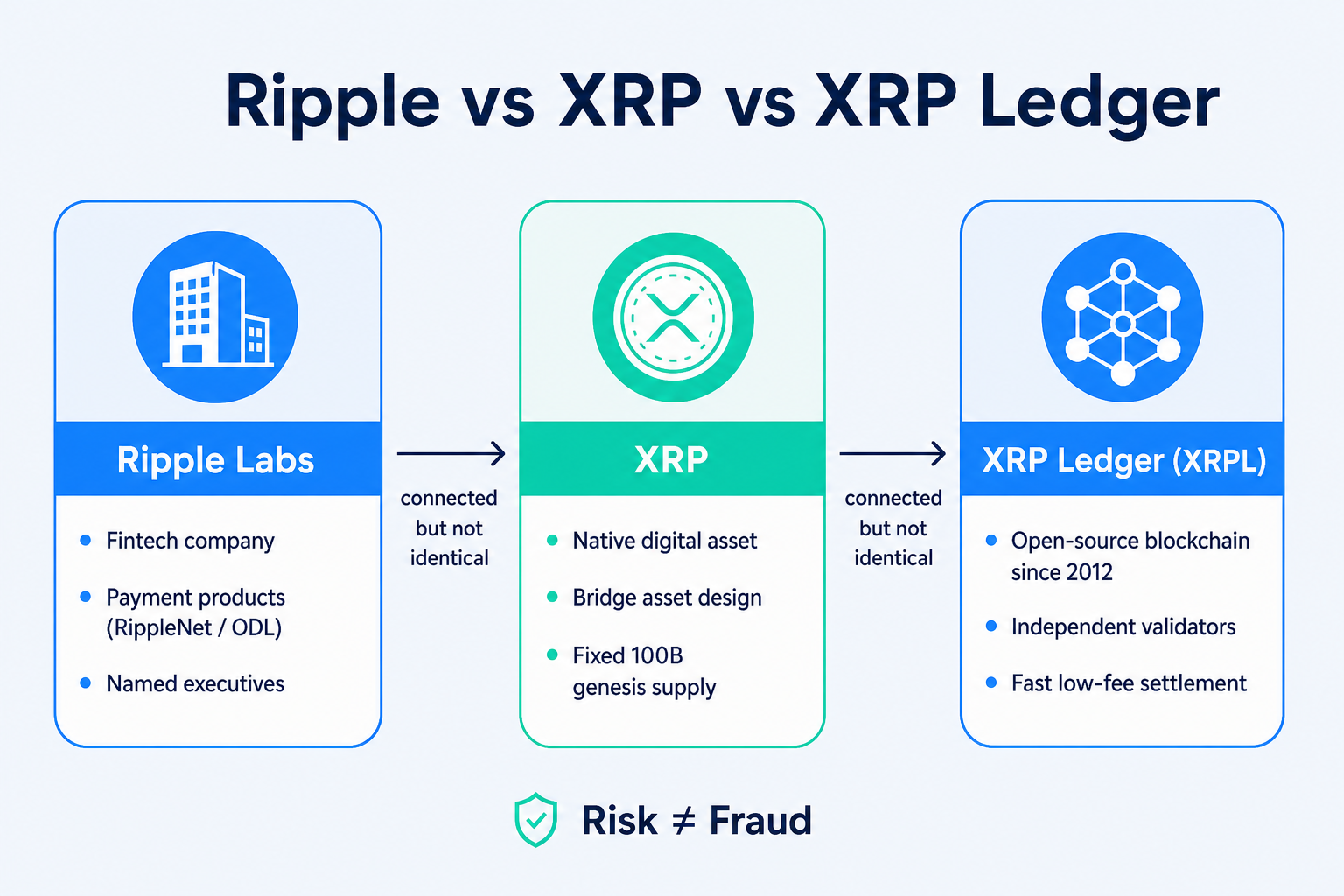
Figure 1. Ripple Labs, XRP, and the XRP Ledger are connected but not identical; risk is not the same as fraud.
Why Do Some People Say XRP or Ripple Is a Scam?
Three drivers keep the accusation alive.
Supply design. All 100 billion XRP were created at genesis (often described as pre-mined). A large share went to Ripple, and tens of billions were placed in on-chain escrow with scheduled releases. Critics treat concentration as control. Concentration is a real structural risk—but when balances and releases are publicly trackable, it is not the same as hidden minting or fake technology.
Regulation. The SEC lawsuit against Ripple Labs centered on securities-registration questions around certain XRP sales—not a criminal Ponzi indictment. Court outcomes added nuance, including distinctions among institutional and other sale types in U.S. proceedings. Regulatory friction creates uncertainty; it is not proof that “the token does not exist.”
Market narrative. In downturns, “scam” often becomes shorthand for distrust of corporate-linked crypto, disappointment with price performance, or disagreement about how decentralized a network “should” be. Separately, phishing rings abuse the XRP brand with fake giveaways. That noise has nothing to do with whether XRPL’s code runs.
How Can You Tell if XRP Is a Scam? A Due-Diligence Checklist
Calling something a scam requires criteria. Common crypto red flags include anonymous or unverifiable founders, guaranteed profits, opaque unlimited minting, no working product, fabricated partnerships, and unexplained insider wallet moves. Apply those filters to XRP and Ripple without special pleading.
- Transparency: Ripple’s leadership and major legal filings are public; XRPL docs and code are reviewable. Early technical figures such as David Schwartz and Arthur Britto are also publicly associated with the project’s origins.
- Technology: The ledger has processed transactions for more than a decade, typically with fast settlement and low fees.
- Adoption claims: Institutional pilots and messaging-layer products are not the same as universal XRP bridge usage. Ripple’s payment stack can involve XRP for liquidity in some flows, but each claim should be verified case by case.
- Market history: Multi-year exchange liquidity and survival through cycles differ from projects that vanish after a few months of hype.
None of these checks make XRP “safe” or “low risk.” They only structure the question: does the evidence match classic scam mechanics, or a contested, high-profile digital asset with real structural debates?
What Are the Verifiable Facts About XRP, the XRP Ledger, and Ripple?
Strip the slogans and start with a short fact set:
- Ripple Labs has operated as a payments-focused fintech company since the early 2010s window tied to XRPL’s launch, with public leadership that has included Brad Garlinghouse.
- The XRP Ledger launched in 2012 and remains a functioning public network with open-source software.
- Total XRP supply is capped at 100 billion units created at genesis; there is no Bitcoin-style mining inflation that mints new XRP beyond that design.
- Large escrow balances and scheduled releases are designed to be visible on-chain rather than hidden off-ledger mint events.
- XRP’s stated design role includes acting as a bridge asset for cross-border payments and liquidity between currencies; how much institutions use XRP itself versus Ripple’s broader messaging stack varies by product and partner.
These points establish operational reality. They do not settle debates about fairness of distribution, ideal decentralization, or long-term demand.
Common Myths vs Facts: Is XRP a Scam?
| Myth |
Fact-oriented reading |
| “XRP is a scam coin” |
Classic scams usually rely on deception: fake tech, fake partners, hidden minting, or guaranteed returns. A live open-source ledger with public supply rules does not match that pattern by default. |
| “Ripple completely controls XRP” |
Ripple’s holdings and influence are material, but XRPL consensus relies on independent validators. Owning tokens is not the same as unilateral protocol shutdown power. |
| “XRP has no use case” |
Bridge-asset and payments-oriented design is documented through products such as RippleNet and On-Demand Liquidity. How widely banks use XRP itself remains debated—and should not be inflated or erased. |
| “The SEC case proves fraud” |
Securities-registration litigation and mixed judicial findings address classification and sales practices. They are not a synonym for “Ponzi.” |
Disagreement with tokenomics is legitimate. Treating every disagreement as fraud collapses the analysis.
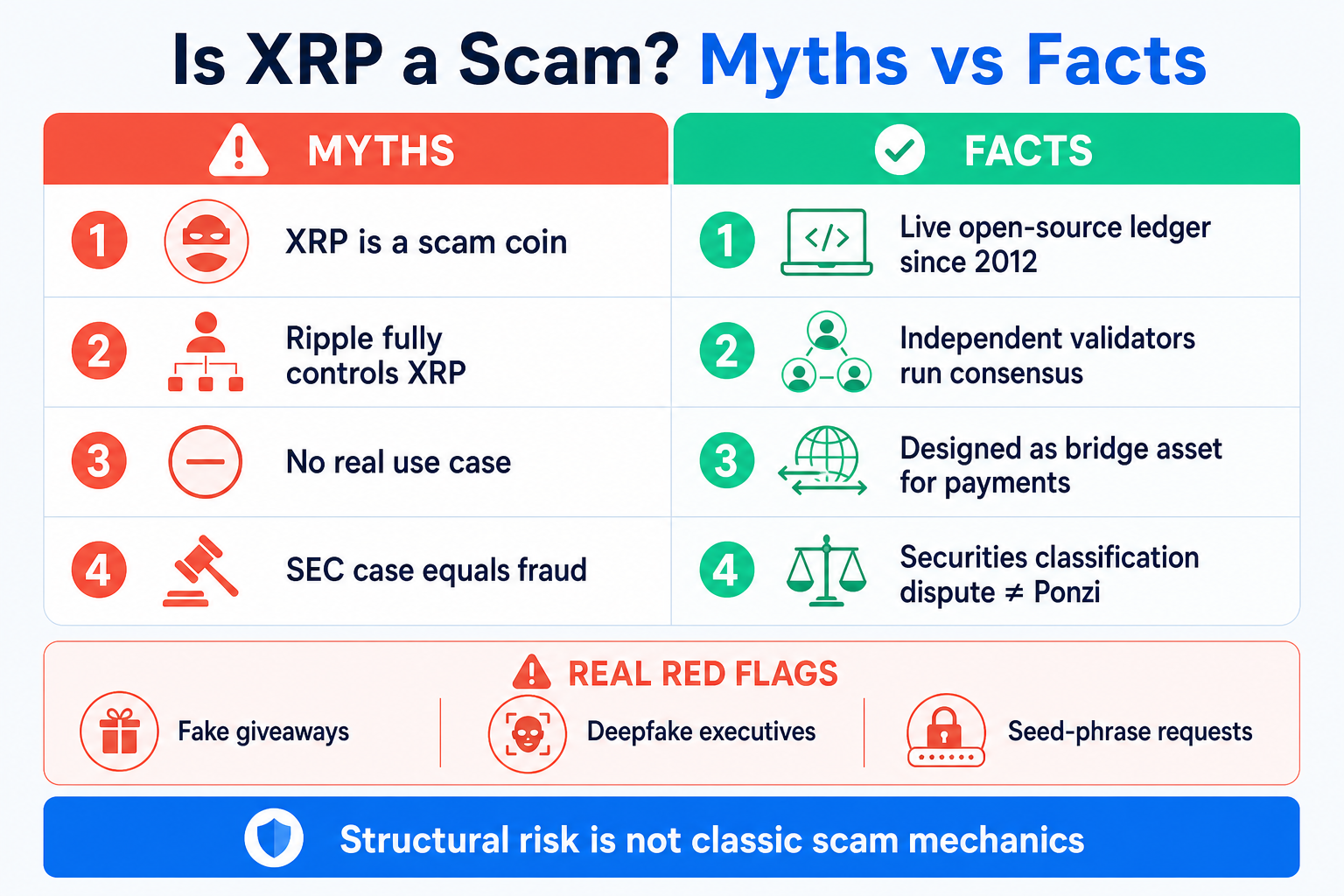
Figure 2. Myths versus facts, plus real red flags: fake giveaways, deepfakes, and seed-phrase requests.
Which Red Flags Are Real: Giveaway Scams vs Protocol Risk?
Brand phishing is where many retail users actually lose money. Impersonation streams, fake social posts, malicious sites, and deepfake promotions featuring Ripple CEO Brad Garlinghouse often push “send XRP to get double back.” Legitimate teams do not ask strangers to send crypto to unlock an airdrop or “verify” a wallet. Seed phrases and private keys requested by “support” are hostile by default. If you are hit, preserve evidence and report through platforms and, where available, channels such as the FTC or IC3.
Protocol-level concerns look different: escrow release schedules, large-holder selling pressure, regulatory access changes across jurisdictions, competition from Ripple USD (RLUSD) and other payment rails, and ordinary crypto volatility. Those belong in a risk section—not a binary “scam / not scam” slogan. Venue safety still matters in custody; see how to choose a safe cryptocurrency exchange and verify deposits with a blockchain explorer when you move assets on-chain.
What Risks Remain Even if XRP Is Not a Scam?
Even when XRP fails classic scam tests, holders still face regulatory uncertainty beyond any single court outcome, supply-concentration effects on market structure, Ripple vs SWIFT competition in cross-border payments, and XRP price volatility typical of liquid crypto markets. Risk and fraud are different categories. Informed skepticism asks for evidence; reactionary labels skip the checklist.
XRP/USDT and other spot markets appear on major exchanges including Gate. Product availability is a logistics detail after research—not proof of safety or a recommendation to trade. Account security still matters, including two-factor authentication.
FAQ
Is XRP a scam?
Under common crypto scam checklists—anonymous founders, guaranteed returns, non-existent product, hidden minting—XRP does not fit. It is the native asset of a long-running public ledger tied to a visible company ecosystem. Structural and regulatory debates should be assessed separately from fraud claims.
Is Ripple Labs a scam?
Ripple Labs is an incorporated fintech company that has faced heavy regulatory scrutiny. Its products focus on cross-border payments infrastructure for financial institutions. Scrutiny and civil securities disputes are not automatic evidence of a fraudulent shell company.
What is the difference between Ripple and XRP?
Ripple is the company; XRP is the XRPL native asset. Ripple builds payment products around the ecosystem, while the ledger operates through a consensus process maintained by independent validators. Confusing corporate sales practices with ledger existence drives many “scam” headlines.
Are XRP giveaways real?
Offers that require sending XRP to receive more XRP are treated as scams—including fake social giveaways and impersonations of Ripple executives. Official teams do not solicit wallet “verification” deposits via random posts.
What are the main risks of XRP?
Regulatory change, token concentration and escrow dynamics, competition in payments rails, custody and phishing, and market volatility—not “the chain is imaginary.” Greater regulatory clarity in some jurisdictions may affect sentiment, but it does not remove market risk.
How can you tell if a crypto project is a scam?
Check founder transparency, whether a real product exists, supply rules, partnership verifiability, and whether marketing promises risk-free returns. Watch for malicious sites and fake support, apply the same bar to XRP, and keep strong account controls such as two-factor authentication on exchange accounts.







