Among semiconductor equipment stocks, LRCX (Lam Research) fits readers who prioritize etch, deposition, and clean as core process pillars; AMAT (Applied Materials) fits readers who need a wider materials-engineering and multi-module mix. Both sit in wafer fab equipment (WFE), but “same industry” does not mean “same product structure.”
Lam Research (LRCX) already frames the issuer, process platforms, and customer types; a side-by-side read should start with process coverage and business breadth. When the next step is executing a buy or sell on Gate Stocks with stablecoin funding, buy LRCX with USDT covers funding prep, ticker search, and order fields.
| Comparison dimension |
LRCX (Lam Research) |
AMAT (Applied Materials) |
| Issuer and ticker |
Lam Research Corporation / LRCX |
Applied Materials, Inc. / AMAT |
| Sector framing |
Semiconductor wafer fab equipment stock |
Semiconductor wafer fab equipment stock |
| Process focus (educational) |
Etch, Deposition, and Clean more prominent |
Broader materials-engineering and multi-module mix |
| Typical adjacent modules |
Clean and related front-end steps |
CMP, ion implant, and inspection more often discussed together |
| Customer types (educational) |
Memory / Foundry / IDM |
Memory / Foundry / IDM |
| Business-breadth takeaway |
Process pillars more concentrated |
WFE process coverage usually wider |
| Gate search entry |
Gate Stocks · LRCX |
Use searchable ticker AMAT on the page |
Confirm issuer and ticker first, then compare process focus and business breadth. Customer types can overlap; serving chipmakers alone does not mean the same exposure.
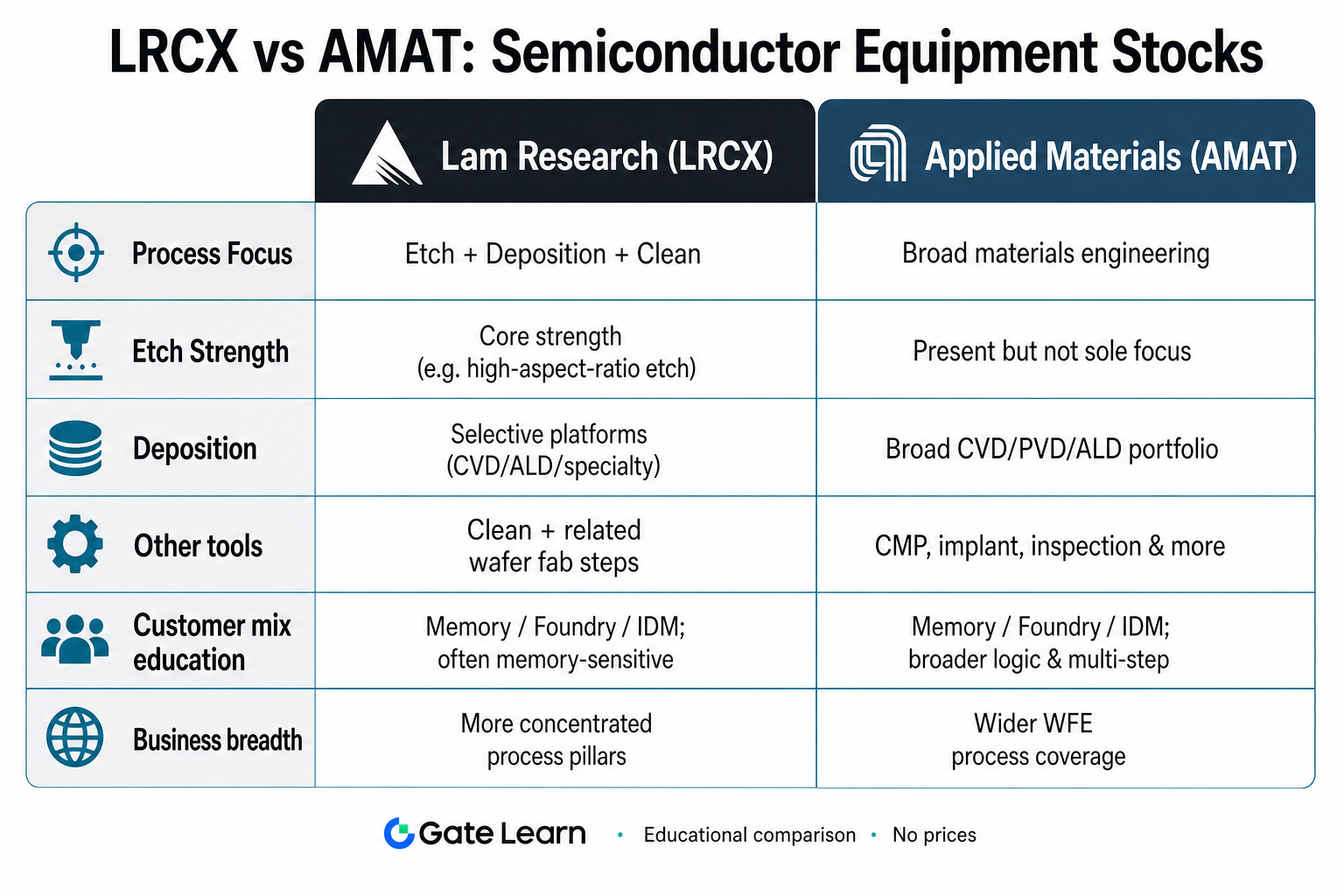
Figure 1. LRCX vs AMAT multidimensional comparison: process focus, etch and deposition, other tools, customer mix, and business breadth (educational; no prices).
What Is LRCX?
LRCX is the Nasdaq ticker for Lam Research Corporation, a U.S.-listed semiconductor wafer fab equipment company. In educational framing, Lam Research sells and services front-end equipment tied to etch, deposition, and clean for chipmakers, with customers commonly described across Memory, Foundry, and IDM. Full issuer, platform examples, and customer framing live in the Pillar; this section keeps only the shortest definition needed for comparison.
What Is AMAT?
AMAT is the Nasdaq ticker for Applied Materials, Inc., another global semiconductor equipment and services company. Applied Materials is often framed with broader materials-engineering capability; product discussions frequently cover deposition (including CVD, PVD, and ALD), etch, plus CMP, ion implant, and some inspection modules.
AMAT and LRCX both sit on the fab capital-expenditure supply chain, but educational process breadth differs: AMAT is more often cast as a multi-step materials-engineering platform supplier; LRCX is more often cast as an equipment maker highly focused on etch, deposition, and clean pillars.
How Do Process Coverage Differ Across Etch, Deposition, and Clean?
On process coverage, LRCX educational framing emphasizes Etch, Deposition, and Clean as three pillars; AMAT is also important in deposition and related areas, but discussion more often extends to CMP, ion implant, and a wider multi-process mix.
On etch, high-aspect-ratio structures are often taught alongside Lam Research core capability; AMAT also has etch offerings, usually not as a single label. On deposition, both can be discussed for CVD and ALD; AMAT is more often written with wider combinations that include PVD. On clean, Lam Research places Clean alongside Etch and Deposition as a core pillar; AMAT comparison weight more often falls on planarization and implant as adjacent steps.
| Process step (educational) |
LRCX takeaway |
AMAT takeaway |
| Etch |
Core pillar; often paired with high-aspect-ratio structures |
Present; usually not the sole label |
| Deposition |
Selective platforms (CVD / ALD / specialty deposition) |
Broader CVD / PVD / ALD mix |
| Clean |
Core pillar alongside Etch and Deposition |
Less often stressed as a standalone main label |
| CMP / ion implant and related |
Less often framed as main pillars |
More often enter business-breadth comparisons |
| Inspection / metrology |
Not the main narrative focus |
May have presence; metrology leaders are often other firms |
The table builds a step-to-role map, not a market-share ranking; company segment disclosures must be checked to confirm.
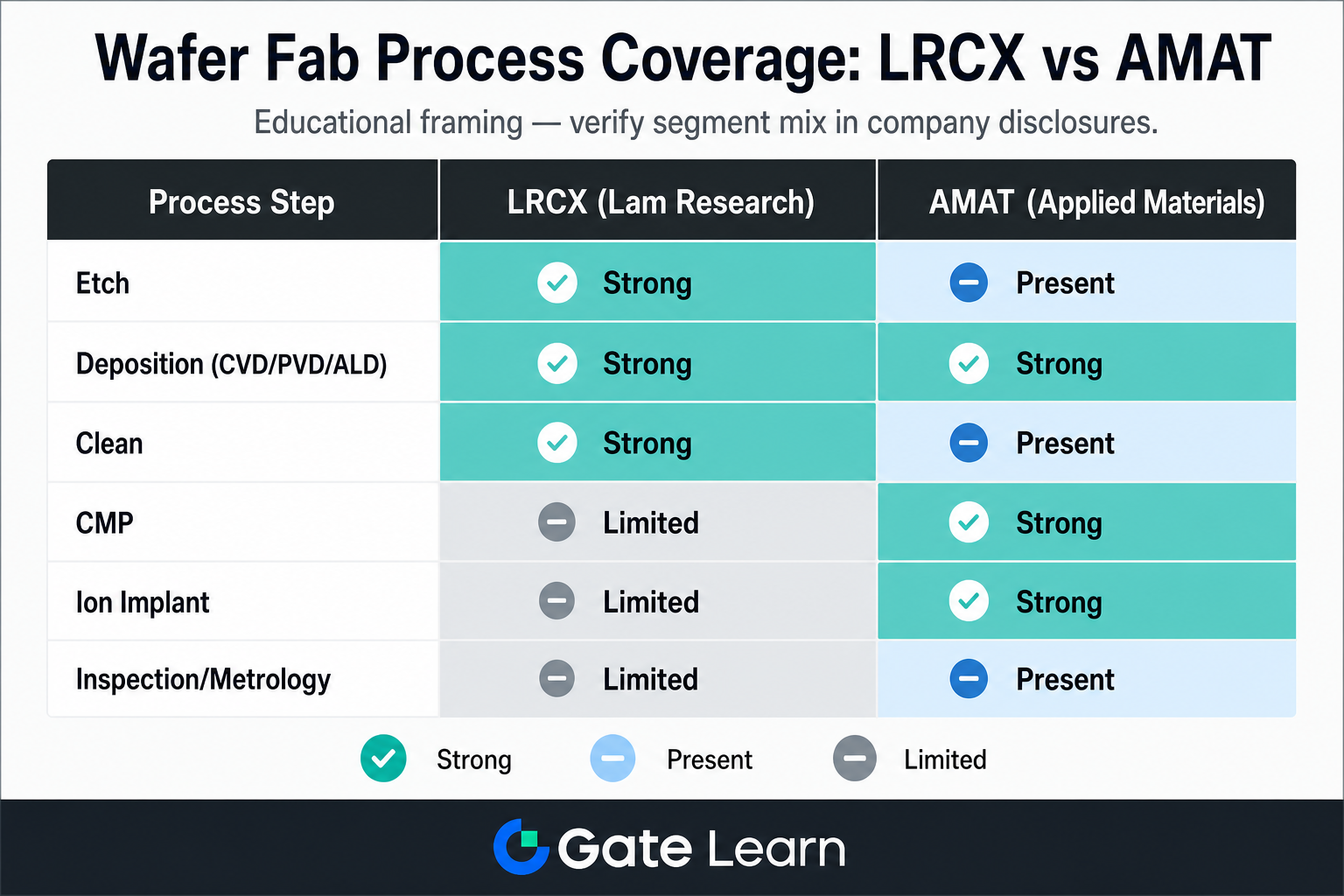
Figure 2. Educational wafer-process coverage matrix for LRCX vs AMAT: etch, deposition, clean, CMP, ion implant, and inspection (verify against disclosed segments).
How Do Customer and Application Scenarios Differ?
On customer types, educational framing for LRCX and AMAT can both cover Memory, Foundry, and IDM; differences show up more in which process steps and capital-spending rhythms pull on each company’s process focus than in mutually exclusive customer lists.
When memory (DRAM, NAND, and related) expands capacity or increases layers, demand for high-aspect-ratio etch plus related deposition and clean often rises, and the narrative more often pairs with LRCX. Foundry and advanced logic at leading nodes and multi-layer interconnect need deposition, planarization, and implant steps, where AMAT’s wider process-mix narrative is used more often. Advanced packaging and WLP can be incremental for both; modules should be separated by disclosure.
A three-question checklist helps: Is the customer expanding memory, logic advanced nodes, or packaging? Does demand lean etch/clean, or a deposition–CMP–implant chain? Do the two firms share customers, or also the same process steps?
How Should Revenue Structure and Business Breadth Be Compared Educationally?
Revenue-structure comparison should use a business-breadth frame, not specific price figures: LRCX educational framing concentrates more on etch, deposition, clean pillars and related services; AMAT educational framing stresses multi-step materials-engineering combinations and service capability.
Beyond tool sales, install, spares, and process support shape long-term customer relationships; service mix and segment names follow investor-relations disclosures. Both compete directly in areas such as deposition; the difference is combination width and narrative focus, not an exclusive checklist. Mapping a single process step to an equipment maker is more direct with the LRCX pillar narrative; mapping multi-step materials-engineering procurement onto one supplier mix is more natural with the AMAT breadth narrative.
Which Should You Choose? Choose LRCX if… / Choose AMAT if…
For a comparison framework, LRCX fits building an Etch / Deposition / Clean process map first; AMAT fits seeing a wider WFE materials-engineering mix in one pass.
Choose LRCX if… the goal is to master etch, deposition, and clean as three actions and equipment roles; to place Memory-related structure intensity and platform examples on one map; or to verify ticker LRCX against the Lam Research issuer on the trading side.
Choose AMAT if… the goal is to compare adjacent steps such as CMP and ion implant; to write Foundry / logic advanced-node materials engineering as a continuous path; or to weigh business breadth and customer overlap together.
Both paths can run in sequence: build process pillars with LRCX, then widen materials-engineering coverage with AMAT. The comparison answers which understanding goal fits better—not which stock is “better.”
What Risks and Limits Apply When Comparing Them?
Side-by-side classification helps, but limits are clear: process labels do not replace segment disclosure, customer overlap is not identical exposure, and capital-spending cycles plus export controls can move both firms while timing diverges.
Process labels are not direct conversions. “LRCX lean etch; AMAT is wider” is an educational compression; actual revenue spans multiple product lines and services and shifts with process migration.
Customer overlap can hide step differences. The same customer may buy tools from both firms for different steps; customer-list-only comparison overstates homogeneous competition.
Capital cycles and demand mix can diverge. Equipment demand depends on fab capital spending; when memory and logic cycles are out of sync, order timing can diverge. Cycle notes are not price judgments.
Export controls and competitive maps. Deliverable scope, regional capacity, and domestic equipment competition can change boundaries; peers also include lithography, metrology, and specialty tools—so “LRCX vs AMAT” does not replace the full WFE map.
Separate research from execution. Verifying issuer and ticker is not the same as understanding process breadth. Structure comparison does not replace order-type, funding, and fee-field checks, and does not constitute buy, hold, or sell advice.
Summary
LRCX (Lam Research) and AMAT (Applied Materials) are both semiconductor equipment stocks; the core difference is process focus and business breadth. LRCX educational framing highlights etch, deposition, and clean pillars and fits building a core process map first; AMAT educational framing covers wider materials engineering and multi-module mixes and fits comparing CMP, ion implant, and related steps. Customer types can cover Memory, Foundry, and IDM for both, while step-level demand and capital-spending rhythm can diverge. Compare with process-coverage and business-breadth frames, verify company disclosures, and keep research conclusions separate from trading-page fields.
FAQ
What Is the Difference Between LRCX and AMAT?
LRCX (Lam Research) and AMAT (Applied Materials) are both semiconductor wafer fab equipment stocks, but process mixes are not identical: Lam Research emphasizes etch, deposition, and clean; Applied Materials usually covers a wider materials-engineering and multi-module mix. Customer types can overlap; compare product focus and disclosed segments.
Who Are Lam Research’s Competitors?
Direct comparisons often include Applied Materials (AMAT) and other equipment makers with overlap in etch, deposition, and related areas; broader peers include lithography, metrology, and other specialty tool vendors. Competitive boundaries are drawn by process step.
What Does Lam Research Do?
Lam Research Corporation supplies wafer fab equipment and related services to chipmakers worldwide; educational core process coverage centers on etch, deposition, and clean. The stock ticker is LRCX on Nasdaq; on Gate Stocks, search LRCX and verify the issuer name.
How Does Lam Research Make Money?
Lam Research primarily earns from selling and servicing wafer fab equipment across etch, deposition, and clean platforms. Fab capacity expansions or process upgrades create equipment and service demand; segment definitions follow the company’s periodic disclosures.
What Are the Main Risks of Semiconductor Equipment Stocks?
Main risks include capital-spending cycle swings, memory versus logic demand divergence, customer concentration and regional capacity shifts, plus export controls and technology transitions that reshape competition and delivery constraints. Trading also involves funding currency, fees, and rule differences.
Should Readers Study LRCX or AMAT First to Understand Equipment Stocks?
If the goal is to build an etch, deposition, and clean process map first, start with LRCX; if the goal is a wider materials-engineering and multi-module mix, start with AMAT. The choice is an understanding path, not an investment conclusion.