Unlike traditional smartphones, smart glasses no longer depend on active user input. Instead, they offer context-driven assistance by continuously sensing the real world. This shift marks AI's transformation from an "information response system" into a "real-time cognitive system," representing a structural leap in human-computer interaction.
From an industry evolution standpoint, the rapid progress of multimodal models, edge computing, and lightweight optical technologies has turned smart glasses into a vital vehicle for AI to move from the cloud into the physical world. This trend not only reshapes the consumer electronics landscape but also redefines the entry logic of future computing platforms.
This article explores Meta's sustained investments in AI hardware, systematically analyzing why smart glasses are seen as a critical terminal entry point in the AI era across dimensions such as strategic positioning, product design, technical architecture, market competition, and future evolution.
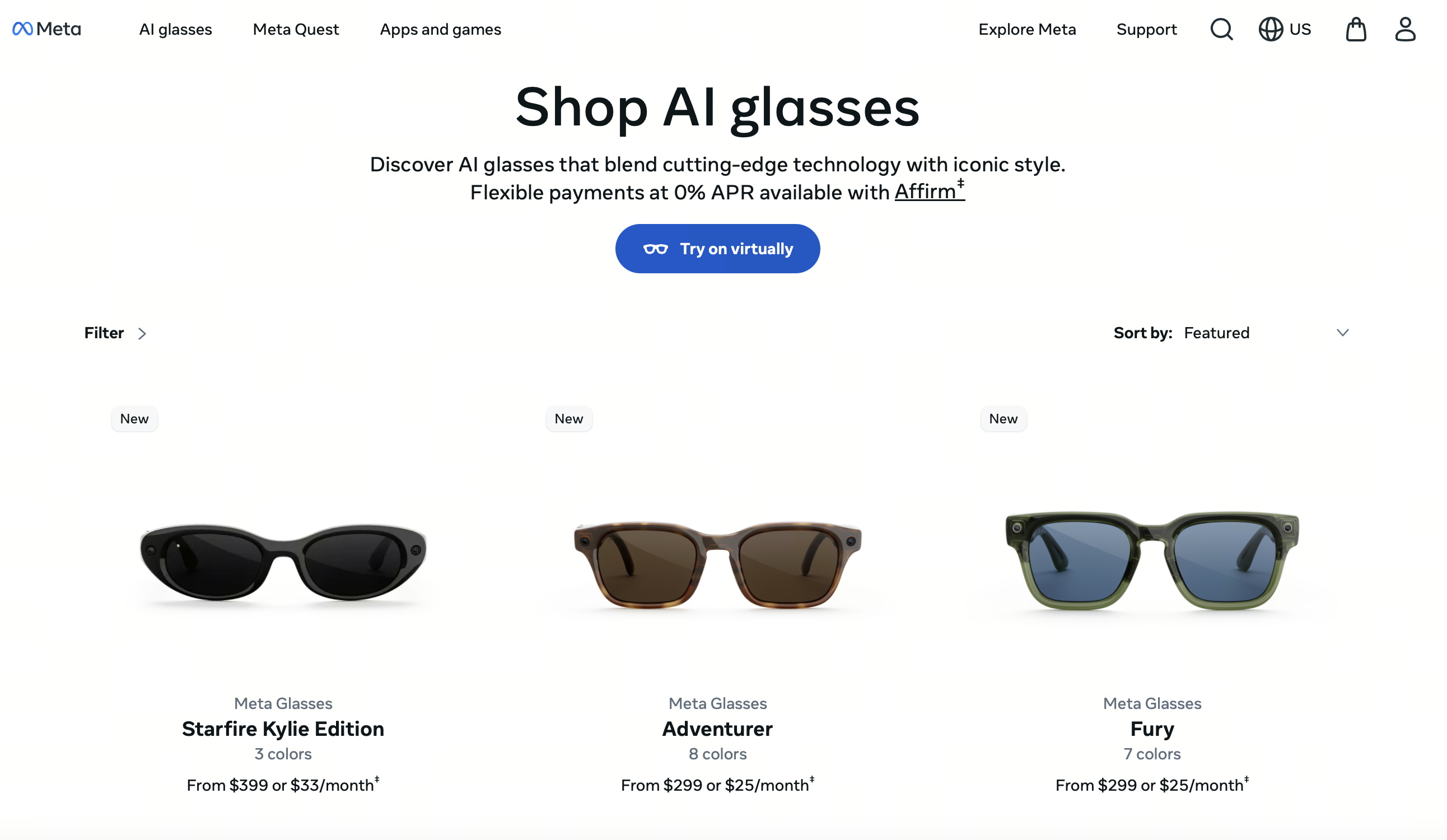
Meta Platforms has been aggressively expanding in the smart glasses space, driven primarily by the need to secure an early foothold in the "next-generation computing gateway." As mobile internet growth slows, hardware gateways have become a critical battleground for tech giants.
Compared to smartphones, smart glasses offer inherent advantages: superior first-person data capture for real-time environmental awareness, shorter interaction paths via voice and vision, and greater penetration into high-frequency use cases like commuting, work, fitness, and socializing.
More critically, smart glasses give Meta a way to bypass the constraints of traditional mobile operating systems. With Apple and Google dominating mobile platforms, a hardware-level gateway is a strategic breakthrough for Meta to build its own AI ecosystem.
Long term, Meta has been pushing the convergence of "real-world social interaction and virtual spaces," and smart glasses serve as the essential bridge connecting the physical world with the digital realm.
Ray-Ban Meta is a consumer smart glasses product co-developed by Meta and a traditional eyewear brand. Its design prioritizes lightweight AI interaction over complex AR displays.
The device packs a camera, microphone, and open-ear audio system, allowing users to take photos, record videos, have voice conversations, and run basic AI queries—all without touching their phone.
Unlike earlier models, the new Ray-Ban Meta's core upgrade is deep AI integration. By connecting to the Meta AI system, it delivers real-time visual understanding—identifying objects, parsing environments, and providing instant translations.
Interaction is screen-minimized, emphasizing "seamless interaction." Users simply use voice commands to access AI features, gradually transforming smart glasses from a "capture device" into a "personal smart companion."
Meta is also continually improving hardware—battery life, camera quality, and edge computing—to enhance long-wear comfort. These upgrades are pushing smart glasses from early-adopter gadgets into mainstream consumer products.
Meta AI in smart glasses is more than a voice assistant—it's a multimodal real-time comprehension system. By blending visual, auditory, and contextual data, it dynamically models the real environment.
For instance, when a user looks at an object, AI combines visual recognition with online info for instant explanation. In travel, it can auto-identify street signs and offer translations. In social settings, it helps record info and generate summaries.
Essentially, AI shifts from a "query tool" to a "perceptive system." Users no longer need to ask explicit questions; the system proactively interprets needs and offers recommendations.
Technically, this relies on on-device and cloud collaboration. Lightweight tasks run locally to minimize latency, while complex reasoning is handled in the cloud. This hybrid approach balances performance and power efficiency.
What Cutting-Edge Technologies Does Orion AR Represent
Orion AR glasses are Meta's major AR research project, aiming to create a true spatial computing device—not just a display tool.
Key areas of exploration include ultra-lightweight optical systems, spatial positioning, and gesture-based interaction, allowing digital information to overlay the real world in 3D.
Unlike traditional AR devices, Orion emphasizes "natural interaction"—users control virtual content via eye tracking, gestures, and voice, without physical controllers.
Orion also pushes boundaries in high-density micro-display and low-power computing. Once mature, these technologies will pave the way for consumer AR glasses.
From an industry perspective, Orion is both a product and a technology validation platform, whose advancements will migrate to future commercial devices.
Why Smart Glasses Are a Key AI Terminal
Smart glasses are considered a critical AI terminal because of their "first-person data entry" capability.
Traditional devices rely on user input, while smart glasses continuously capture environmental data, enabling AI to understand the user's real context. This upgrades AI from "passive response" to "active perception."
In practice, this means more natural interactions—navigation without typing destinations, AI inferring intent from gaze and surroundings; information search triggered by vision rather than keywords.
As multimodal models grow more powerful, AI evolves from language understanding to environment understanding, and smart glasses are the core vehicle for this shift.
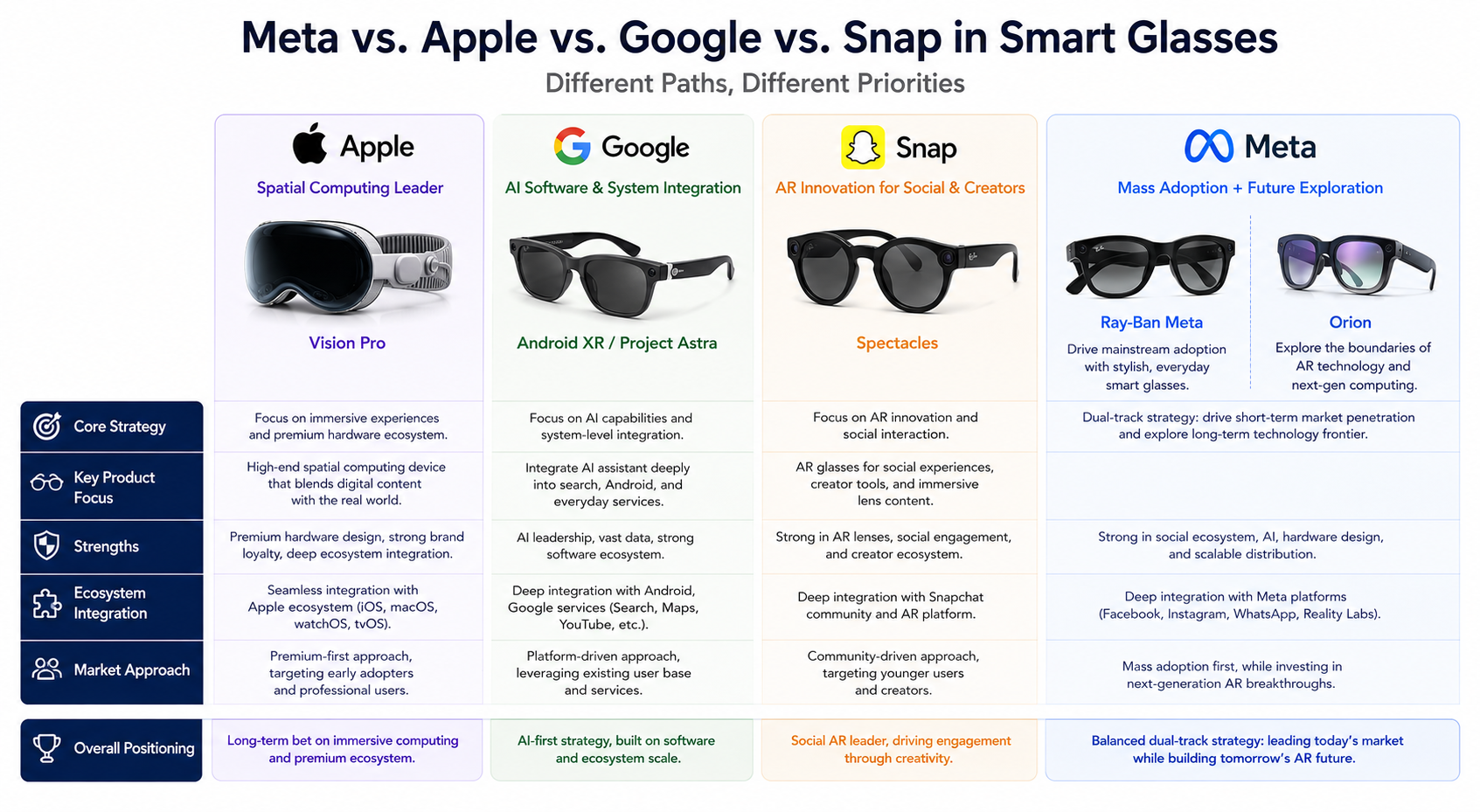
In the competitive landscape, Apple Inc is pushing spatial computing with Vision Pro, focusing on immersive experiences and a premium hardware ecosystem.
Alphabet Inc prioritizes AI software and system integration, embedding AI assistants into search and Android.
Snap Inc pioneered AR glasses but leaned toward social filters and creator tools.
Meta's approach stands out as "popularization-first." It drives consumer adoption with Ray-Ban Meta while exploring future tech with Orion. This dual-track strategy balances near-term market growth with long-term innovation.
What Challenges Remain for Smart Glasses Adoption
Despite rapid progress, mass adoption of smart glasses faces multiple hurdles.
First, hardware constraints—battery life, heat dissipation, and computing power—limit sustained complex AI operations.
Second, the trade-off between wearability and functionality: balancing lightweight design with rich features is tough.
Third, privacy and social acceptance: cameras and continuous sensing raise data privacy concerns in public.
Finally, a lack of mature development platforms and app ecosystems restricts functionality to what manufacturers provide.
Meta's smart glasses will evolve along three core paths: stronger on-device AI, more natural human-computer interaction, and lighter hardware.
Thanks to advances in model compression and edge computing, more AI inference will shift to the device, cutting latency and enhancing privacy.
At the interaction level, voice, vision, and gesture will converge, moving toward "interface-free operation."
Long term, smart glasses may transition from an accessory to a primary computing terminal, complementing or even replacing smartphones.
Summary
Meta's smart glasses strategy reflects its redefinition of the AI-era gateway. From the consumer reach of Ray-Ban Meta to the frontier exploration of Orion AR, its approach spans both near-term markets and long-term technology.
As AI moves from cloud to edge and from language to multimodal systems, smart glasses are becoming the vital link between the real world and digital intelligence. Their strategic importance will only grow, potentially reshaping the next-generation computing platform.