OpenAIIf OpenAI has not yet gone public, direct trading of common shares typically lacks an exchange pathway. Gate Pre-IPOs discloses pre-market circulation and event settlement arrangements for OPENAI asset certificates; these follow the product rules for mirror notes and are not OpenAI stock settlements.
The announcement specifies the trading method as Pre-IPOs Zone Pre-Market, with trading scheduled for July 20, 2026, at 08:00 (UTC). PANews provides a Chinese summary of the pre-market opening time for cross-verification. Interpreting "tradable" as "equivalent to listed company shares" skips the essential product qualification step.
How do you access pre-market trading after unlocking?
Once allocation certificates are unlocked in three phases—25%, 35%, and 40%—the corresponding quantities become eligible for pre-market trading. Subscription allocation and unlocking clarifies that allocated and unlocked quantities are distinct: subscription completion determines final allocation, the unlocking schedule dictates phased releases, and pre-market trading only covers the portion already released. Pre-market trading allows holders to buy and sell unlocked certificates according to platform rules, but does not convert mirror notes into company shares or automatically generate shareholder registry records.
| Stage |
Transferable Basis |
Key Rules |
| Subscription End |
Final allocation result |
Unallocated funds returned as disclosed |
| Phase Unlocking |
Quantity released per phase |
25% / 35% / 40% |
| Pre-Market |
Unlocked certificates |
Temporary code and total circulating supply |
What does a temporary code signify?
Since the target company has not officially gone public, Pre-Market uses temporary trading codes and corresponding circulating quantities. Temporary codes are used for platform identification and internal circulation; they do not indicate that OpenAI has listed shares, nor do they guarantee future automatic mapping to a stock code. After listing, related arrangements may be adjusted according to actual circumstances, affecting product trading parameters—not shareholder registration.
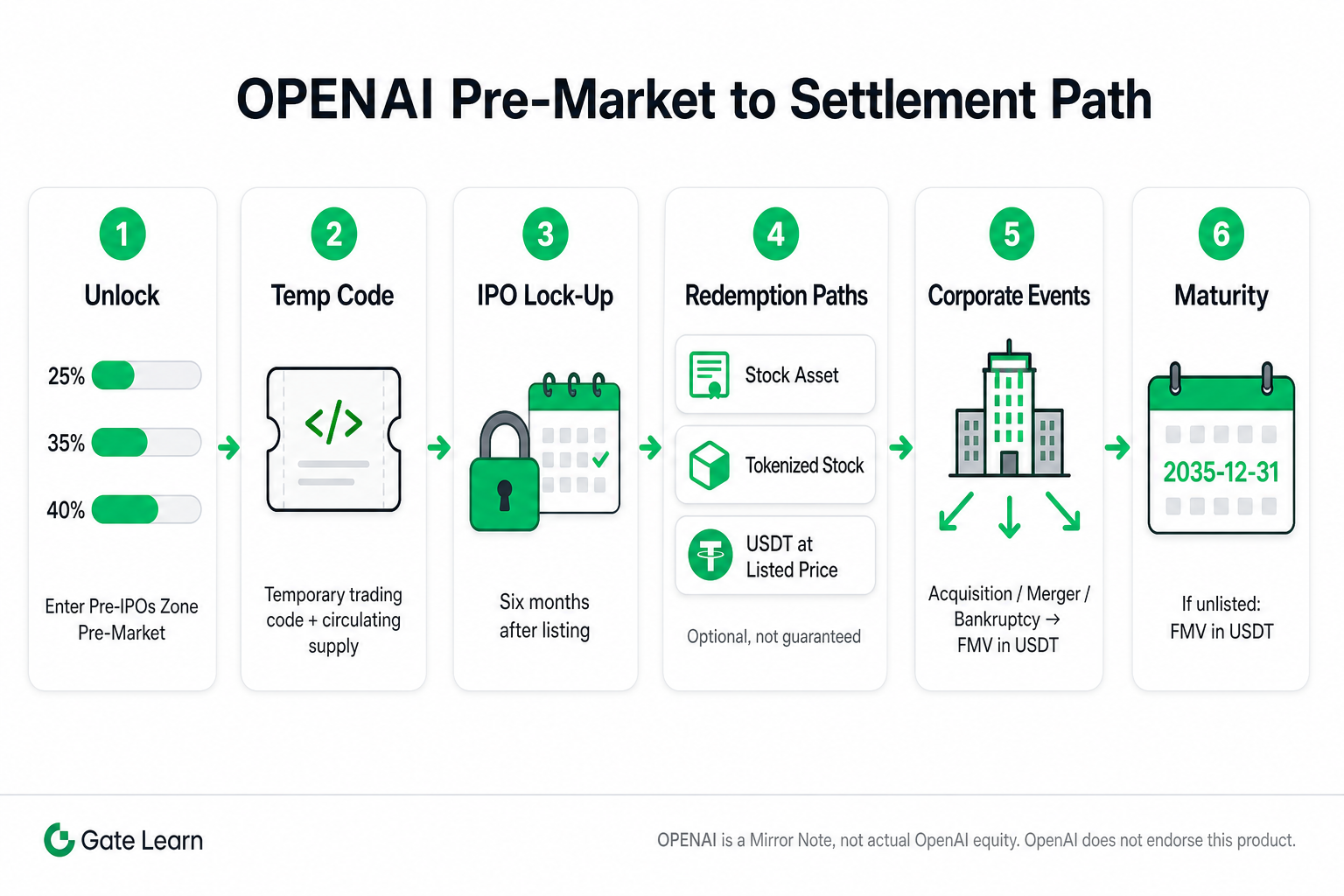 Educational pathway from phased unlocking and temporary code pre-market to IPO lock-up period and settlement options.
How does the six-month lock-up period after IPO affect settlement?
The announcement states: This asset is subject to a six-month lock-up period after OpenAI's actual IPO. The IPO event does not automatically convert OPENAI into shares. Before the lock-up period ends, assets may still circulate via the pre-market pathway at market price; after the lock-up period ends, Gate provides an exclusive exit page.
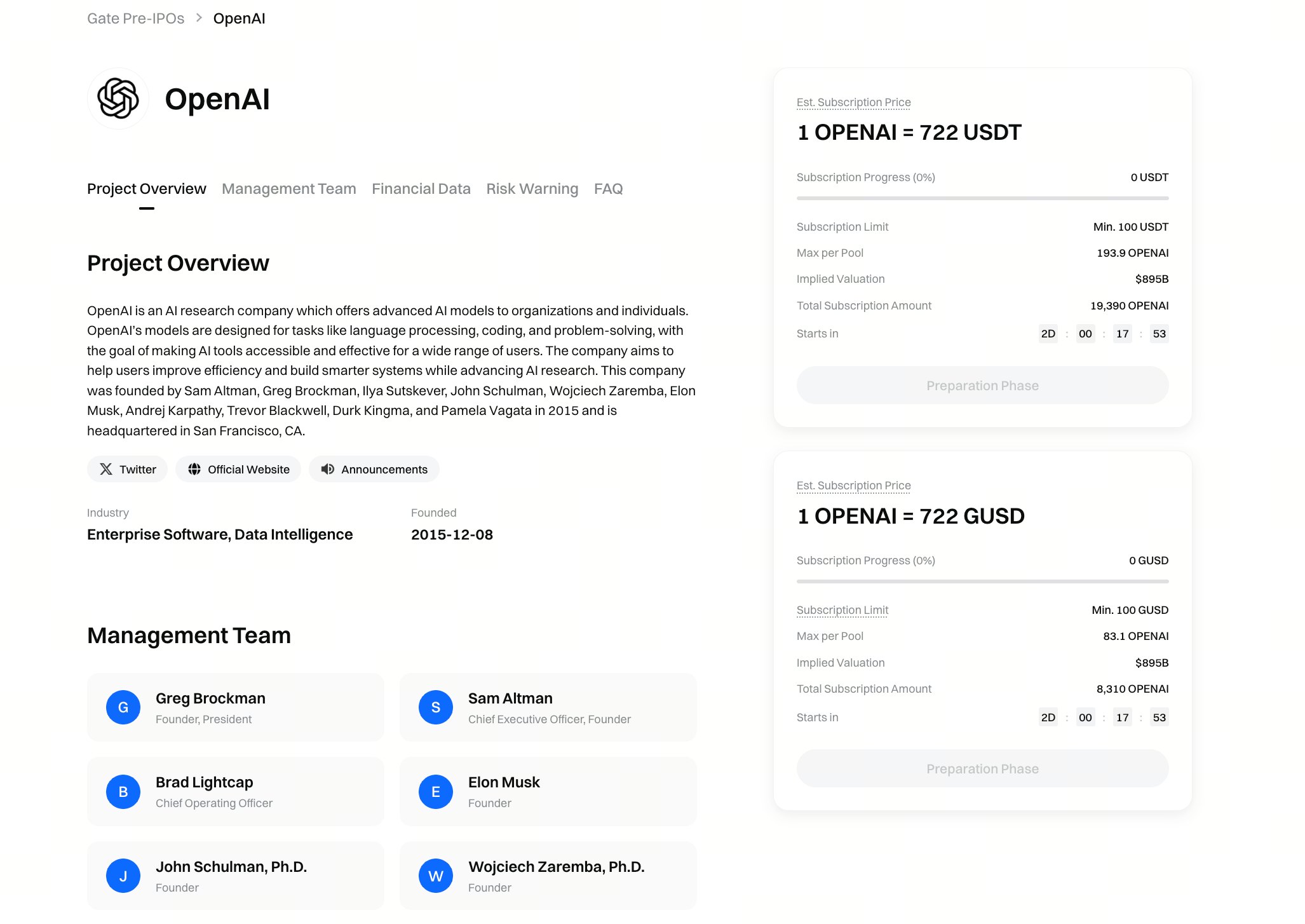
The project page FAQ distinguishes two types of issues: asset certificates themselves are tradable in pre-market; only after the target company’s IPO lock-up period ends can OPENAI be converted to tokenized stocks or redeemed for USDT based on post-listing stock price. Both the announcement and project page should be reviewed to avoid misunderstanding "certificate tradable" as "holding listed company shares."
What redemption options are available after the lock-up period?
The announcement lists that users may redeem assets for stock assets, tokenized stocks, or USDT at the actual post-listing stock market price. The project page FAQ also notes the option to convert to tokenized stocks or redeem for USDT based on post-listing underlying stock price. Specific availability depends on the page, account, and regional rules at the time; disclosure does not guarantee delivery in any particular form.
| Possible Path |
Settlement Reference |
Not Represented |
| Stock Assets |
Post-listing stock asset terms |
Already a shareholder at subscription |
| Tokenized Stocks |
Platform tokenized stock terms |
Mirror Note automatically becomes equity |
| USDT |
Post-listing real-time market price |
Fixed price or yield |
How are scenarios handled if not listed, acquired, merged, or bankrupt?
If the target company enters bankruptcy restructuring, reference value is adjusted and settled based on the actual disposition of common shares in restructuring; if bankruptcy liquidation results in common share value becoming zero, product reference value may also be zero, and investors may lose all principal with no recourse against the target company. Acquisition or merger may also result in settlement based on fair market value.
How is settlement handled at the December 31, 2035 maturity date?
The maturity date is December 31, 2035. If OpenAI remains unlisted at maturity, or is acquired, merged, or bankrupt, Gate discloses settlement based on OpenAI common shares’ fair market value in USDT. Fair market value is not a fixed entitlement ratio, nor equal to the implied valuation input at subscription; the approximately $895 billion in implied valuation and dilution is a reference for that subscription period and not the maturity settlement basis.
What are the risk boundaries for trading and settlement?
Risks include: non-equity nature, OpenAI not endorsing, pre-market liquidity and price volatility, adjustment to temporary codes or circulating parameters, uncertain IPO timing, event settlement may cause reference value to drop significantly or even to zero, and regional and account qualification restrictions. Pre-market tradability does not guarantee transactions at expected quantities at any time; adjustments to temporary trading codes and total circulating supply may also affect comparable market depth.
It is also essential to distinguish between "company IPO lock-up period" and "certificate phased unlocking." Phased unlocking determines when allocated certificates become transferable; the six-month lock-up period determines when the exclusive redemption page opens after listing. When two timelines run in parallel, conflating one with the other leads to misjudgment of exit points. In bankruptcy scenarios, there is no recourse against the target company, further illustrating that product losses cannot be automatically converted into remedies through company equity. See product risk checklist for details.
For readers tracking OpenAI’s listing process, the settlement section is valuable for outlining conditional scenarios: pre-market circulation, post-lock-up redemption, maturity FMV, merger/bankruptcy events—each triggers a distinct settlement basis. Understanding these branches prevents treating a single implied valuation figure as the settlement answer for all cases.
Summary
OPENAI’s circulation and exit are defined by the product pathway disclosed by Gate: after phased unlocking, assets enter the temporary code pre-market; after OpenAI’s IPO, a six-month lock-up period follows, then redemption options such as stock assets, tokenized stocks, or USDT become available; at maturity or certain company events, settlement is based on common shares’ fair market value. This entire pathway serves mirror notes, not registering holders as OpenAI shareholders. When reviewing settlement rules, conditional scenarios matter more than a single price figure.
FAQ
What market can OPENAI enter after unlocking?
According to the announcement, it can enter the Pre-IPOs Zone Pre-Market. Unlocking releases the transferable quantity of allocated certificates and does not convert the product into actual OpenAI shares.
Why are temporary trading codes used?
When OpenAI has not officially gone public, temporary codes are used for platform trading identification and circulating supply arrangements, not for listed stock codes.
How long is OPENAI locked up after IPO?
This asset is subject to a six-month lock-up period after OpenAI's actual IPO. After the lock-up period, subsequent redemption arrangements follow exclusive page rules.
What settlement methods are available after the lock-up period?
Disclosed options include redemption for stock assets, tokenized stocks, or USDT based on post-listing real-time stock market price; availability depends on rules at the time.
How is settlement handled if OpenAI does not go public?
If OpenAI remains unlisted after December 31, 2035, or is acquired, merged, or bankrupt, settlement is based on OpenAI common shares’ fair market value in USDT.
Will OpenAI shares be received in bankruptcy liquidation?
No. The product is a non-equity mirror note; if common share value becomes zero, product reference value may also be zero, and there is no recourse against the target company.