The relationship between QQQB and the Invesco QQQ Trust (QQQ) stock ETF can be described as "the same underlying asset, different forms of representation." QQQB translates the economic exposure of the Nasdaq-100, tracked by the QQQ ETF, into an on-chain BEP-20 token, rather than creating a separate index basket.
The QQQB stock token defines the bStocks mechanism and trading process from a comprehensive product perspective. To fully understand the source of exposure, it’s essential to examine the composition of the QQQ ETF, the mapping logic of QQQB, and the differences in rights and ETF share structures under tokenization.
The Nasdaq-100 is primarily made up of large-cap, non-financial U.S. stocks, with a heavy concentration in leading technology, consumer, and healthcare companies. QQQ, issued by Invesco, is a listed ETF that tracks this index through a replication strategy. QQQB encapsulates the economic rights of the QQQ Trust into tokenized securities units on Binance and the BNB Chain, enabling 24/7 trading and on-chain composability for stock exposure.
What Is the Invesco QQQ Trust (QQQ) Stock ETF?
The Invesco QQQ Trust (ticker: QQQ) is an ETF listed on U.S. stock exchanges that tracks the Nasdaq-100 Index. The index consists of approximately 100 large-cap companies listed on the Nasdaq, excluding the financial sector, and is dominated by leaders in technology, internet, semiconductors, and consumer services.
QQQ is traded as ETF shares on the securities market, with Invesco serving as issuer and manager. By holding the underlying stocks or using an equivalent replication method, the share NAV mirrors the performance of the Nasdaq-100. Investors who buy QQQ shares gain price exposure to the Nasdaq-100 basket and can trade during regular market hours through their brokerage accounts.
| Element |
Description |
| Tracking Index |
Nasdaq-100 |
| Product Form |
Exchange-listed ETF shares |
| Issuer |
Invesco |
| Component Profile |
Large non-financial stocks, tech-heavy |
| Trading Venue |
U.S. stock exchanges (regular trading hours) |
This table summarizes the core features of the QQQ ETF. Before exploring QQQB, it’s important to recognize that QQQ represents exposure to the "Nasdaq-100 basket"—not a single company stock.
How Does QQQB Map QQQ’s Economic Exposure?
QQQB (Invesco QQQ Trust Tokenized bStocks) is issued by BTech Holdings Limited and is part of the bStocks tokenized securities product line. Each QQQB is fully backed 1:1 by real shares of the Invesco QQQ Trust, held with a regulated U.S. broker, and circulates on the BNB Smart Chain as a BEP-20 token (contract address: 0x205812cdbed920aff76c6580abd681a46d11efc7).
This mapping is about transmitting economic exposure, not replicating the form: QQQB does not directly hold QQQ ETF share certificates on-chain. Instead, it anchors rights to the QQQ Trust via real share reserves. Holding QQQB provides price and dividend exposure (if applicable) aligned with the underlying Trust. Reserve issuance and redemption are tied to circulating supply, ensuring the on-chain token cannot expand independently from the underlying asset.
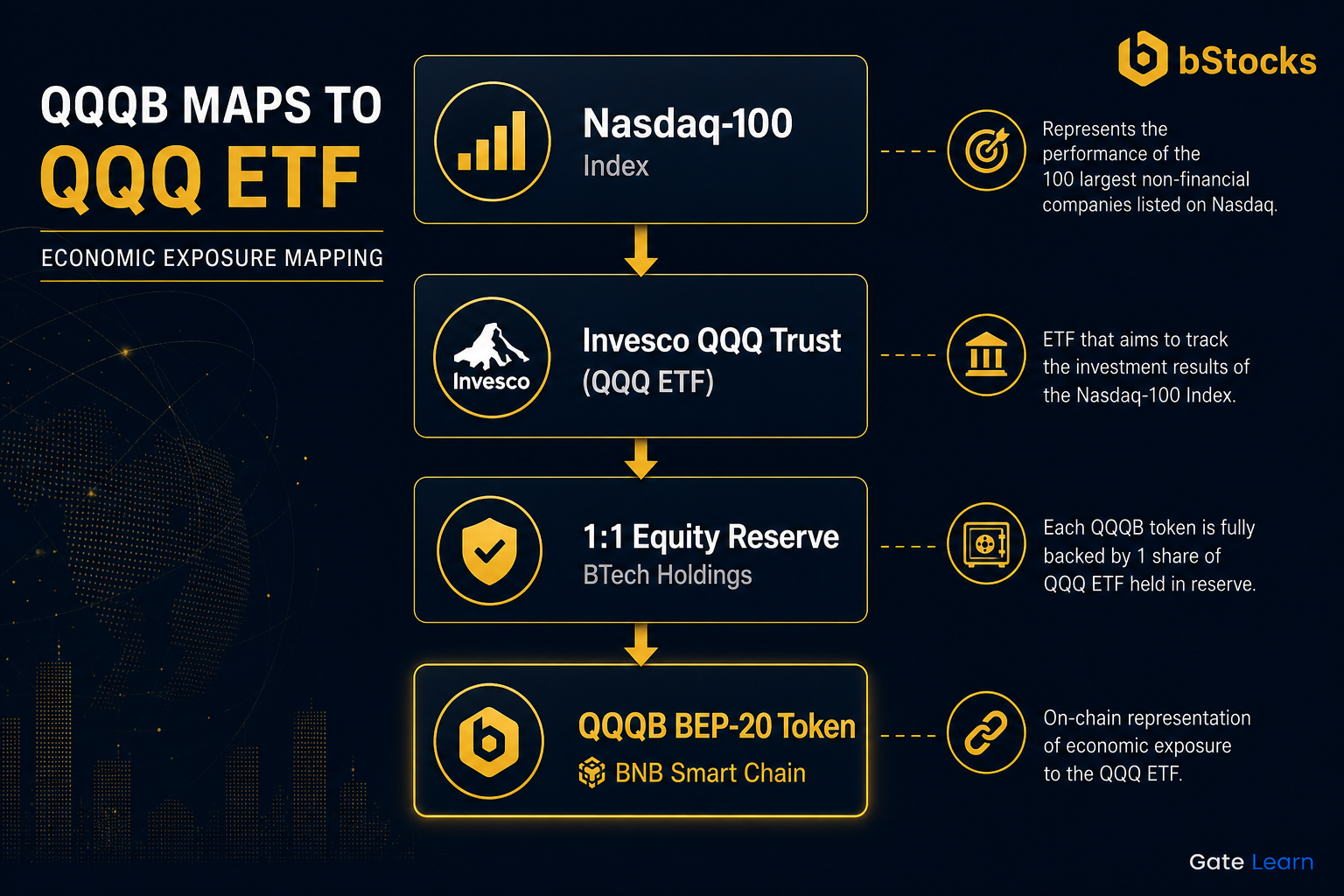 Figure 1. QQQB’s economic exposure mapping from Nasdaq-100 through Invesco QQQ Trust to 1:1 real share reserve and BEP-20 token.
The QQQB 1:1 Reserve and Corporate Action Mechanism explains Proof of Collateral standards and Multiplier corporate action handling. Users can convert between QQQ and QQQB in both directions, fee-free and 1:1, but this conversion right only enables switching formats—it does not grant all registered shareholder privileges of direct ETF share ownership.
How Does the Nasdaq-100 Component Structure Affect the Underlying Asset?
The selection and weighting of Nasdaq-100 components directly determine the NAV of QQQ, which is then reflected in QQQB via the Trust. The index is primarily market-cap weighted, with tech giants holding substantial influence, making the basket’s performance sensitive to a few large constituents.
Component changes (such as inclusions, exclusions, or rebalancing) are driven by index rules, and QQQ’s replication strategy must adjust accordingly. When the Trust’s underlying rights change, QQQB’s Multiplier rebasing mechanism ensures token holders’ economic exposure remains in sync with the underlying securities. When evaluating exposure, users should focus on the index’s industry distribution and concentration, not just the QQQB token symbol.
| Transmission Stage |
Function |
| Nasdaq-100 Compilation Rules |
Determine component range and weighting |
| QQQ Replication Strategy |
Enables ETF NAV to track the index |
| QQQ Trust Underlying Rights |
Anchor QQQB’s reserves |
| Multiplier Rebasing |
Synchronizes corporate actions to token |
This table shows the four layers of transmission from index to token. QQQB does not introduce new stock selection logic independent of Nasdaq; its exposure direction remains consistent with QQQ. Differences are mainly in representation and settlement, not in the index itself.
What Are the Rights Boundaries for Tokenized Holdings?
QQQ ETF shares are registered securities holdings, with shareholder rights (dividends, voting, etc.) governed by U.S. securities law and ETF bylaws. QQQB, as a BEP-20 tokenized security, provides economic exposure to the underlying Trust, but does not grant all the rights of direct ETF share ownership.
The essential distinction: 1:1 conversion right ≠ registered shareholder right. Token Conversion enables fee-free, two-way 1:1 switching between QQQ and QQQB, facilitating format conversion and exposure alignment. Governance rights—such as voting and shareholder meeting participation—must be verified according to bStocks product terms and applicable regulations, and are not automatically equivalent to full brokerage account shareholder rights.
For dividends, QQQB holders may receive distributions when the underlying Trust pays dividends (if applicable), with timing and settlement based on Binance account records. Corporate actions are automatically handled by Multiplier, so users do not need to manually claim rebasing.
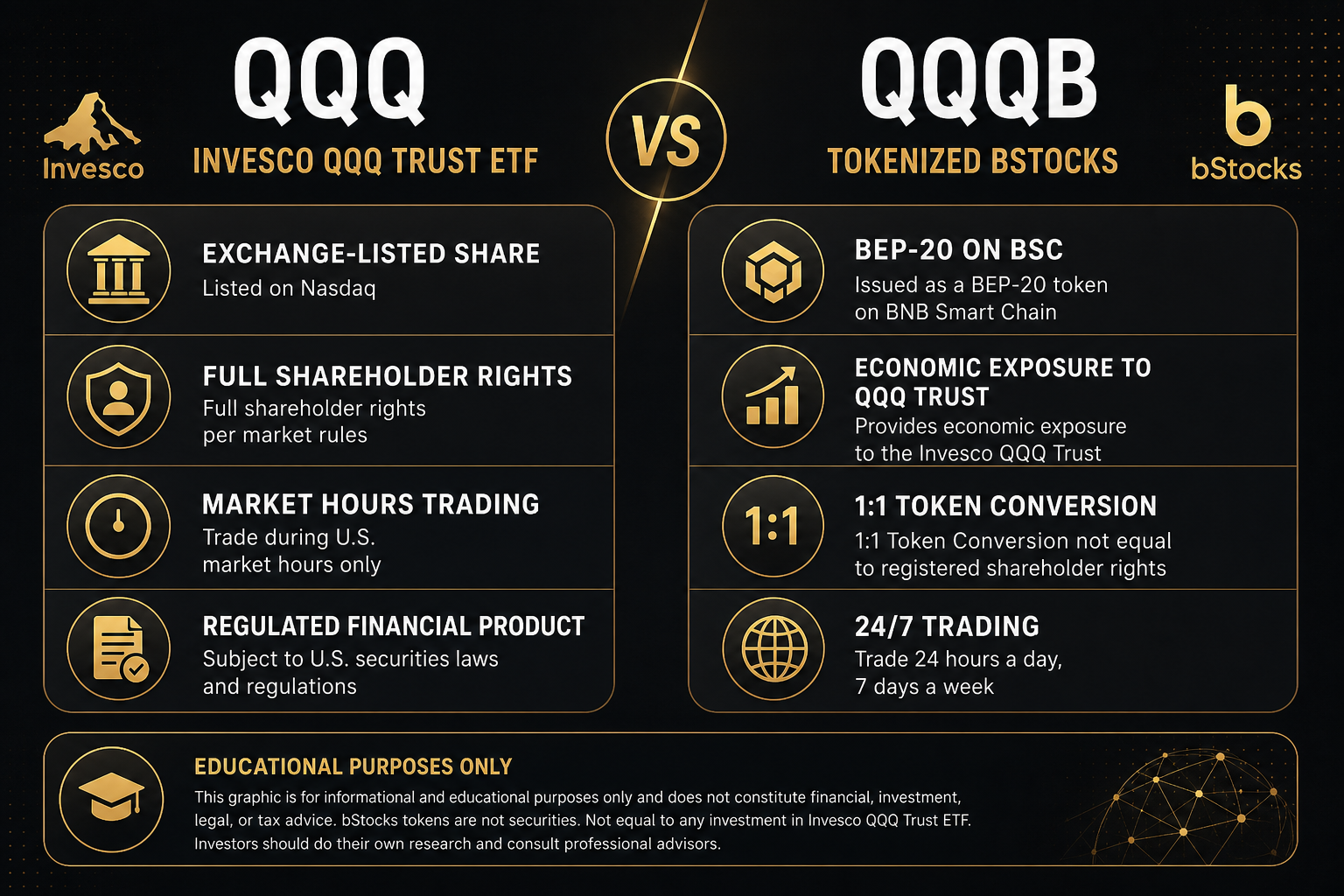 Figure 2. Comparison of rights, trading paths, and exposure types: Invesco QQQ Trust ETF vs. QQQB tokenized form.
The QQQB Risk and Compliance Boundaries article summarizes common misconceptions and compliance checkpoints. Once tokens are withdrawn on-chain to a self-custody wallet, custody responsibility shifts to the user, who must separately assess economic exposure and governance rights.
Table: Key Differences Between QQQ and QQQB
| Comparison Dimension |
Invesco QQQ Trust (QQQ ETF) |
QQQB (bStocks) |
| Product Form |
Exchange-listed ETF shares |
BEP-20 tokenized security |
| Underlying Asset |
Nasdaq-100 basket |
Invesco QQQ Trust economic rights |
| Issuer |
Invesco |
BTech Holdings Limited |
| On-chain Standard |
Not applicable |
BNB Smart Chain · BEP-20 |
| Reserve Mechanism |
ETF replication holdings |
1:1 real share reserve + Proof of Collateral |
| Conversion Capability |
Not applicable |
Token Conversion 1:1 fee-free |
| Trading Hours |
Exchange regular hours |
24/7 (Binance and on-chain) |
| Shareholder Rights |
Full ETF shareholder rights |
Economic exposure; governance rights per terms |
| DeFi Composability |
None |
Can be withdrawn to BSC wallet for DeFi |
This table compares QQQ and QQQB across nine dimensions. Both share Nasdaq-100 exposure, but differ structurally in account setup, settlement, rights, and composability. The QQQB vs QQQ ETF vs other tokenized stocks article provides broader comparisons for product selection.
Common Misunderstandings About the Underlying Structure
Misunderstanding 1: QQQB is a new index product independent of QQQ. QQQB does not create separate stock selection rules; it is anchored to the Invesco QQQ Trust. Its exposure follows Nasdaq-100 via QQQ, not a reconstituted token basket.
Misunderstanding 2: Similar token symbols mean identical rights. QQQB and QQQ are both named for the underlying Trust, but one is a BEP-20 token and the other is an ETF share. Their account structure, settlement, and rights are different and should not be conflated.
Misunderstanding 3: 1:1 reserve equals 1:1 registered shareholder rights. The reserve describes asset quantity correspondence; Token Conversion enables form switching but does not automatically grant the full governance rights of a traditional brokerage account.
Misunderstanding 4: On-chain holding guarantees all DeFi yields without extra risk. QQQB can be used in protocols like Venus, Lista DAO, and PancakeSwap, but smart contract, liquidation, and private key risks are independent of underlying asset volatility.
Misunderstanding 5: QQQB works the same as all tokenized ETFs. Different issuers have varying standards for reserves, conversion paths, chain protocols, and DeFi support. Always verify terms for each product; do not generalize.
Summary
The relationship between QQQB and the Invesco QQQ Trust (QQQ) stock ETF is based on the same underlying asset: Nasdaq-100 exposure is transmitted from the QQQ Trust to QQQB’s 1:1 real share reserve and on-chain BEP-20 token. When evaluating the asset structure, consider index composition, reserve mapping, rights boundaries, and form differences, and distinguish clearly between economic exposure, conversion capability, and governance rights.
FAQ
What Is QQQB?
QQQB (Invesco QQQ Trust Tokenized bStocks) is a BEP-20 tokenized security issued by BTech Holdings Limited, providing holders with economic exposure to the Invesco QQQ Trust (the QQQ ETF tracking the Nasdaq-100). Each token is backed 1:1 by real shares at a regulated U.S. broker, can be traded 24/7 on Binance, and supports on-chain withdrawal and DeFi integration.
What’s the Difference Between QQQB and the QQQ ETF?
Both share the Invesco QQQ Trust as the underlying asset but differ in form: QQQ is an exchange-listed ETF share, traded during regular market hours; QQQB is a BEP-20 token on BNB Chain, supporting 1:1 Token Conversion, 24/7 trading, and on-chain self-custody. Their account structures, settlement mechanisms, and rights differ.
How Does QQQB Differ from Traditional Stock Trading?
Traditional stocks are registered holdings via brokers on stock exchanges, granting full shareholder rights and subject to market hours. QQQB is a tokenized security traded 24/7 on the Binance order book, can be withdrawn to a BSC wallet for DeFi use, and provides economic exposure to the underlying Trust. Governance rights and settlement standards must be verified per bStocks product terms.
Does QQQB Pay Dividends? How Are Dividends Settled?
QQQB provides economic exposure to the Invesco QQQ Trust, and holders typically receive corresponding distributions when the Trust pays dividends (if applicable). Distribution timing follows Binance account records; dividends, splits, and other corporate actions are automatically adjusted via Multiplier rebasing to keep token exposure aligned with the underlying securities.
What Are the Risks of Trading QQQB?
Key risks include volatility in Nasdaq-100 constituents, liquidity differences on Binance spot or DEX, DeFi smart contract and liquidation risk, private key self-custody risk, and compliance restrictions on conversion and trading rights across jurisdictions. The 1:1 reserve ensures asset correspondence but does not eliminate these risks; see the risk and compliance section for details.