Samsung Electronics does not directly offer general-purpose large language model capabilities. Instead, it facilitates the implementation of AI through semiconductors, memory, displays, and smart devices, positioning itself as a vital element of next-generation computing infrastructure. The rapid advancement of AI is reshaping the hardware industry's operating model. Over the past decades, computing power growth has largely depended on mobile internet and device upgrades. Now, with generative AI, training, inference, and real-time computing are driving more stringent requirements for chip, memory, and device coordination. This shift signifies that AI competition extends beyond the model layer to hardware infrastructure.
From an industry standpoint, Samsung Electronics occupies several critical nodes: it builds foundational semiconductor and memory capabilities, while also delivering terminal devices and consumer ecosystems. This cross-layer structure allows Samsung Electronics to bridge data processing, model execution, and user experience—making it a key player for understanding the AI hardware cycle.
Why AI Is Driving a New Wave of Hardware Upgrades
Over the past decade, the global tech industry's growth logic has been primarily rooted in mobile internet expansion. Computing tasks occurred mainly between cloud services and mobile devices, with hardware upgrades centered on performance gains, energy efficiency, and user experience.
Generative AI has fundamentally changed this dynamic.
Model training requires massive hashrate clusters, inference demands higher bandwidth and faster data retrieval, and real-time AI applications are migrating to edge devices. As a result, computing systems now depend less on processor performance alone and more on holistic architectural strength.
From an industry perspective, AI is shifting the computing paradigm from "single-chip competition" to "system-level collaboration." Chips, memory, interconnects, displays, and terminal experiences collectively determine overall efficiency. This explains why hardware companies are once again in the spotlight. In the future, hardware value may hinge not just on manufacturing capability, but on the ability to support ever-growing computing demands.
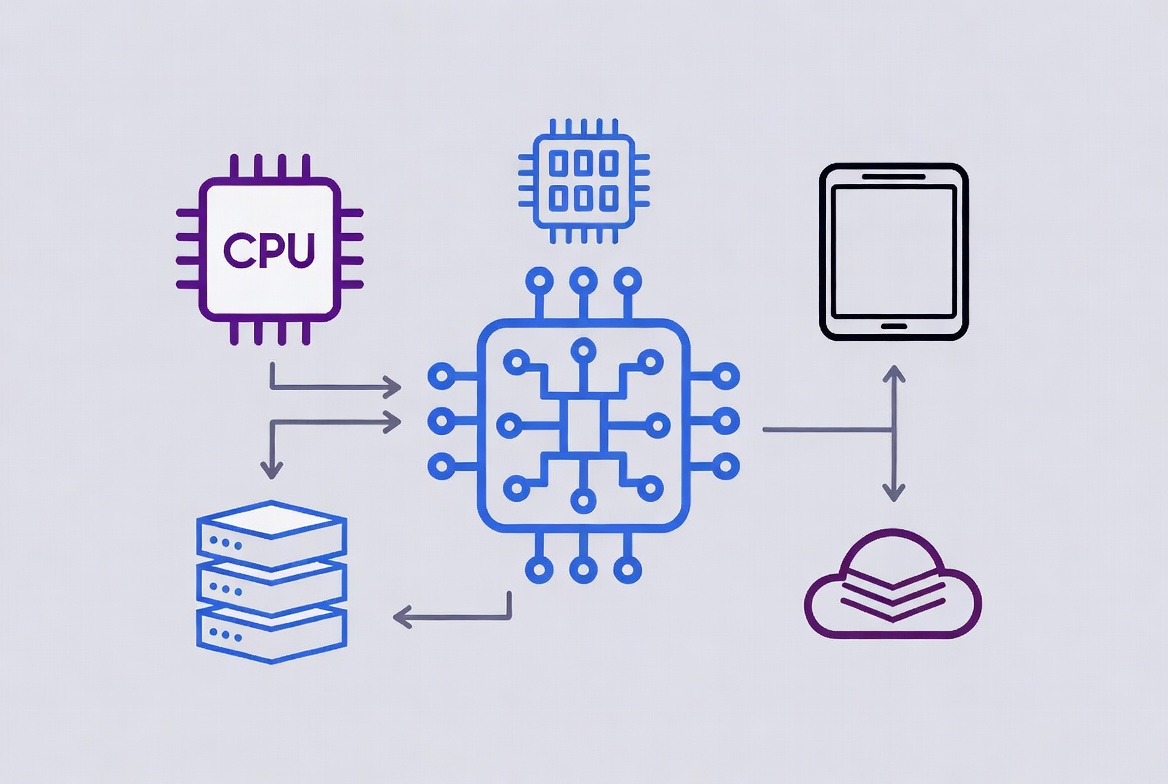
Samsung Electronics' Position in AI Infrastructure
Samsung Electronics' approach to AI does not follow the typical path of large model development. Instead, it functions more as an underlying computing infrastructure provider. Unlike companies that directly train models, operate AI platforms, or offer general-purpose model services, Samsung Electronics has long invested in semiconductors, memory, display technology, and terminal devices. Its value lies in supporting AI system operation rather than directly delivering model capabilities.
As generative AI scales, the industry is reassessing the complexity of computing systems. Modern AI systems do not rely on a single chip; they are an integrated chain of computing, storage, data transfer, system integration, and terminal interaction. In this chain, the importance of underlying hardware continues to grow. Larger models and more frequent training cycles impose greater demands on infrastructure, shifting the industry focus from raw hash rate to overall system efficiency.
From Samsung Electronics' vantage point, its AI value manifests in two primary areas. First, its accumulated memory capabilities directly impact data access speed and system throughput. Second, its presence in semiconductor manufacturing, displays, and terminal devices enables it to bridge core computing and end-user applications. Additionally, as some AI workloads move from the cloud to devices, terminals are taking on more real-time inference tasks, further solidifying Samsung Electronics' role in the AI infrastructure ecosystem.
Thus, understanding Samsung Electronics' relationship with AI should not be reduced to whether it owns proprietary models. Its role should be evaluated from a computing infrastructure perspective: it connects data processing, system operation, and terminal experience, serving as a foundational capability participant in the AI ecosystem.
When discussing AI hardware, GPUs often come to mind first. However, high-performance computing has never been solely about a single processor's capability. As model parameters grow rapidly, bottlenecks increasingly arise in data exchange, memory bandwidth, and system coordination, not just in the compute core itself.
During AI model execution, continuous parameter reading, data caching, and cross-node communication are essential. If data cannot reach the computing system quickly, even the most powerful processes may fail to unlock full efficiency. Consequently, modern AI infrastructure emphasizes high-bandwidth memory, low-latency access, and system-level optimization. Computing speed determines theoretical performance, but data flow determines actual efficiency.
This shift has transformed the memory industry's role. Previously, memory chips were seen as standard electronic components, with competition centered on capacity, cost, and reliability. In the AI cycle, memory has become a computing infrastructure component critical to model training and inference efficiency.
For Samsung Electronics, this gives its traditional strengths new industry relevance. As high-performance computing expands, memory capacity no longer just supports hardware operation—it actively contributes to the efficiency of the entire AI computing system. Looking ahead, the evolution of AI hardware may involve not only more powerful processors but the co-evolution of computing and memory.
AI's impact on Samsung Electronics extends beyond data centers and infrastructure. Terminal devices are emerging as crucial computing gateways for the next phase. For decades, smartphones, TVs, and home appliances focused on displaying information and executing functions. As AI matures, devices are shifting from tools to intelligent interactive systems.
This change means consumer electronics are not merely about hardware upgrades—they reflect a fundamental change in device capability logic. Future devices will increasingly emphasize understanding user needs, autonomously completing tasks, and continuously learning from their environment. For example, terminals may handle real-time content generation, voice understanding, image recognition, cross-device collaboration, and intelligent decision-making. The user experience will evolve from operating a device to cooperating with it.
Samsung Electronics is naturally positioned to benefit from this trend. With both terminal products and underlying technical capabilities, it can transform foundational computing power into user experience without relying entirely on external ecosystems. Hardware capabilities, display quality, and device coordination collectively determine whether AI features are truly realized.
From an industry viewpoint, future competition in consumer electronics may not be about who has the most devices but who can translate underlying model capabilities into a consistent, stable, and natural user experience. This explains why more tech companies are reinvesting in terminal intelligence.
Samsung Electronics and the GPU Ecosystem
AI computing is often associated with GPUs, but a GPU alone does not constitute a complete computing system. With the rise of generative AI, many perceive GPUs as the core AI resource. However, modern AI infrastructure has evolved into a collaborative framework comprising computing, storage, interconnects, manufacturing, and terminal capabilities. Boosting compute power in isolation does not guarantee improved system efficiency.
Technically, GPUs handle parallel computing tasks essential for model training and inference. Memory systems ensure continuous data supply, determining whether the system can maintain stable performance. Packaging, network interconnects, and system integration then determine how efficiently components work together. Finally, terminal devices convert computing power into tangible user experiences.
This architecture means Samsung Electronics and GPU companies are not direct competitors but collaborators across different layers. As AI models expand, growing demand for compute resources will drive further upgrades in memory, manufacturing, and terminal capabilities. In turn, improvements in these areas will fuel further model advancement.
| AI Ecosystem Layer |
Core Responsibilities |
Role in AI |
Samsung Electronics' Involvement |
| Model Layer |
Model training and algorithm development |
Provides intelligence |
Indirect support |
| Computing Layer (GPU/AI Chips) |
Training and inference execution |
Delivers core hashrate |
Partial involvement |
| Storage Layer |
Data access and high-speed exchange |
Enhances system throughput |
Core involvement |
| Manufacturing & Integration Layer |
Chip production and system assembly |
Provides operational foundation |
Core involvement |
| Terminal Device Layer |
User interaction and application execution |
Delivers final experience |
Core involvement |
From an industry structure perspective, the future AI ecosystem will likely feature a more defined division of labor: the model layer handles intelligence output, the computing layer executes tasks, the infrastructure layer manages system efficiency, and terminal devices deliver capabilities. Samsung Electronics' position is not about single-point breakthroughs but about connecting multiple technology layers to transform computing power into continuous products and service experiences.
Therefore, understanding Samsung Electronics' relationship with GPUs should go beyond whether it manufactures GPUs. It must be viewed within the complete AI infrastructure context. Its value stems from connecting computing, storage, manufacturing, and the terminal ecosystem, rather than competing on models alone.
Global AI Hardware Competitive Landscape
As AI becomes the core driver of the next technology cycle, the global hardware industry is restructuring.
In the past, competition revolved around device sales or chip process nodes. In the future, the focus is shifting to complete computing systems.
An increasing number of companies are simultaneously investing in chips, cloud capabilities, terminal devices, and system-level coordination.
This shift means that single-point technological advantages are no longer sufficient for sustained competitiveness.
The industry structure is transitioning from a linear supply chain to ecosystem collaboration.
Samsung Electronics' uniqueness lies in its ability to both build infrastructure capabilities and connect to the terminal market.
Thus, its competitive field is not limited to a single company but involves capability combinations across different layers.
Samsung Electronics' Future Technology Directions
In the coming years, AI's impact on the hardware industry is expected to intensify.
As computing demands rise, the market will increasingly require efficiency, bandwidth, system coordination, and terminal intelligence.
Samsung Electronics' development path will likely revolve around three core dimensions.
First, continuing to strengthen foundational computing infrastructure.
Second, driving the upgrade of device-side intelligence.
Third, connecting infrastructure with terminal ecosystems to deliver a seamless experience.
This evolution underscores that the hardware industry is regaining strategic significance.
For Samsung Electronics, its long-term value may derive not from any single product but from its ability to connect multiple technology nodes.
Conclusion
Samsung Electronics' relationship with AI is not about model competition like traditional software firms. Instead, it is a foundational capability system built on the synergy of semiconductors, memory, terminal devices, and consumer ecosystems.
As generative AI reshapes computing architecture, hardware importance is rising again. Industry value is expanding from single-chip capabilities to complete system-level performance. Because Samsung Electronics bridges underlying technology and terminal applications, it serves as a key window for observing the next-generation computing system. Understanding how Samsung Electronics participates in AI is essentially understanding how future hardware and intelligent systems will co-evolve.
FAQ
Is Samsung Electronics an AI company?
Strictly speaking, no. Samsung Electronics is closer to an AI infrastructure and terminal capability participant, not a model development company.
Why does AI drive demand for semiconductors?
Because model training and inference require continuous compute power while depending on chips, memory, and system coordination.
Is Samsung in competition with NVIDIA?
The two operate at different layers. NVIDIA's GPUs provide compute power; Samsung Electronics focuses more on foundational capabilities and terminal ecosystems.
Will AI change consumer electronics?
Yes. Future devices will evolve from functional tools to continuously running intelligent interaction gateways.