Over the past decade, the global tech industry has gradually shifted from single-product competition to ecosystem competition. Users no longer just buy hardware—they purchase devices, services, systems, and ongoing experiences. This means competitive advantage has moved from product performance to ecosystem synergy, with Samsung Electronics and Apple representing two classic models.
From an industry perspective, Samsung Electronics aims to cover both core capabilities and end-user devices, creating synergy across semiconductors, display technology, and consumer electronics. Apple, on the other hand, focuses on controlling the user entry point, building long-term relationships through a unified system and software experience. Understanding the differences between them is essentially understanding how the modern tech industry organizes value creation.
Where Samsung and Apple Sit in the Value Chain
Although both sell electronic products to consumers, their roles in the value chain differ significantly.
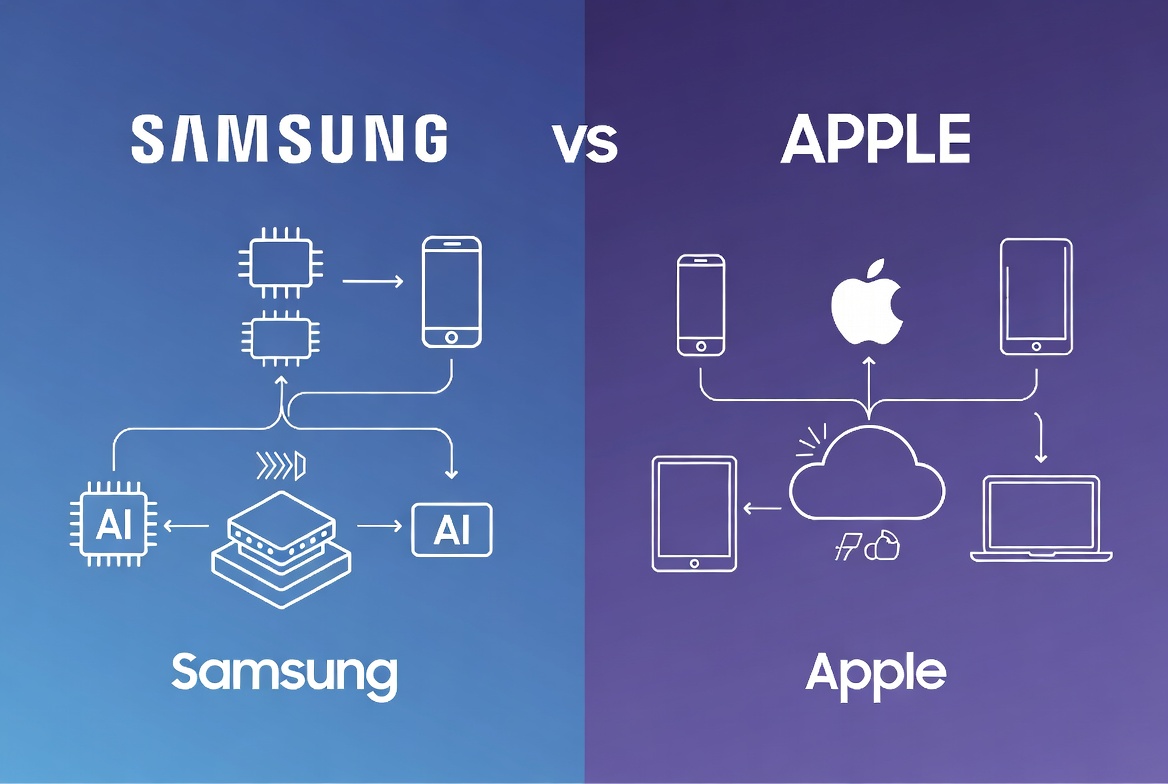
Samsung Electronics has long pursued vertical integration. Beyond selling phones, TVs, and consumer electronics, it invests in semiconductors, memory, displays, and some manufacturing capabilities. This means Samsung is involved in both core component production and final product assembly, spanning multiple layers from tech infrastructure to consumer markets.
Apple, by contrast, emphasizes ecosystem orchestration. Rather than manufacturing, Apple prioritizes product definition, user experience, and system synergy. Its focus lies in device design, software capabilities, and ecosystem connectivity, with underlying production handled by a global supply chain.
This structural difference leads to different growth patterns when facing the same industry trends. For example, when chip demand rises, Samsung benefits from infrastructure expansion, while Apple gains more from upgrades in end-device experiences.
In the long run, there's no simple "advanced vs. lagging" relationship. Both companies build competitive advantages at different levels of the industry.
How Each Company Makes Money
A key way to understand the difference is to examine revenue sources.
Samsung Electronics has a classic multi-business synergistic structure. Revenue comes from consumer electronics as well as semiconductors, displays, and tech infrastructure. Its performance is thus affected by multiple industry cycles. This structure reduces reliance on any single product but requires continuous investment across several technology areas.
Apple, by contrast, is closer to a terminal-ecosystem-driven model. Hardware sales remain important, but an increasing share of value comes from the device ecosystem and long-term user relationships. Once users enter the system, they generate ongoing value through services and device synergy.
This means that while both companies sell devices, their business logic is fundamentally different. Samsung is more of a technology capability platform, while Apple is a user experience platform.
Chip Capabilities and Supply Chain Differences
Chip capabilities are often the core lens for understanding the differences. Samsung's long-term investment in semiconductors allows it to both manufacture chips and serve its own devices, giving it strong industry control and a path from core capabilities to end-user experience.
Apple, while strengthening its chip design capabilities, focuses on product integration. Chip design serves device experience rather than forming an independent infrastructure capability.
This difference also shapes supply chain strategies. Samsung tends to strengthen internal capability integration, while Apple coordinates a global supply chain for greater efficiency and faster iteration.
| Dimension |
Samsung Electronics |
Apple |
| Core model |
Vertical integration |
Terminal ecosystem synergy |
| Industry position |
Infrastructure + terminal |
User entry point + ecosystem |
| Revenue structure |
Multi-business portfolio |
Devices + services |
| Chip strategy |
Manufacturing and application synergy |
Design-driven |
| Supply chain logic |
Strong internal capabilities |
Global coordination |
| User relationship |
Product coverage |
Long-term ecosystem connection |
| AI involvement |
Hardware foundational capabilities |
User experience entry point |
From an industry perspective, Samsung emphasizes technology capability coverage, while Apple emphasizes value integration. Though their paths differ, both have established high entry barriers.
Ecosystem Models and User Relationships
Modern tech competition increasingly centers on ecosystem capabilities, not just product performance.
Samsung builds its ecosystem through device synergy and hardware connectivity. Phones, TVs, displays, and other terminals form a unified network, enhancing experience through multi-device coordination.
Apple emphasizes system unity. Devices, accounts, services, and apps form continuous connections, extending user relationships beyond the product lifecycle.
This leads to different user acquisition strategies. Samsung expands scenarios through capability coverage; Apple enhances retention through consistent experience.
The future of ecosystem competition may no longer be about who has more devices, but who can continuously create a closed user value loop.
AI and Future Growth Directions
AI is reshaping the global tech landscape, and Samsung and Apple are moving in different directions.
Samsung's approach to AI is closer to infrastructure expansion. As demand for computing power, storage, and system capabilities grows, Samsung's importance on the hardware side continues to rise.
Apple focuses on device-side intelligence. In the future, AI will likely integrate into terminal experiences, allowing users to perform more tasks directly through their devices. This means both companies will participate in the AI cycle, but in different roles.
One drives computing system upgrades; the other drives experience model upgrades. From a long-term view, both paths will likely form essential parts of the future intelligent industry.
Evolution of Competition Models in Tech
The tech industry once built advantages through single products, but future competition increasingly depends on ecosystem synergy.
Samsung represents an integration path from core capabilities to terminals.
Apple represents an organizational path from terminal experience to ecosystem.
There is no single right answer. Both companies create value at different industry positions.
Understanding this difference helps build a more complete framework for analyzing the global tech industry.
Summary
Although both are global tech leaders, Samsung and Apple don't belong to the same business system.
Samsung forms vertical integration through semiconductors, displays, and terminals—closer to a model combining infrastructure with consumer capabilities. Apple forms a terminal ecosystem through devices, software, and services—closer to a user value organization platform. Understanding the difference between them is not just about two companies; it's about understanding how the future tech industry will redistribute value among manufacturing, ecosystems, and user relationships.
FAQ
Which is bigger, Samsung or Apple?
Both are large global tech enterprises, but their revenue structures, business scopes, and industry positions differ, so they can't be simply compared by a single metric.
Does Samsung manufacture its own chips?
Yes. Samsung Electronics has long been involved in semiconductor capabilities across multiple technical segments.
Why doesn't Apple manufacture its own chips?
Apple emphasizes design capabilities and ecosystem synergy, using the supply chain for production.
Do they belong to the same type of tech company?
Not exactly. Samsung leans more toward a vertically integrated tech system, while Apple leans more toward a terminal ecosystem platform.